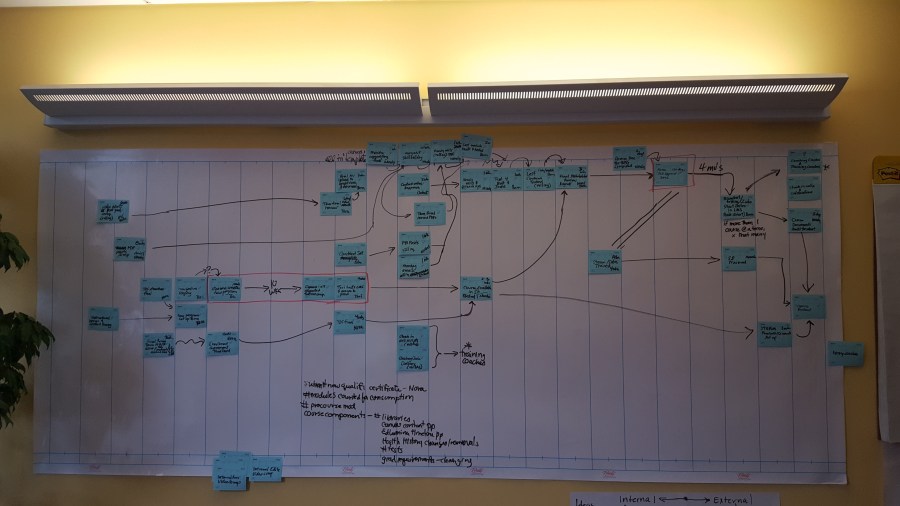
I’m going to let you inside my mind here, see the crazy that goes on inside when I’m at work.
One of my favorite things to do with a leadership team is journey mapping. I love connecting dots, seeing what the picture will look like. For some reason, my mind processes this most effectively with a journey map.
How do people who need our help discover us? How do they learn enough about us to make a decision to push the green button? How do they onboard and get started? How do they engage with our product? What if they need support during the engagement? Once they’ve engaged the first time, how do they continue to engage with us?
This helps me see the organization through the eyes of the most important stakeholder: the customer. Are there gaps or friction points that might interrupt the customer’s journey? Who within the organization owns each step in the journey and how does that team report out on success or roadblocks?
Then I dig deeper into each stage. What are the processes that support each step in the journey? How do those work? What systems and platforms support those processes? Are we accurately engaged with each of those systems or processes, with enough investment that we can scale but not overinvested? Do the technology owners have an effective process for ensuring that the right new employees get access but not everyone? And that, when people graduate from roles and stop needing access, that it is discontinued?
How about the teams? How are they structured? How do they communicate? Are there smooth handoffs between people? Are we over-indexed anywhere or understaffed anywhere? Are we holding onto processes that served us previously just because that is a tenured employee’s definition of success? How do we onboard people into the department, to ensure that best practices are transferred and not just learned through osmosis, if even that?
Then I look at the strategy. Is the leadership team aligned on what they need to get accomplished? Or does each executive have a different agenda? Are budgets and resources aligned to the strategic priorities? Are these priorities effectively cascaded through each of the departments, so that any departmental projects align with the priorities? And that individual goals align with the projects? And does each leader have a clear picture of what work needs to stop to make room for the new work? How is progress tracked – using what KPI, captured how, reporting distributed how? How do roadblocks get escalated? What is the rhythm of the year? What meetings provide support for this process?
All the while, my change management hat is twitching. Where does resistance lie? Who are the internal influencers? Who pushes for change? Who needs to be convinced? How much change fatigue is built up? Where do we have change debt, operational debt, technical debt? Where do our current systems not support change?
My whiteboard is often filled with drawings, maps, sticky-notes capturing all of these maps, waiting to be transferred into an online tool, where they can be saved, referenced.
Sometimes I collect this information formally, meeting with teams. Sometimes I collect it as I talk with individuals. Always interesting to see whether two individuals working on the same team or on the same project see things the same way.
I geek out on this stuff. In my brain, it’s like a flip book. Ask me a question and, behind my eyes, I flip to that page, see the map in front of me, and then answer. My eyes light up if you hit on something I haven’t mapped yet – an opportunity to learn more! More dots help form a more complete picture.
Once, I was working on an annual sales conference. Traditionally, the conference had been being an executive showcase, each leader trotting out on stage for their moment in the spotlight, to present the top products from their area and tell the sales team what to think. We wanted to make it more about the audience: what did they want to know? How could we make that stick?
We surveyed them. What were their biggest challenges? What data and information did they need to sell more during the peak period? What worked for them at previous conferences? What felt like fluff?
The survey included over 1000 people. Our partner conducted the survey and analyzed the data, summarizing the responses into charts that executives love, because then they don’t need to look at the individual data points.
I looked at the individual data points. I remember remarking to one of the executives that there was so much gold in the data, not just applicable to the conference but to how we get other things done, as well. She looked at me as if I had grown another head. “Well, like here, on page 214,” I pointed out. “it sounds like communications on this topic haven’t been getting through. That’s backed up here, here, and here,” I added, flipping to other pages I had highlighted. She shook her head. She wasn’t interested in the details.
But I was. As a leader, you spend much of your time up on the balcony, looking down at the dancefloor, watching the patterns, calling out to individuals, “Faster!” and “Slower!” to ensure that the dancers don’t run into each other. That is as it should be, for executives. If you’re down on the dance floor too much, you aren’t getting the right perspective. But, if there’s a persistent problem over there, where the product gets handed off to the customer, if the dancers keep tripping up, you may need to descend from the balcony, weave your way through the dance, look at what’s happening at ground level, and remind someone to tie their shoes so they don’t stumble on their shoelaces.
Gosh I feel like a nerd about this stuff.
(I find it’s better not to talk about it so much at work, just to do it and let people marvel at the results.)
 Change+Management