
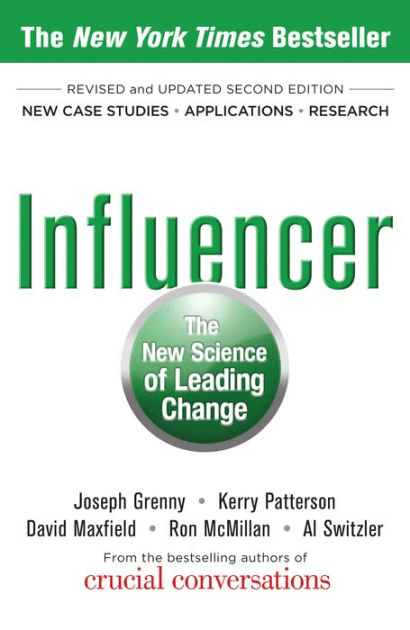
Well, it turns out I own two books on this topic, with very similar titles. They both predate the era when “influencer” became a dirty word, someone slimy who creates and then uses their inflated presence in social media to promote products for which they are paid, some of which are actual products (looking at you, Soylent Green – oh, sorry, Athletic Greens), some of which are ideas or just plain misinformation.
No, this book predates that definition. At least I think it was this book that my colleague, Sal, suggested that the team read for our business book club. (I trust you will correct me if it was the other one, Sal, but i’m pretty sure it was this one because of the margin notes.)
At the time, our team was responsible for representing a diverse internal user community of sales managers, 40,000 strong, spread across the country. We talked to them on conference calls or visited their local sites, read their emails and took their phone calls, listened to their ideas about what the organization could add – or more often, take away – or change, to help them succeed in meeting the company’s revenue goals. Then we came back to the office, identified the corporate partners that owned those lines of business, to try to help them take advantage of that data.
I say “try” rather than “do” because we had very little structural power. Most of the team weren’t managers and were considered “entry-level” by peers and leaders outside our area. Almost all of us had been promoted out of field-level positions; the team was young – so young! Some team members didn’t even have (gasp) college degrees. It was a pretty flat organization and the people they needed to influence were often directors and VPs, with years of experience under their belt, and specialists in their business area.
In other words, we had no structural power and couldn’t just tell people to change things. That’s often the way it is, you can see that things need to change. You think that you can just tell people and they will change things. And it doesn’t work that way.
That’s the background for why Sal and I agreed this would be a good book for the team to read.
Each week, we read a chapter on our own, then took a few minutes in our staff meeting to discuss the ideas that we had read about, whether we had seen something like that in action, and how it might play out with our team in our organization – and where, maybe we had made mistakes in that area in the past. We discussed how we might do little experiments to see what worked for us and what didn’t.
Here are some quotes I dogeared and underlined at the time:
- From the chapter, Make the Undesirable Desirable: “When facing highly resistant people, don’t try to gain control over them by wowing them with logic and argument. Instead, talk with them about what they want. Allow them to discover on their own the links between their current behavior and what they really want.”
- From Surpass Your Limits: “Demand more from yourself than the achievement levels you reach after minimal effort. Instead, set aside time to study and practice new and more vital behaviors. […] Insist on immediate feedback against clear standards. Break tasks into discrete actions, set goals for each, practice within a low-risk environment, and build in recovery strategies.”
- From Harnessing Peer Pressure: “it’s essential that you engage the chain of command. Smart influencers spend a disproportionate amount of time with formal leaders to ensure that the leaders are using their social influence to encourage vital behaviors.”
Other chapters cover topics like, Find Vital Behaviors (to influence change), Change the Way You Change Minds, Find Strength in Numbers, Design Rewards and Demand Accountability, Change the Environment, and Become an Influencer.
Influencing behavior around us – our corporate colleagues in the way that they interacted with the sales teams; and the sales teams in how they responded to calls for change – became our theme for the year. One of my favorite exercises that we did – and I apologize if you’ve heard this before but I loved it so much that I tell the story often – just needed a big empty wall, a bunch of sticky notes and pens, and an hour.
- Each team member took a pen and a pad of sticky notes and, for 5 minutes, in silence, wrote on the sticky notes (one per note) the names of colleagues they had worked with .
- Then, again in silence, we spent 5 more minutes, sticking the notes to the wall.
- For 5 more minutes, again without speaking – the without speaking part was hard for us – we reorganized the sticky notes so that similar people were together. (HR with HR, etc.) The teams we already felt we could influence (sister teams, like Learning & Development), we put at the left side of the wall. The ones where we needed to have more influence, we put toward the right.
- Then we stepped back and evaluated.
- There were some quick wins – I remember one person reached up, grabbed a note, read off the name, demanded to know who had added that note, and then exclaimed, “I’ve been trying to get time with them for months!” He’d been trying share data with the person, data that would influence the analysis that person was doing, and to borrow some of their data for his own analysis. We quickly agreed that an introduction was in order.
- Other influencing took longer. We noticed that we had almost no sticky notes from a particular department who was, incidentally, a thorn in our sides, constantly dropping work on us at the last minute, which meant that it hit the Sales teams at the last minute. We came up with some simple strategies based on the book we had read. It took time but, by the end of that year, that department was working so closely with us that we had extended the runway that we had to work on their work – and they had invited us to join and present at their annual on-site team day.
There was no rocket science here. The tactics we applied were simple. We weren’t MBAs or rocket scientists, we were just a bunch of crazy kids (okay, some of us were crazy and others were kids) with a dream and the moxie to try something new.
And it worked.
Gosh, I loved managing that team. I’ve loved all my teams, but that team had so much fun trying new things. We worked hard, often late into the night. We worked together as a team, leveraging the strengths of our peers to achieve more than what we could do individually. We cared passionately about making a difference for the team members we served – and we took immense pride in what we did.
Could you for more from a team experience?
 Change+Management