
Teamwork is hard. Getting leaders – especially senior leaders – to operate as a team is hard. Nobody likes Team Building exercises because they are usually really dumb and don’t do any good.
About a million years ago, I read an article – perhaps it was in Fast Company or maybe Sloan – about a teambuilding event1 that included a tower of power. A woman volunteered to go first and climbed to the top of the tower, followed by a peer who was a man. When he got to the top, he reached over the edge of the platform and she grabbed his wrist. He expected her to pull him up but instead she asked him to promise that he wouldn’t steal her ideas in meetings anymore. He tried to laugh it off but she said, without cracking a smile, that she had asked him nicely several times before but he kept forgetting, so now she was asking in a way he wouldn’t forget. He was having trouble holding on, so he finally promised, but it took a while. They ended the exercise early and that was the end of the event.2
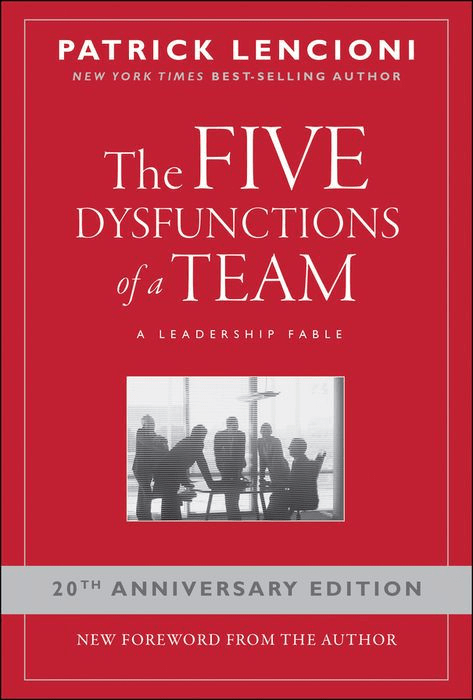
I like Five Dysfunctions of a Team because I’ve seen it work. I was working with an executive team who met weekly by phone and monthly in-person. They were seriously dysfunctional and it showed, not just in the sales numbers, but their direct reports and even their direct reports, could see it when employees transferred between regions: same job title but completely different policies, definitions of success, priorities… In my meetings with them, where they were reviewing their discussions that week and aligning on what to share with their direct reports, when, and how, they were checked out, scrolling through their phones – one of them even said once, that the rest of them could do X but he was going to do Y because he disagreed, then they all looked at the big boss, waiting for him to step in.
It wasn’t working.
There was a gap where I didn’t see them for a few months. Then I saw them again – and they were transformed. They were paying attention, making the conversation in the room the priority. When they disagreed about something, they talked it through and eventually agreed on an approach and, if someone still disagreed, that person noted their disagreement but said they’d go along with the team’s decision – and then did. The big boss focused on getting the team to work effectively together, asking questions like, “Do we have enough information to make a decision now?” instead of imposing a decision.
Were they perfect? No. But they had made a ton of progress and they continued to work on it, in the weekly conference calls and individually, traveling together.
Working effectively together had become an ongoing objective for them, something they worked at and evaluated themselves on, and kept working on every single day.
And it showed.
In the way they worked together, in how their employees treated them, and in their sales results.
It worked so well that the organization worked with Lencioni’s The Table Group, to build materials that the rest of the sales teams could use, and a few of the other corporate teams used it, too. I used it with my team. How could I not, after results like that?
What surprised me was that were corporate teams who didn’t use it.
And that showed, too.
It’s a very easy model to use – the book is short, a fable about a team that had to learn how to learn how to work effectively together, followed by the model.3 It won’t take you more than a couple of hours to read. In fact, make everyone on your team read it. Then follow the model in the back.
Here’s the thing though: if you decide to do this, don’t make it an “event” – make it part of your daily DNA, something you work at over time.
Oh, and you have to do the whole thing. Don’t skimp – it doesn’t work if you pick “just the good parts”. They’re all good parts. Do them all.
That’s the way to make it work.
 Change+Management