
Chapter 2: What is Corporate Culture anyway?
The organization I’m working with now was, for most of its life, a founder-led organization. (As was the organization that I grew up in and the start-up that I worked at.) When I joined, I called it a “re-start up” because it had some of the qualities of a start-up but was starting to face the challenges of a mature organization. I took this job because, when I interviewed, all four of the senior leaders I spoke with – Legal, Education, IT, and HR – expressed concern for the company’s employee community and the changes that were coming now that the founder had moved on. How would people adjust to a faster pace with pivots? To a different way of evaluating success? To new members of the leadership team and reporting to a board? How could they make the necessary changes to help the company grow and succeed without causing their employees unnecessary pain? It was something I was interested in learning more about. I remember telling a friend, also in change management, about my new job and she looked at me in horror. “Why would you do that to yourself?” she asked. Clearly it wasn’t something that fascinated her.
The organization had, I found when I started, a very strong communal culture. They were about 98% on-site and many of the 100 employees – from entry level to executive – had lunch together every day in the same room. That’s culture. When Covid hit, the company was just ramping up to support new projects, focuses on new areas; there were a lot of new people – and we went from working 98% on-site to working 100% from home. We managed to make the transition, some groups had to navigate technology issues that impacted delivery time, but most groups established new processes that enabled them to work together productively. Each team tried to find ways to maintain the culture and pass it on to new hires. New rituals were formed, especially during 2020, launched from the center, that allowed people to engage with leadership, understand where the company was going, reinforce shared values, celebrate and mourn together.
When Covid ended and waves of people started rolling off of the huge projects that had dominated most of our pandemic life, I volunteered for the culture committee, newly-formed to address some of the new cultural challenges: how to entice local people back to the office, how to make those who lived outside the commute-zone feel like part of the community, how to integrate people from a newly-purchased brand. The first couple of meetings were rocky, as early group dynamics often are. People needed to vent – people who self-select for culture committees often want to change something or change something back, and they needed to share their concerns. Someone, I don’t remember who, said something about how the company was becoming so “corporate.” Having worked for and with companies that were “corporate” I smiled inside. It was a complaint I had heard from others in my four years with this organization. I thought about friends who worked for large consulting firms – Goldman-Sacks, KPMG – who talked about golden handcuffs. People who complain about this organization being “too corporate” have no idea what it means to work someplace “corporate.” But I kept a straight face. Under the word “corporate” was an emotion that was important: things were changing and they were afraid they would lose things they loved about the organization.
So I asked a question: what would you like the culture here to be? The person who had complained about corporate culture dodged the question: they weren’t in charge, they didn’t make the decisions, it wasn’t their place to say. I asked my question again and added my belief that employees own culture as much as leaders do. Leaders can dictate what they want culture to be but culture is actually what employees do every day. You can say, as a different company I know said, that your values include treating employees with respect and dignity. But if a leader in that company routinely belittles 1st level managers, reducing them for tears just for doing their job, and HR does nothing about it because that leader “makes money for the company,” then the stated value becomes aspirational – what the company wants to believe about itself, as opposed to the lived values modeled by the leader. How other leaders treat their employees begins to change. People who don’t enjoy working there find other places to work; or retire.
But I digress.
My point, to the employee at this company (as opposed to that other company) was that, if you want the culture at your organization to be different, to not be “corporate” then you need to figure out what that looks like and be a willing participant in changing it. Talk about what is important to you, find others who believe those things are important, and change your behavior to align with those values. If, for example, it’s important to you that the organization listens to customers, find ways to share the voice of the customer. Ask if you can share, in staff meetings, letters from customers talking about how the organization improved their lives. Analyze trends in customer feedback and report out on that. Create an avatar of a customer, give her a name, maybe hang a picture of her on the wall, and invite her to meetings by asking, “What would Becky think about this? Would she find it easy to use?” These are things within your power that you don’t need permission to do. (Although you may have to put up with some joshing until the value of Becky proves itself, and people start turning to you and asking, “What would Becky think about this?”) Do these things enough, they shape the culture.
I’ve written before how, at one point, a company I was working for did a huge reorganization. Roles were eliminated; people ended up in new roles. I felt left out, disoriented. I mentioned this to a friend in another department, and she agreed. She said she had been given a huge assignment by her new boss, an a**hole who had been hired not grown and had no idea how to get things done. Boundaries between the newly formed departments were unclear and she found that a friend in another department – with another newly hired a**hole director – had been given the same assignment. The two directors were competing against each other for dominance, through the women who worked for them. We decided we’d had enough and started meeting quietly for lunch in unpopular conference rooms, first just the two of us, then three, then five, then seven, then nine, then fifteen. We talked about how we felt about the changes; we discussed what was confusing for us, where there were process gaps because someone had been laid off in the reorg and no one had told us and no one knew that, once a year, that person performed an important part in an annual process that kept the company running, a part that no one else now knew how to do. We discussed what we were working on and people decided to work together on projects that their directors had assigned them individually. After a few months, this brown bag lunch group had served its purpose and we stopped meeting. Meanwhile, we had changed the culture – the little bit of the culture that touched us, anyway, and that little bit rippled out, changing those we came in contact with. Each of these women went on to do great things at the organization. Some are still there, still doing great things.
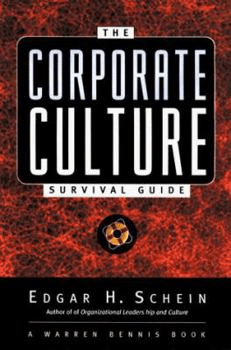
Schein’s Corporate Culture Survival Guide talks about the levers of organization culture and how to use those levers when you are trying to deliberately change an organization’s culture, for example, when you are merging two organizations, say a silicon valley start-up who works in Agile sprints, and a mature organization that is wed to waterfall. Sometimes organizations are so firmly entrenched in “the way we do things around here” that they don’t even know that people do things differently elsewhere. (“Agile? What the heck is that, anyway?” “You’re still using Waterfall? I didn’t think anybody used that anymore…”)
I love Schein. This book is easy to read – even with his scholarly footnotes – and packed with great information. It inspires me every time that I read it. Sometimes, when I reread management books, I am surprised to find what a lingering impact they had on me – oh, that’s where I got that from. I forget that I ever thought differently.
Just don’t expect this book to give you an easy cultural change for dummies in 1-2-3 like those infographics you see on LinkedIn (12 steps to culture change, step 1, take a culture and slice it finely, add onions). Every culture is different and how you change your culture will be different from how I change mine. Culture change can be messy, organic, disciplined, craved for, unwelcome, sudden, slow, in fits and starts. It can come from the top, with a leader who demonstrates values and sets examples. It can come, as Mark Twain says, from the edges. It can happen inadvertently, when people follow what a leader does instead of what they say. It can happen deliberately, through an Appreciative Inquiry, for example.
This book gives you enough information to recognize the different levers of change so you can start to shift a lever – just a little – and observe what happens before you nudge another one.
Dip your toe in. It’s fun.
 Change+Management