
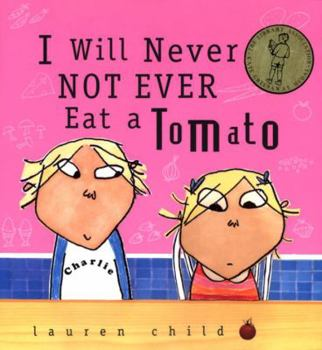
Someone asked, the other day, for books that are not about change management that are about change management. My mind immediately went to Hellspark but I could have also mentioned Charlie and Lola.
Lola is resistance personified. And Charlie’s mission as her older brother is to overcome that resistance.
Charlie has a fine career ahead as a change manger. People will think he’s a miracle worker.
In this book, Lola is a finicky eater. Determined not to eat carrots, or peas, or potatoes, or fish sticks, or – gasp – tomatoes, Lola puts her foot down. Charlie’s parents put him in charge of making sure she eats dinner tonight. And she puts her foot down.
But he makes a game of it, pretending the carrots are “orange twiglets from Mars” and she tastes them and declares that they are, “Mm, not bad.” And he declares the peas to be “green dots from Greenland” and the potatoes “cloud fluff from the top of Mt. Fuji” and she enjoys them all.
Has he fooled her? Not really, for when he says that the fishsticks are mermaid’s nibbles from an undersea grocery store, she replies that she “went to that supermarket once with mom.”
And in the end, she is the one who asks for a not ever never “moonsquirter” – for she would never eat a tomato.
So what does this teach us about change management?
Can you make it fun? Can you reframe the problem to be solved, take them outside of themselves?
I’ve had some luck in the past, when dealing with someone who was super-resistant to the change, of appointing them of being in charge of getting others to change. When you reframe the situation, make it their mission to make the change happen, sometimes that works.
At one point, we were rolling out new technology to a bunch of teams, and the team managers were reluctant to adopt this scary new tech. So, after training the managers how to use the technology, I asked them what they thought their teams would find confusing about the new tech, what might they be confused about. That gave them permission to take a step back, to look at the tech neutrally, as if they weren’t involved, and report out on the emotions objectively. Then we brainstormed how they might help their teams overcome that confusion and fear. They came up with the ideas, and learned from themselves and from each other.
Having taken ownership of solving the problem, they could then go back to their teams and take on the challenge getting people on board.
You know, tomatoes are funny things. When my friend, Christopher, and I went out for lunch one day, he asked whether the tomato in the Caprese crepe would be cooked or not; and hearing that it was, he decided he was having that – and I decided that I was not having it.
I have a theory that the world of people is broken into four groups: 40% of people will only eat cooked tomatoes; 40% will only eat uncooked tomatoes; 5% will eat tomatoes in any form; and 5% will never not ever eat tomatoes under any circumstances, even if you call them moonsquirters.
And the 40% who love braised tomatoes will insist on cooking for the 40% that love their tomatoes raw.
 Change+Management