
Is there a place that your family went when you were a child, someplace magical that you thought you could always go back to, that you thought, at the time, would be the perfect place to live forever and ever?
For me, it was my grandfather’s property in Davie, FL. He had 150 acres, split between orange groves1 and cattle fields, with a little set aside for his office, their house, a pool and cabana, and his garden2. To get there, you drove out SR862, a lonely road without much on it at the time. When you saw Hiatus Road shooting off to the right, you slowed down because you had to make a hard right turn right after the canal. You drove down that sand road just a little, then hopped out, unlocked the big swinging gate, swung it open then closed again after Mimi drove the car through, then swung it shut and locked it again.3 After driving straight about twice as long, you turned left into the groves4, passed the blacksmith’s shed with all the tractor parts left open to the air, out of the groves again, then turned right past Pop’s office, through the split rail fence and past the three tall palms that those cows had once made the mistake of standing under in the lightning storm, and on down the fine white sand of the drive. Past Easter Hill5, so-called because that’s where the big bells stood, the ones that we got to ring on Easter morning to call all the friends and relatives sleeping over and camping in the garden, to scrambled eggs and cut up oranges for breakfast.
The house stood apart, long and low with a portico entry that no one ever used, wide porches along the back lined with rocking chairs that no-one ever sat in (spiders). Beyond the house was a tall screen structure covering a huge rectangular swimming pool with a cabana with two changing / bathrooms (labeled Colts and Fillies) and a kitchen with a pass-through window. That’s where we celebrated holidays and birthdays with the family. We loved the farm because we got to hand-feed the cattle6, ride the ponies, swim, spend time with our cousins, and lay about reading all day.
When I visited as I grew older, it became less entertaining. The cousins had their own lives, the ponies had been sold, I had realized that the cattle were destined for “their uncle up in St. Pete”, my adult eyes saw that Florida was – well, Florida, the kind of place that when you exited the airport, the first thing you saw lined up next to each other were a gun store, a strip club, and a liquor store, welcome! – and all I had was reading. Eventually the town of Davie decided they wanted the land so they took it and turned it into a park, named after my grandmother. You can visit if you want. The entrance is on Hiatus Road now; you’ll wonder if you go why I remember it so sentimentally because it’s not the same. The pool has been filled in and the house has been gutted to make a rec center that gets rented out for birthday parties and such, the groves are mostly gone, alas.
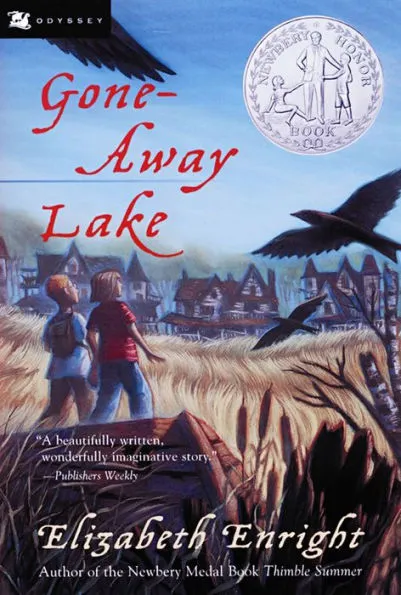
In Gone-Away Lake, Portia, her younger brother Foster, her mom and dad, go to visit her cousins in the country upstate. Exploring the area with her cousin, Julian, they discover an old house (“Villa Caprice”) and, wandering further, they discover a mostly gone lake – Gone-Away Lake, drained by an upstream dam into a boggy mess, including a quaking bog that you can bounce on and the gulper, a bog that will swallow you whole – and the ghost town along its shores.
Here they meet Minnie and her brother, Pin. Minnie and Pin are elderly but independent. They had come annually to Gone-Away Lake as children, back when it was a summer colony for the wealthy, and – later – when things had not looked so promising for them in the real world, they remembered how much they loved the place as children and returned to live there. They had their pick of the abandoned old houses and fixed them up, dressing in the period clothes that they found there. They planted gardens and raised goats and chickens and set up a hive for honey. They live simple lives without power or running water – and it appeals to the children’s sense of adventure and romance. They spend long days there, keeping it a secret from their parents, until finally Minnie and Pin decide they don’t want to be a secret and introduce themselves to the folks, who also adopt their neighbors.
A big attraction for the children, beyond the excitement of collecting eggs from chickens and pumping water by hand, are the tales that Minnie and Pin share about their young summers there and the people who lived in the houses nearby, including Villa Caprice. Their favorite stories are about the legendary Baby Belle, the rebellious only daughter of a proper Victorian lady who was determined to civilize her against her will into bows and ruffles and high button shoes – while all Baby Belle wants is to run wild with her friends, exploring the woods, and row out to the islands where pirates are rumored to roam, and swim in the lake. Somehow, despite her mother’s best efforts, Baby Belle gets the upper hand every time.
What paradise! A forgotten lake, a ghost town, two friendly old folks who tell you stories of the amazing baby belle – stories proved true, they find, as they explore and discover proof carved into nearby rocks – kid heaven! The setting here will win you over, and the kids and old folks will have you wishing that you had grown up knowing them, too.
This is a book that could only take place in the past7; I can’t imagine modern parents allowing their children to run wild across rural neighborhoods, exploring abandoned victorian mansions, disappearing into the woods, adopting “squatters” living in run-down houses without modernizations, even allowing the children to spend the night there, with adult strangers! Children today are way over-scheduled. It may keep them out of trouble – you think – but children need increasing amounts of adventure to thrive, and you don’t get adventure at school or planned activities, watched over by adults. And the kind of risks they encounter online are far more dangerous than pre-internet kids encountered as they roamed wild in the streets.
So if you want to leave your everyday life of zoom calls and social media and grocery stores and politics and neighborhood associations and running your kids from place to place all the time, give Gone-Away Lake a chance.
- Juice oranges, not grocery store oranges. They were sweeter but uglier with mottled yellow and green skins. My grandfather picked and cut up oranges and we ate a little crystal bowl of them every night after dinner. The skins and trimmings we fed to the sweet black angus who crowded the fence every evening for this special treat. ↩︎
- My grandfather, like my mom, loved plants. As he traveled about Florida for his work, if he saw an interesting plant, he took a cutting that he planted in a little spot beyond the cattle fields when he got home. Some of the things in his garden had been made extinct in the wild by the suburbanization and urban sprawl that became the norm in Florida during his life and could only be found in his garden. ↩︎
- If you were really quiet, you might here the gator in the canal calling his love. ↩︎
- Someone asked me the other day if I ever picked oranges. Maybe when I was very little but later, I didn’t like to go into the groves. The spiders there wove webs from one row of trees across the gap to the next that would put Shelob to shame, and hung there heavily in them, as big as your hand. When you drove through the groves, they went splat! on your windshield. Ew. ↩︎
- Not really a hill – it is South Florida after all – more of a low hump. ↩︎
- Except the big red angus bulls that he bought later. They were scary, so full of artificial testosterone that they had hair-trigger tempers, unlike the old black bulls that Pop had before. ↩︎
- Copyright 1961. ↩︎

