
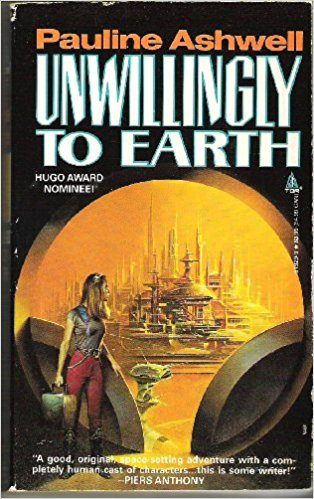
I’m having a morning. It was hard to get up this morning because I made the mistake of taking yesterday’s book to bed with me and then I had to finish reading it so am a little sleep deprived. I woke up with another book – this book – in my head but I couldn’t find it on my shelves. I took the front row of SFF books off one shelf – discovered a mystery that had somehow gotten mixed in there, along with a non-fiction book about Lizzie Borden.1 Then I did the same on the shelf above that – no luck – then the top shelf although I didn’t think there were mass markets behind the trade paperbacks and hardcovers and, by golly, I was wrong and there were those books I had been looking for, for years.
But not the one I was looking for. I went one shelf below the lowest shelf showing SFF but, behind the Durrell was only Vallee. And why Vallee behind Durrell, is beyond me. Some time when my husband is out of town, I’ll take a staycation day and reorganize the shelves entirely. Then you’ll get a whole new crop of books to hear about.2 Anyhow, my copy of Unwillingly to Earth never showed up so I’m doing this one from memory.
Let me start by saying I really liked this book although it has one of the worst last pages that I have ever read. I’m going to tell you what happens on the last page because it doesn’t have anything else to do with the rest of the book, so it’s not really a spoiler. Telling you absolutely won’t give away the plot because the last page has nothing to do with the plot; there is no foreshadowing, no hint that it is coming. It is tacked on with the brute force of a male SFF editor demanding that a female author give her main characters a “happy ending” that will “appeal to the ladies.” Which I will give the author the benefit of the doubt and assume is what happened.3
But first, the rest of the book that I really enjoy reading for reasons that will quickly become obvious to those who know me or have read two or three of my posts this year.
The book starts on a far away planet, settled by humans. It’s a western sort of a planet – or, as I always pictured it, an Australia sort of a planet. Lizzie, the main character, lives on a farm with her father, who is a rich farmer. She’s rough around the edges – wearing overalls and speaking the local slang – as he is, because it’s just the two of them and he started out as a miner. He struck it rich one day and then could afford to import a wife, buy a lot of farmland, and settle down. In the early pages of the book, he gets very badly injured and Lizzie rides to the city in the ambulance with him. At first, the doctors at the hospital isn’t sure if he will live or die. Lizzie, depressed and spoiling for a fight, goes for a walk and wanders into a dive bar, a hangout for the roughest, toughest miners on the planet. One demands to know what she’s doing there, a pretty little blonde-haired, blue-eyed teen like her, and she tells her sob story. Upon which the fellas assume that her father is poor like them, and band together and adopt the sweet little thing. They become reformed. They take baths and watch their language around them and beat up anyone who casts aspersions on her.
Including a brash young man who indignantly demands to know what she is doing there, spoiling his assignment and is lucky to escape with his life. About the time that Lizzie’s old dad is starting to get better, she realizes she’s in over her head and has no way to diplomatically escape the assumptions of her well-intentioned new friends about who she is. If they find out that her dad is rich, it will spoil the story they’ve made up for themselves about her, and she could be in danger. Luckily a stranger shows up. He learns her story and approaches her one day when she’s leaving a visit to the hospital. He suggests a solution that will give the fellas at the bar closure. She agrees but then discovers that her rescuer is actually there to recruit her to a school back on earth where they study behavioral economics or something4 and he has conspired with her dad – who has always dreamed of sending her to school but didn’t have the heart to send her away from him – to send her to his school on far-away Earth. Something she opposes vehemently.
The book, like The College of Magics, is split into three parts: part one is the part I just described; part two is about Lizzie’s time in college, her struggles to fit in. And, I just found a review of the book online which reminded me that there are actually four parts to the book, the third part taking place during her vacation on the moon, in which she solves a mystery. The fourth part is her final assignment from the school, where she and her classmates are asked to apply their studies in – ah, here’s exactly what she was studying – Cultural Engineering, which I thought Ashwell had made up for the story but is actually, Google tells me, a real thing.
To boil Cultural Engineering down, for those of you who aren’t familiar with it5, here’s a quote from some guy on LinkedIn where he says one of the purposes of CE is to: Promote a paradigm shift on cooperative, social and solidarity bases, by fully mobilizing the driving forces of cultural rights, in favour of a knowledge-based society and sustainable human development.6 In other words, trick people into doing what’s good for them. Like inspiring the miners on Lizzie’s home planet to quit fighting and take baths by introducing a blonde-haried, blue-eyed, forlorn girl, with a dying father, who needs taking care of. Or, in the case of Lizzie’s final team assignment, to prevent a war from breaking out between two factions on a distant planet that will almost certainly lead to the genocide of one of the factions. Lizzie and her classmates, under the supervision of the guy who brought her to school in the first place, have to research the cultural levers on the planet, think up a scheme for preventing the war, and execute on it in a way that leaves the people of the planet no idea that they have been engineered into acting against their baser instincts. I won’t tell you how she solves it.
The writing develops throughout the book, the style shifting as Lizzie moves from rural farm girl to college student to advocate for the unfairly accused (on the moon) to sophisticated cultural engineer. The writing style also evolves – the early section sounding like Heinlein’s boy’s adventure novels, the later a more adult, modern writing style – Lizzie’s voice changes, she loses her accent and provincial ways of thinking, and the characters around her develop more dimensions, in the same way that our parents and the people around us become multi-faceted as we mature. As the other review I consulted to refresh my memory about this book since I can’t put my hands on it just now7 reveals, it turns out Ashwell is mostly known for her short stories and this book is actually just four of them, all about Lizzie, put together to make a book. That makes sense.
But it’s highly enjoyable anyway.
Until you get to that last page – last 10 pages, the other reviewer says – where Lizzie and her mentor suddenly declare their love for each other.
What?!?
There was no hint of this anywhere else in the book and the guy is like twice her age and, for much of the book, she is in ward to him. Eeewwwwww. Talk about an inappropriate relationship! And totally unnecessary, as far as I’m concerned. The last story in the book is well-written, compelling, adventurous, cinematic – and then this happens. Look, I like a good romance as much as the next reader and I don’t mind mixing romance with SFF, but to drop it on the reader from the middle of nowhere, between a young woman who is underage and her guardian is just wrong. And, as I said before, I’m going to give Ashwell the benefit of the doubt.8
Despite that, I still love this book. Cultural Engineering, while perhaps a little cold-blooded, is somewhat a cousin to Change Management and Behavioral Economics, looking at how to get people to change to their benefit, and I find it interesting to see it in action throughout this book.
I recommend this book but you may, as I did, have to buy it at a used book fair. It doesn’t seem to be in print or available on e.
- One Lizzie Borden theory as good as another, at this point. At one time, I had two books, published about the same time, same trim size, similar covers. One stating with absolute certainty that Lizzie had killed her parents herself. The other stating, with absolute certainty, that she had absolutely not done it, and the author knew who did. I may have had a third book – now lost to time or flood – that stated with absolute certainty that she had not done it with her own hand, but knew who did because she had been in cahoots with them. That pretty much covers the gambit, unless you want to state with absolute certainty that her father killed her stepmother then killed himself and Lizzie is lucky to have escaped with her life or that it was Freddy Kruger or something. Some things we are never meant to know. Lizzie Borden. Jack the Ripper. Jon Benet Ramsey. ↩︎
- Thieves World, anyone? ↩︎
- If it’s not, don’t tell me. I like this version of reality better. ↩︎
- This is where I miss having the book in my hand to look up details. ↩︎
- Those of you who are familiar with Cultural Engineering, pipe down. I know there’s more to it than this. This definition is for those who haven’t heard of it before, and is simplified to focus on what’s happening in this book.. ↩︎
- https://www.linkedin.com/pulse/cultural-engineering-global-approach-sustainable-human-alexandre-col/ ↩︎
- Credit where credit is due: https://fantasiesofpossibility.wordpress.com/2017/04/02/reader-i-unwillingly-to-earth-by-pauline-ashwell-1992/ ↩︎
- If you know differently, don’t disillusion me. ↩︎
 Change+Management