
In 1971, John List, an unemployed company-man with financial problems, in danger of losing his NJ Victorian mansion and aspirational way of life, with a religious obsession, decided to solve his problems by murdering his entire family: his alcoholic wife, his embarrassing and uncontrollable children, his elderly mother whose bank accounts he had been quietly looting. He shot each of them, laid out their bodies in sleeping bags, turned up the A/C to glacial levels, called the kids’ schools and after-school jobs to say they were going away on a long vacation, and slid out of town to take on a new identity and restart his life elsewhere.
That is not the family in this book – I don’t think it’s even mentioned in this book – but it ran through my head for much of the time I was reading it. As, I suspect, it ran through the author’s mind, too.
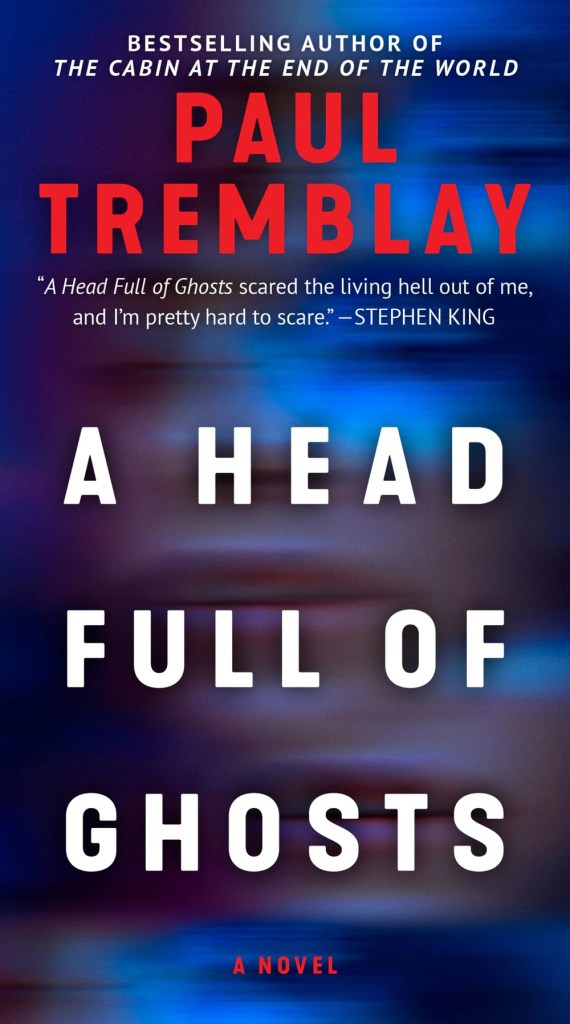
This family lives in a mock-colonial near Salem, MA that they are in danger of losing for financial reasons. The father, like List, is a member of the long-term unemployed. The mother, unlike Mrs. List, works as a bank teller, the only income that the family has. The older daughter, 14, and the younger daughter, 8, are unusually close. Marjorie, the older daughter, makes up stories for her sister, Meredith (Merry), in which Merry is the main star. Merry writes them in the margins of her Richard Scarry’s Cars & Trucks & Things That Go book.
But recently Marjorie has taken to locking herself in her room for hours at a time, refusing to engage with the rest of the family. And, when she does admit Merry, her stories have gotten creepier: the tale of the Great Molasses Flood – a horrific historical event – washes over Richard Scarry and haunts Merry’s dreams.
And the made-up tale of a world taken over by plants, in which the sisters discover that their father has murdered their mother and fed her to the plants in their basement. Their only hope for survival is to escape together while their father is away, although he made them promise to stay in the house where it is safe.
Or did Marjorie really tell Merry those tales? For Merry is the narrator of this book, telling it to a bestselling author who, 15 years after the events, is consulting Merry for a book the author is writing.
And Merry, as she reveals herself, is not a reliable narrator. Her child self, she reveals, embellishes the facts to get attention from adults. Her adult self also admits to fuzzy memories, supplemented by outside media sources that she is obsessed with. She spent many years in therapy as a result of the events in this book, and frames some of her memories through the psychological perspective.
Marjorie, Merry declares early on, was a budding schizophrenic, with voices in her head telling her to do crazy things – scary enough to have in the house as a little kid. The mom enrolls Marjorie in psychotherapy, expensive and not immediately efficacious. As her behavior continues to become more bizarre – obviously so to the reader from a safe and objective outside position – the father ( who, like List, has an unhealthy relationship with the church) takes Marjorie to the local Catholic priest instead of her appointments because, he says, he has come to believe that she is possessed by a demon. Or demons.
And there are some genuinely creepy things going on around Marjorie. Some right out of The Omen and other horror movies she’s probably seen. Others, less easily explained: her ability to sneak into Merry’s room and add or remove things, despite a complex “If I can’t come in your room, you can’t come into mine” booby trap that Merry sets. The trap works, as we see when the mother inadvertently sets it off. There’s also a particularly chilling scene where Marjorie literally climbs the walls of her room during a “night terror.” (Her parents standing below her alternately commanding her to Get Down Here Right Now and shouting over their shoulder that Everything’s Fine and Merry should Get Out of Here and Go Back to Bed. Parents.)
What does Marjorie herself say is happening? She is also an unreliable witness: sometimes she says she hears voices; sometimes strange voices emerge from her, claiming to be the devil; sometimes she confides in Merry that she is faking it all to reveals their father’s madness so that the sisters and mother can escape before it’s too late.
Or so Merry says Marjorie says.
Things get completely out of control when the father sells the family out to a reality TV show that fills the house with cameras and recreates with actors the dramatic events that the father has told them have occurred around Marjorie. The TV show being yet another unreliable storyteller in this book of storytellers.
An exorcism is planned; the mother escapes into drinking; right-wing picketers block the driveway and trap them in the house; the father becomes even more erratically violent, sometimes for a change in front of outside witnesses. Marjorie is quickly in over her head and losing control of the situation, if she ever had control of it, at one point even accusing Merry of instigating the creepier events.
And perhaps Merry is.
This book is genuinely creepy because you aren’t sure what is happening or who to believe. On one page, my inner skeptic said, “Marjorie has a laptop, she could be looking up all this ‘secret knowledge’ that she’s spouting at her father and the priest.” But then I remember other things that happened earlier: did Marjorie really sneak through Merry’s booby traps and draw on a sleeping Merry’s arm? Or is that just a sign of Merry’s unreliability as a narrator?
Merry is, after all, being paid as a consultant to share her family’s story with the author. The better the story, the more the book will sell, and the more money the author and Merry will make. Merry learned this lesson from her father, who declared the reality TV-show to be the family’s new job, pulling the kids out of school and insisting that the mom leave her job. The family becomes isolated, trapped in their house by the shooting schedule and the protestors, performing for the cameras while unable to escape them.
The ending is as deceptively linear and as bafflingly twisted as the rest of the book.
I discovered this book at a small bookstore that I hadn’t visited before, in a tiny Horror section only a few shelves tall. It’s funny how you can overlook a book in one store that jumps out and grabs you at another. I started reading it later that afternoon and stayed up into the wee hours to finish it. It’s the kind of story, like Buried Child, that I see returning to again and again, trying to puzzle out what’s going on, suspecting that it’s so obvious that the mystery reveals my own blind spot.
Copyright 2015, it’s also extremely relevant now: the father, pushed out of the company where he’s made a respectful living for himself by larger economic factors, unemployment run out, increasingly turning to religion (first Catholicism and, when that lets him down, more extreme religions), imposing it on the females of the family against their will, exploiting it to control them, to mold Marjorie into something more compliant; quoting old testament verses at his wife that she should submit her will to her husband’s. The younger child seeing her 15 minutes of fame on reality TV, through her blog, through the bestselling author’s book.
Highly recommend although now I want to read more by this author. My towering stack of unread books grows ever higher, threatening to topple and crush me.
Tell my family I loved them.

