Last night I dreamed that I found two extra rooms in my apartment (every New Yorker’s fantasy!).
In the dream, my apartment had two rooms: a bedroom and a public room (living/dining with a kitchen along one wall). The apartment was starting to show its age: ceilings were peeling, paint needed touching up, wood floors needed repair, furniture needed recovering.
In the dream, I told a visitor about two options we had considered:
Solution 1: Move all of the furniture from the living space to the bedroom and repair the living room; then move everything from the bedroom to the public space and fix the bedroom. Living in the apartment the whole time to save money. This was the option proposed by the logical, frugal person in my life.
Solution 2: Give up on this mess, send our furniture out to be repaired, move into another apartment entirely and have the repaired furniture delivered there. This was my pragmatic proposal.
As I described these options to my guest, we walked towards the front door.
That’s when I realized that there was a third space:
The apartment actually contained a foyer, a large, paneled room containing the front door. I had overlooked about it because I often just moved quickly through it to the living room or the bedroom.
This is quite a large space, my guest commented and then asked about a multi-doored cabinet built into the wall.
It turned out to contain a lot of interesting things, antique buttons and knobs, old game pieces. I was having fun imagining all the things I could make or do with these things.
Then we realized that one wall of the foyer was actually a full-height, 10-foot wide wooden door.
We swung open the door and found ourselves in yet another room:
A double-length room, with antique paneling and arts-and-crafts features. I confessed that I had completely forgotten that the apartment contained this room. It didn’t get much light and was dim and rather dirty since we’d lived in the apartment for 20 years and had never visited this room.
How, I wondered, do we get people – including us – to want to spend more time in this room? How could we make it usable space – which goodness knows we needed – rather than a giant junk drawer?
We would need to reorganize how we thought about our existing spaces, I mused, wandering back into the foyer.
And then noticed yet another door.
Assuming it would be a closet, I pulled it open, walked inside, and found myself in what turned out to be, after a little exploration, a shopping mall. In which I got completely lost.
And was unable to find my way back because my phone refused to close the video game it had automatically loaded and I could not access to GPS.
And what does this have to do with the Johari Window?
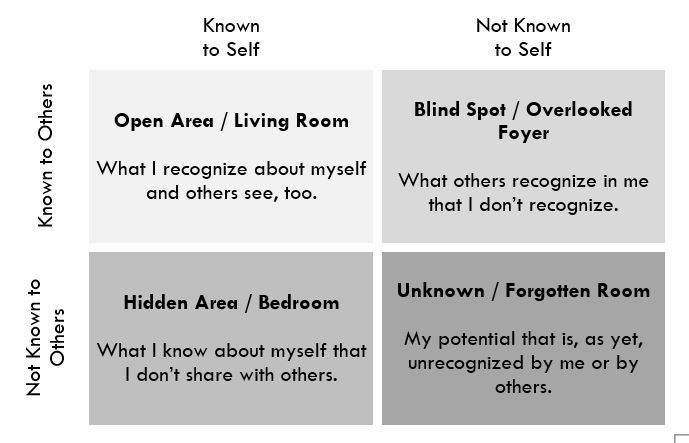
The Johari window is a four square that looks like a window with four panes:

In my dream, the apartment’s main room was clearly the first square, the Open pane of the window: the space where you and others both see you the same way. This is the much lived in, much loved, bright and airy space with the memories.
The bedroom was the Hidden pane, where you know things that others don’t see. Although the bedroom didn’t play a big part in the dream, Solution 1 was to move everything from the shared/public space into the private (hidden) area, and then stay there in that unworkably crowded space while remodeling the Open area. Clearly this is unworkable.
The Foyer represents the Blind Spot, a part of the apartment that I had overlooked but that the guest recognized as having potential, with cabinets full of all sorts of useful ingredients that I didn’t even realize I possessed.
The double-length room that we found last would then represent the Unknown, a room neither I nor my guest realized was there, dim, shadowy, the potential unknown. So much space! What to do with it!
And the question I asked in my dream was: how do I bring the Unknown and the Blind Spot into better use, make them convenient to spend time in and not just fill them up with stuff that is no longer useful?
But what about the shopping mall?
Twice in my dream, I attempted to escape my Johari-Window self altogether.
In Solution 2, I proposed walking away from it entirely as a solution. Just starting over in a different place and time. Escaping. Which seems pragmatic until you realize that deserting everyone you love and all the skills and experience that you have is really not a solution.1
And, by walking, a la the Narnia door, out of the apartment into the shopping mall and getting lost there, I recognized that it’s could be easy to lose myself, who I am, amongst all the different options that are offered on the open marketplace: although I know who I am and what I want to do with the next phase of my life, there is the pressure to just pick up something off the shelf, someone else’s idea, and go with that: it’s easy, it’s convenient, it’s fast, it’s cheap, they’ll tell you how to do it, who to be. But there are so many ideas to choose from, and choosing from someone else’s choices is a cop-out.
The phone refusing to access GPS indicates that I am spending too much time online and that’s not going to give me the solution. It’s just going to suck me further down a rabbit hole and tie me up when I need to get back to the apartment.
Because the answer lies back in those two untapped rooms of my apartment: the blind spot, with all it’s potential; and the Unknown.
And the only way to figure out how to integrate them into my life is to begin spending more time in them.
Doing things that I haven’t done before.
- We moved so much as a child that abandoning my persona and starting a new one became my default. When being who I was wasn’t working out, I would just wait for us to move again, with the idea that I could then redefine myself entirely. This was only really a problem in Tucson, where I attended three different schools in five years and had four different personas, which made birthday parties very confusing since everyone called me a different name. And it didn’t really work out anyway – because you can never really leave who you are behind. ↩︎
 Change+Management