“And whose job is it to input the date?”
Many years ago, I was working with a cross-functional team who managed an annual inventory process.
Between the 10 of us, we hired the vendor that sent crews that went out to 1000 locations to count the product, coordinated scheduling with the vendor and the 1000 managers, advised the managers on prepping for the count, uploaded the vendor’s file into our systems, reconciled our inventory counts based on the inventory date, adjusted based on sales or receipts that had happened after that date, and fired off replenishment orders.
No biggy.
Except this one year, something broke down after the vendor sent us the file. It wouldn’t load. We were all talking by phone and sending emails and we couldn’t figure it out.
So I finally got everyone in a room to walk the process.
What is Walking the Process?
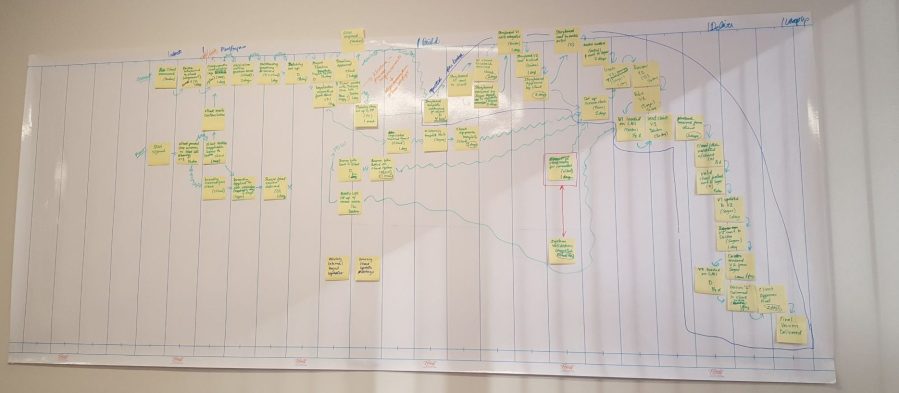
In this case, we started at the very beginning of the process and mapped it out on a big whiteboard. Each person talked about what they did, what inputs were required for them to do it, what triggered their part of the process, how long it took. and the output that was delivered to the next team in the process.
Another fun way to do this is with sticky notes: each step goes on a sticky note, and then you attach them to the whiteboard and draw lines showing how each step connects to the next.
It’s one of my favorite ways to learn about a process.
What We Learned
The team fought me a little on this. They had all been doing this same process, rinse and repeat, every year for a long time, with improvements as the technology evolved. But they needed to resolve the problem so the executives would quit yelling at them; so they played along with me.
At first, the drone in people’s voices reflected their boredom with walking the process. “And then I do this, and then I do that.” Every now and then, interrupted by me asking another dumb question.1
“And who inputs the date into the system?” I asked, expecting someone to answer in a bored tone that implied it wasn’t worth asking.
Silence.
I repeated my question. Silence.
“What happens if the date isn’t in the system?” I asked innocently and they all sat up.
“If the date’s not in the system, the file can’t process,” someone said and everyone started talking at once.
I interrupted to ask, “Whose job is it to input the date in the system?”
Silence.
I offered to assign my coordinator to manually enter the dates into the system this year, if someone else would agree to build an interface allowing us to upload the schedule the next year, so my team got out of the business of doing data entry (always risky and time consuming). Problem solved.
“Let’s keep going,” I suggested and they all agreed, now highly engaged with the discussion.
Many jobs later, one of the other participants still talked about this conversation and how it went from being just another boring meeting to being a meeting where things got done.
The Importance of Process
Having a smooth running workflow within your team is critical to the Process aspect of the People-Process-Perception triangle that makes managers effective.
I often see managers struggle with Process. Their People love working with them; they understand how to manage Perceptions about the work that their team does – but they can’t figure out how to smooth the transition between work intake, the steps as work gets processed, and work output. This results in bottlenecks and delays, duplicate effort, and results that don’t meet standards.
Unfortunately, when Process is not managed effectively, it impacts the other two aspects of the triangle: your People become unhappy because they don’t feel successful; there can be conflict between People because hand-offs are not managed smoothly; and, because your team is not meeting results or delivering outputs on-time, to-scope, on-budget, Perception of your team and of you as a manager suffers.
So even if you’re the “creative” type – the type who doesn’t want to be bothered with structure and systems and all that boring stuff, you’ll benefit from learning how to manage process (or hiring someone for your team who understands process).
How to Get Started
Walking the process is a great way to start to understand what’s working and opportunities to improve the process. It promotes awareness amongst the team about what others in the process do, and allows them to build relationships that enable them to resolve future problems without you.
Another time, I walked the process with a cross-functional team that included people from Sales, Technology, Product, Supply Chain, Logistics, Warehousing, and Accounts Receivable. This time, people had been walking process with me on different things for years and arrived excited to participate.
Here’s what we discovered: everyone else was using a location code that started with an “S” and one team was using an old location code that started with a different character. That one small character meant that orders were being delayed and misrouted, which impacted repeat sales.
But, more importantly, these 30 people – many of whom had never met before – now understood what could go wrong and knew who to go to when it did go wrong, so things could get fixed. Priceless.
So if you’re starting out in a new department or trying to problem-solve a bottleneck in an established department, begin with walking the process.
Your Turn
- Is Process a challenge for you? Is there someone on your team who has a knack for process?
- What have you discovered when you’ve “walked the process” in the past?
- What techniques do you like to use when “walking the process”?
- One of my teachers in grad school called it “accessing your ignorance” – not pretending to have all the answers so you can ask the dumb questions no one else wants to ask aloud. ↩︎
 Change+Management