
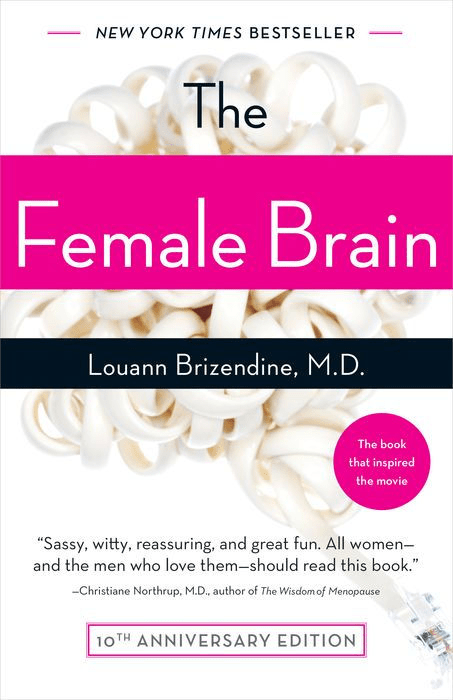
Okay, I’m going to admit that I bought this author’s other book – which I will write about tomorrow – The Male Brain first. Then I went back and picked up this book. I am one of three sisters, in a family that was dominated by my mother, my aunts, my older female cousins, and – in a softer way – my grandmothers.
So when I embarked on my journey as an aunt to nephews – and determined to be a cool aunt – I had to figure out these guys out. (My husband, who continues to be a mystery to me, was of little help.) So I bought the book I’ll write about tomorrow and then enjoyed it so much that I bought this. (I also have nieces.)
This may not be the book you think it is.
Dr. Brizendine is, I believe, a neuropsychiatrist who specializes in hormones and neurobiology.
In other words, how the chemicals coursing through your body at different phases in your life influence how you act and are perceived by others.
An example, selected randomly from the book, from the chapter on Love & Trust:
By adulthood, modern females have fine-tuned their superior ability to read emotional nuance in tone of voice, eye gaze, and facial expressions.1
As a result of this extra cautiousness, the typical female brain isn’t as ready to admit to being overwhelmed by infatuation or the sheer excitement of sexual behavior as the male. Women do reach the same or a higher romantic end point, but they’re often slower to confess to being in love or more careful than males in the beginning weeks and months of a relationship. […] Brain-imaging studies of women in love show more activity in many more areas, especially gut feelings, attention, and memory circuits, while men in love show more activity in high-level visual processing areas. These heightened visual connections may explain why men tend to fall in love “at first sight” more easily than women.
Once a person is in love, the cautious, critical-thinking pathways in the brain shut down…
Well, that explains why men are such mushy romantics – it’s those darned “heightened visual connections.”
Whether you are a male or a female, there’s a lot there to think about. Why do I behave like this? Why is she behaving like this?
It’s a fun book to read, progressing from prenatal hormones through post-menopausal lack thereof.
Want to understand why, when your daughter is a teen, her – as my gentile southern mother would say – “hors are moaning”?
This book will answer that question and more.
And all in a very easily readable way.2
I bought copies of this for my sister, sisters-in-law, and breeding friends.
Highly recommended, especially if you have kids.
 Change+Management