
Let me start with my Bigfoot story.
I don’t have one. It would have been nice to have one – it would nice to believe that something mystical could be out there because I’ve personally witnessed it.
I haven’t even seen a moose in the wild, or a bear.1 Last November, we went to Death Valley and I saw my first coyote. I lived in Tucson for five years and California and the Pacific Northwest for another six; my parents camped with us in all those areas. We knew coyotes were around because they had been sampling our housecats (not while we were camping; from outside our home). But I had never actually seen one until I caught a fleeting glimpse of one behind the dumpster in Death Valley.
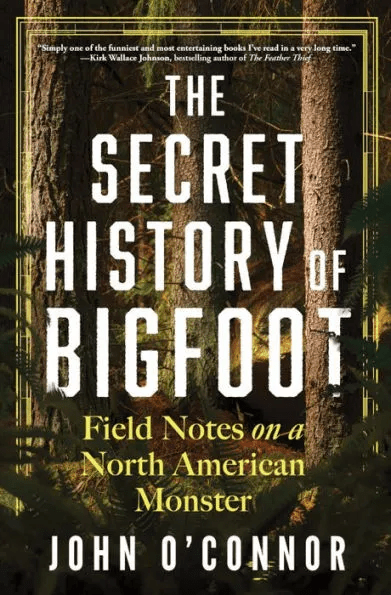
O’Connor has had better luck than I, although he has not seen Bigfoot either. He has hiked portions of the Appalachian trail and done other Outside Magazine type stuff like that. For this book, he embedded himself with different groups of Bigfoot hunters around the country. The book opens with a group in the Pacific Northwest, including some of the original hunters. Then it moves to areas that, in my mind, seem less likely locations: Massachusetts and Texas. He likes these enthusiasts, he likes them as people, you can tell. He doesn’t make fun of them, even when he is clearly going to need more persuading than a sound they heard or a shape they saw, can be linked to Bigfoot.
O’Connor pauses his explorations to look at the history of “monsters” in literature through the ages (Marco Polo and Herodotus, for example), followed by sasquatch itself in American folklore and movies. “ ’It’s simply a better idea if Bigfoot is real,’ “ according to Lynne S. McNeill a folklorist at Utah State University, talking with O’Connor. “ ‘It says something positive about our wilderness spaces. It says we haven’t totally destroyed our planet, that there are enough wild places left that a creature like Bigfoot can live undetected.’ “
Then O’Connor heads on to explore the Kentucky backwoods with another group of Bigfoot hunters, only now he is describing their demographics (white2, and mostly male, although some wives come along), their politics (mostly pro-Trump) and, while he doesn’t describe their employment status3, he does run down the current economic headwinds that Kentucky is facing: coal and manufacturing, going or gone; healthcare, education, median income, air and water quality, job availability, and life expectancy hovering at the bottom of American states. He doesn’t see Bigfoots in Kentucky either, although he meets some very nice people who do, on that night’s jaunt. One of the attendees is a psychologist who discuss the tricks our brains play on us, showing us what we hope to see, in hopes of helping Bigfoot Researchers minimize errors during encounters.
And then you hit the chapter about the Ivory Billed Woodpecker, a creature that went extinct when the old growth forest was cut down, destroying its ecosystem. 81,000 acres of virgin old growth forest, which the Audubon Society, Franklyn Roosevelt, the US Forest Service, the US Fish & Wildlife Service, and the Governors of five states tried to turn into a national park only to be refused by the owners: Chicago Bill & Lumber Company, who clear cut it and turned it into wooden boxes. Said the chairman of CB&LC board, “We are just money grubbers. We are not concerned, as are you folks, with ethical considerations,” bringing in German POWs to cut the timber, “who were appalled by the destruction.” And yet people still sometimes report sightings of Ivory Billed Woodpeckers, with the same enthusiastic passion that people report Bigfoot sightings. And meet with the same skeptical scientific reception. And so O’Connor takes a break from hunting an elusive cryptid to hunting a (probably) extinct woodpecker. With the same amount of luck. “Of the approximate 1.04 billion acres of virgin forest that formerly existed in the United States, more than 96% of it has been cut down. Almost nothing older than two hundred years old remains anywhere.” Which about sums up why the probability of there being a Bigfoot out there is pretty low.
O’Connor goes on from there to discuss the spiritual side of nature, looking at the beliefs of Indigenous Americans who, for the most part, refused to discuss what white settlers called Bigfoot or Sasquatch, tired of having what, for them, are tales that define their identity, taken out of context and applied to a “monster” that reflects more what modern white Americans believe than about what it meant spiritually to the indigenous population. From Native American spirituality, O’Connor turns to western spirituality, trekking around California helping a camera crew recreate the famous Patterson-Gimlin film4 and reflecting on Thomas Merton, an entire cinematic festival of Bigfoot movies, and the economic evils of modern American capitalism and the number it’s done on the modern American men.
I’ve shared a few quotes from the book here. As I was reading, knowing I would review this one, I bookmarked passages that I’d want to share. I bookmarked NINE in the final chapter. NINE. About how people, to paraphrase David Brooks’ recent talk at the Aspen Institute, have lost their faith in religion, government, liberal democracy, and the social systems that were supposed to make them free and haven’t. About how – which David Brooks did not say – when people loose faith, they crave “reassurance they’re not alone in their beliefs, even when – especially when – the meaning of those beliefs isn’t always intelligible.”5 Quotes about how “Many have reported that Bigfoot released them from fear and depression, that other Bigfooters nurtured them and gave them purpose.” Quotes about how beliefs like this enable people to deal with negative emotions and escape the burnout drear of everyday life.
And then O’Connor pulls some scientific fact. Studies about how belief in the paranormal can become “gateway drugs to dangerous conspiracy theories.” He interviews biologists who study moose and bear populations in remote areas of U.S. forests who know, as fact, how hard it is for large animals to stay hidden, to avoid finding bones that are even years old. One of them shares their own story about hearing a strange noise in the woods – a noise that they had never heard before in all their years of traversing the woods. Their heart leaps up, could it be…? Their mind starts to speculate. And then they see what it really is.6
It reminds me of a chapter from – of course – The Little House in the Big Woods. The chapter contains two stories about bears, both of which take place when Pa has carried his furs to town, at the tail end of winter, hoping to get a good price by beating the other trappers to market. While he is away, Laura and Ma go out to feed the cow, they see the bulk of the cow within the pen and are surprised – they thought Pa had put her in the stable earlier. Ma hands Laura the lantern and reaches for the latch to the gate with one hand, while extending her other arm over the top rail to slap the cow’s rump, telling her to move away, as she has done a million times before. But then the light from Laura’s lantern illuminates the shape’s shaggy black fur and the head turns and Laura and Ma see, not the big doe-eyes of a cow, but the small dark eyes of a bear. A bear in spring, when bears are hungrily emerging from hibernation. Ma and Laura make it back to the house and latch the door behind them.
Pa, on his way back from town, a little later than he meant to be, looks ahead down the path through the woods and sees, in the moonlight, a bear standing up on its hind legs blocking Pa’s way, staring at Pa. Pa sees its front paws, its snout, its eyes twinkling; it’s so thin from hibernation that he can almost count its ribs in the moonlight. Pa freezes, unsure what to do: the bear is very large. Finally, after an interminable time and a long internal monologue, he snatches up a nearby branch and runs screaming ferociously at the bear, only to find himself swatting a tall old stump he remembered passing on his way into town.
I hope there is a Bigfoot out there, that we have not destroyed our wilderness to the extent that there could not be a Bigfoot. Like Mulder, I want to believe.
But, unlike Scully, I cannot take this on faith alone.
- I did see an 8-point buck once. It was late at night, I had stopped at the stoplight by the Chevron just off the freeway, empty lots and rental houses on one side of the street and, back beyond the Chevron, third or fourth growth forest, with a few houses tucked in. Out of the bushes on one side, it emerged, looked both ways, then stepped off the curb and sedately crossed (in the crosswalk) and disappeared into the blackberry bushes on the other side. The light changed. I drove home. ↩︎
- With a single African American exception, who states he has never felt anything other than welcome ↩︎
- Hard to ask while you’re busy wood-knocking and avoiding copperheads which apparently smell like sliced cucumber, which is handy to know. ↩︎
- Which I thought had been pretty much debunked by now, or perhaps I shouldn’t say that out loud. ↩︎
- He’s talking here about Trump, not Bigfoot. ↩︎
- Spoiler alert. Not a Bigfoot. ↩︎
 Change+Management