
Did you read Encyclopedia Brown as a child? EB, for those who don’t know him, was a kid like us who had read a lot and was often able to solve mysteries because his encyclopedic knowledge helped him spot something that grown-up’s had missed. The story that sticks with me is where he figured out that an adult was a liar because that adult had created a taxidermy display that showed polar bears hunting penguins. Penguins only exist in the Antarctic; polar bears only in the Arctic. It was an easy mistake to make – icy place where many humans hadn’t been – and many adults still make it.1 But not Encyclopedia Brown!
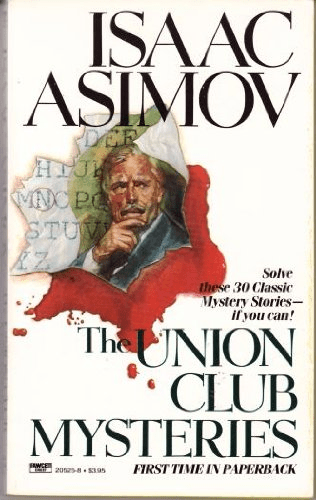
This book is similar to Encyclopedia Brown: the stories are short – maybe 7-10 pages, including the reveal – and depend on one man’s cleverness. The set-up is simple: several older gentlemen are sitting about a room in their club2; one of them complains about a topic that they clearly know little about, for example, “What I don’t understand about this rash of spy stories infesting us today is what the hell spies are good for nowadays.” or “My own feeling… is that in order to cut down on terrorist activity, it would be best to bring down an absolute curtain of silence over it.” They gentlemen discuss the topic ignorantly for 3-4 paragraphs and are then interrupted by an even older gentleman sitting nearby, who they had assumed was dozing or they wouldn’t have risked speaking in front of him because he tends to take over the conversation with some boring story that aggrandizes his life.
That man – Griswold – immediately wakes up, tells a short 2-3 page story in which his expert brain had been called upon to solve a problem, often on behalf of the government during the war, which ends with something along the lines of, “And, of course, since you know what the telephone number was, that’s the end of the story.”
And then falls back asleep.
Only to be shaken awake in the next paragraph by the men who demand to know what the solution was and how Griswold figured it out. There follows a 3-4 paragraph reveal. End of story.
Very much like Encyclopedia Brown, but with more Scotch and privelge.
Asimov wrote these stories, he tells us in the foreword, for what he calls a “girlie” magazine (which means something more like Playboy and less like Teen Vogue). The magazine would print up to the part where Griswold falls back asleep in the main section of the magazine, then print the reveal later in the magazine, thereby allowing the reader to solve the problem, if they could, then check their answer. He wrote about 30 of these little mysteries, one per month, then tried to quit but was suckered into continuing to write them, despite the fact that he was a little busy, as says modestly in the afterward, “It isn’t as if it’s all I have to do.” In the 67 years following when he learned to read at age 5, Asimov wrote or edited more than 500 books, wrote 380 short stories, edited a science fiction magazine, and also taught biochemistry until his voluminous writing habit began to interfere with his research.
Some of the answers are clever – a number revealed by a date, for example. Some require obscure knowledge, like the undercover German spy revealed because he knew the words to the third stanza of the Star Spangled Banner and, since “no loyal, true-blood American knows the words to the first stanza of our glorious national anthem, and they’ve never even heard of the third stanza”, Griswold was able to pick out the spy.
What I enjoy about this book is seeing how Asimov’s mind works as he crafts these little mysteries. Did he know the third stanza of the national anthem, and was he shocked that others didn’t? Or did he have a friend who complained about the third stanza once, and he filed it away in that brain of his for later use? Griswold, like Asimov himself, worked in chemistry during WWII, and I wonder how much Asimov took from that experience.
Asimov, best known for his Foundation Trilogy 3, wove mystery into a lot of his science fiction. His Robot series uses mystery and suspense, and somewhere here I have a collection of short-story SciFi mysteries that he wrote, including one that hinged on the last words of a silica-based alien.4 Asimov also wrote several mysteries that take place on earth: another set or two of these short-stories, and Mystery at the ABA.5
If you loved Encyclopedia Brown as a child and like brain-twisters, you should give these a try.
- I am consistently surprised by people who ask me if, when I went to the Antarctic, I saw polar bears. The answer is No. They are surprised and a little defensive when they learn that there are no polar bears at the south pole; they are sure I am mistaken. ↩︎
- The gentlemen are white, the club upscale. This is where the stories show their age. ↩︎
- Which are on my shelves but actually belong to my husband who read and enjoyed them thoroughly as a child. I’ve read a lot of Asimov’s stuff and tried to read Foundation Trilogy but couldn’t make it through the first book. Too serious for me. ↩︎
- Still sends chills down my spine, although I haven’t read it in years and cannot remember anything else about the story. ↩︎
- ABA = American Booksellers Association. The murder takes place at their annual convention which goes by the same acronym. ↩︎
 Change+Management