
The other day, I was talking to someone intelligent, who follows politics, has an academic job, reads the paper every day, doesn’t disappear down internet rabbit holes, and watches minimal TV. I mentioned Olympia, WA and they wondered why Olympia mattered. Well, it’s the capital, I replied. They looked perplexed. Of Washington. Washington state. They had thought Seattle was the capital.
No big deal unless you live in Olympia, right?
Perhaps you, like I, spent time in elementary school, memorizing state capitals. Based on their age, I’d guess this person did, too. I won’t pretend to be able to name all the state capitals. But I do remember, while going to school in the diagonal-opposite corner of the US, mapping out the locations and names of the original 13 colonies, and I can still draw a little stacked map of named squares of them.
But geography is more than just memorizing state capitals, or even knowing which state is which (although that is helpful, too). There is, of course, understanding the geographic features of a country, the way they make their money, the religious composition of their people, their politics. Until I read this book, I didn’t realize that geography can be applied in other interesting ways – medical geography, for example, is used to track the spread of disease.1 Other geographers study and report on changes in the natural world – those geographic features that we think of as unchanging, until they do change, like rivers and forestation. Some geographers work in politics, protecting politicians from making boneheaded statements to visiting dignitaries, or boneheaded policies based on misinformation. Some look at why towns – or shopping centers – arise in unexpected locations and thrive, while other towns – or shopping centers – are planned in perfect locations and fail. Think about all the fascinating articles that you read in National Geographic Magazine or the cool shows you watch on their channel2 – that’s geography.
Geography is cool.
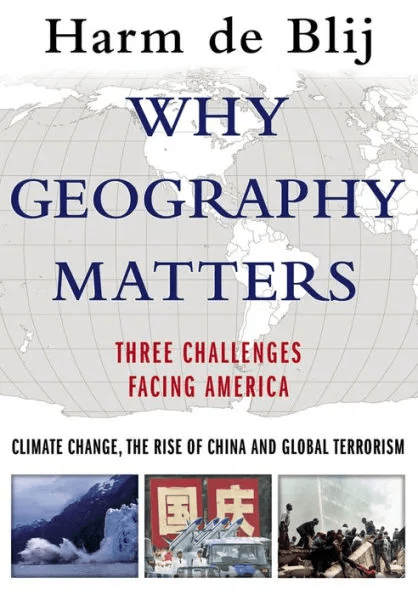
I just didn’t realize how cool until I read this book. This is one of those books that makes me, when I finish reading, wonder why I chose the career that I did, when I could have been doing something cool like geography.
Anyhow, de Blij makes geography really interesting, telling the stories of different areas of the world, areas most of us in America don’t think about much on a day to day basis, and then explains how these areas of the world are going to matter to us in the future. He discusses the impact of population growth – which none of us worry about at a macro level but, at a micro level, everyone worries about because they can’t find housing, jobs, and are stuck in traffic all the time.
He also touches on the changing climate, which we all experience as temperature and storm, drought and flood, but which also drives all those extra people out of places where they had been living and are now uninhabitable, to seek places that are still habitable and if you think I’m talking about the southern border or the boat people from Northern Africa well, yes, but also my sister who fled California for Nevada during Covid and is now moving to southern Tennessee, partially to avoid all the sprawl and COL increases that followed Californians to Nevada, unheeding that the area she chose is the new destination for retirees fleeing the disaster that Florida is quickly becoming.
Geography touches us every day.
I live in a neighborhood near the UN with a lot of consulates in it. After a neighborhood diner suspiciously burnt down about 10 years ago, it was replaced by a tall building, much more profitable, which bears a discrete label indicating that it contains the consulate for Lesotho, a country I had never heard of3. Where the heck is Lesotho? It’s a small, land-locked country in Africa, completely surrounded by other countries, which doesn’t happen much. It is remarkable for being entirely located entirely above the altitude of 1000 meters, with over 80% of it being above 1400 meters. Even its lowest point is higher than the lowest point of any other country. Remembering that there are countries out there like Nepal in the Himalayas and Switzerland, in the Alps, this is impressive. Snow is not unusual there and I have in the back of my head that I met someone once who had gone there to ski. It produces diamonds and water, although one of its primary risks is drought. It’s populated primarily by the Basotho cultural group, and is mostly Christian. It has the highest literacy rate of any African country. Lest you think it is a kind of Wakanda4, it has a one of the lowest life expectancy rates in the world, the 2nd highest rate of Aids, and the highest reported rate of rape of any country anywhere. An increasing amount of American clothing is produced in Lesotho.
Back to the book: de Blij also talks about Russia and China and the rise of terrorism, the potential for a European “superpower” and hope for the future of Africa. The book is 10 years old and much of it is still true, although it is interesting to see the impact and influence that the use of misinformation on the internet and social media have had on the geopolitical world since this book was published. The book was reissued a couple of years ago with updates (which I have not read).
If you read Guns, Germs, and Steel or The World is Flat or any of the sequels to those books, you’ll eat this book up. But I also bought a copy, after reading it, and gave it as a Christmas gift to – oh, wait, I gave it as a Christmas gift to the person I mentioned in the opening paragraph, the one who didn’t know the capital of Washington State.
LOL.
- Think of the work Randy Shilts wrote about in And the Band Played On, of tracking down that one flight attendant, who was a vector for HIV. ↩︎
- Particularly liking Arctic Ascent, with Alex Honnold right now. And Photographer. ↩︎
- Please note that I am not implying that Lesotho had anything to do with the diner burning down. I suspect New York real estate. ↩︎
- The director of Black Panther actually stated Wakanda was inspired by Lesotho. ↩︎
 Change+Management