
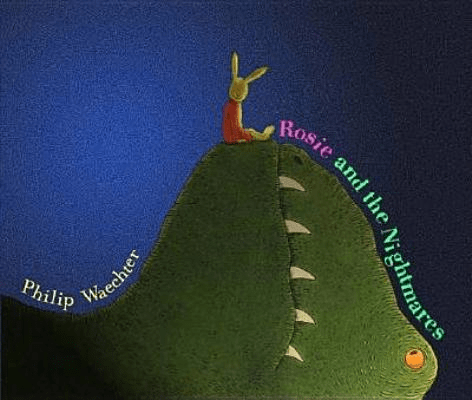
Rosie, the heroine of this tale, as you can gather from the title of this book, has a sleep disorder: every night, as she dreams, she fights monsters. After one particularly harrowing nightmare where the monster almost but not quite gets her, she seeks professional help.
The Dream Expert (“Dr. Man”) recommends a particular book which Rosie purchases and hurries home to read. The illustration shows us the title of the book: Everything You Ever Wanted to Know about Monsters.1 It’s a real page-turner; she can’t put it down.
“She learned how to be a calming influence upon them… how to incapacitate a monster with a simple throw…and how to take to her heels in an emergency.” And we see her practicing these techniques on the furniture in her apartment.
Then Rosie takes the battle to the monsters on her own terms. Wide awake, she jumps into a cab and hastens to an amusement park, where she buys a ticket to the tunnel of fear.
And there, inside, are the monsters from her dreams. Rosie jumps out of the ride and lets loose, dispatching monsters left and right. The monsters flee in terror, pursued by Rosie, who is beginning to have fun – only to be interrupted by a carnie with a flashlight that illuminates the scene revealing seams and zippers on the cowering creepies.
Rosie is evicted from the amusement park and banned for life. She celebrates with ice cream and Jasmine tea, before settling down to read another chapter in the monster book, and falling peacefully asleep. And she is revealed, in the final illustration, as riding the scariest of the monsters as they soar together through her dream.
So who is this Rosie and what is she afraid of?
Rosie, as we see on page one, is a rabbit. A bunny in a little red dress. She lives alone, in a small, cluttered apartment – a studio, it looks like – in what is clearly a European city, probably somewhere in Germany, the author’s home. The apartment contains wine bottles, so clearly Rosie is an adult, and a lot of books, so Rosie is perhaps an introvert. (In fact, aside from transactions with the Dream Expert, the Cab Driver, the Carnie, and an Ice Cream vendor, we don’t see Rosie interacting with other people at all.) Photos adorn Rosie’s walls: photos of her, a beaver, what looks like a woodchuck, and a shark with long pointy teeth. Rosie uses a toilet – this is the cutest illustration of someone on a toilet I’ve ever seen – and worries while practicing yoga and meditation, just like most humans – or at least this human – would.
When she goes to the Dream Expert and to the bookstore, she goes alone, a rabbit wandering through a human world. There are no other rabbits in sight; the other animals shown are dogs mostly on leashes, behaving like dogs and birds acting like birds. Although Rosie wears a red dress in the human world and in her dreams, when she is home alone, she walks about in the nude. Rosie confidently hails a taxi – something daunting to introverts in Manhattan who don’t have the gall to sing out “TAXI!” – and no one remarks as she goes about her business, “Hey, that lady is a rabbit!”
In fact, they don’t mention it at all until the Carnie drives her out of the amusement park. “Just like a rabbit,” he mutters, “nothing but mischief on the brain.” So he seems to have had incidents with other rabbits that informs his opinion of what is clearly a minority in this world. In fact, he tells her she is banned for life and the amusement park institutes a “one-year ban on bunnies” in general, as if they had been waiting for an excuse.
So who is this Rosie? Introverted bookworm, practicing mindfulness, drinking wine (we see a glass beside her as she reads) and Jasmine tea, making her way through town on her own, without a mother or other bunnies beside her. Action oriented, she takes matters into her own hand. And she is clearly a minority, people make generalizations about her based on experiences with others of “her kind.”
And what do these monsters really represent? Do they play the role of Betty and Barney Hill’s aliens? Judging her, making threats against her, playing out her fears? Are they bullies she has perhaps come up against in the real world, that she hasn’t had the courage to stand up to? Or that she has stood up to, only to find herself the target of increased attacks? And why do the monsters in the house of fear look so much like the monsters in her dreams? Are her dreams perhaps recreating an attack she experienced in real life?
I love how Rosie takes action: she seeks professional help, follows the Dream Expert’s instructions, practices the techniques expounded in the book, and then finds a way to bring the battle to her own territory: her waking world. That the “monsters” she KOs are symbolic – carnies in monster costumes, as opposed to the terrifying beasts of her dreams – doesn’t matter: she has demonstrated that she can win and has won. And the final illustration proves that she is now in control of her dreams.
This would be a great book to read with a child, especially if you want to practice a little bibliotherapy with a child who has monsters under the bed or in their dreams. There’s so much to see on every page. Poor little all-alone bunny, the way a child feels all alone in her dreams, with no parent to protect her or that she can depend on. But she parents herself and she takes it to the monsters, demonstrating that sometimes, when you have the courage to confront your fears, your tormentors learn to respect (or at least fear) you.
As Susan Jeffers says in Feel the Fear and Do It Anyway, “Whatever happens, I can handle it.”
Like Rosie, you have to.
- Not in my collection, yet, but I would totally buy it. ↩︎
 Change+Management