
A Story of Jane Jacobs
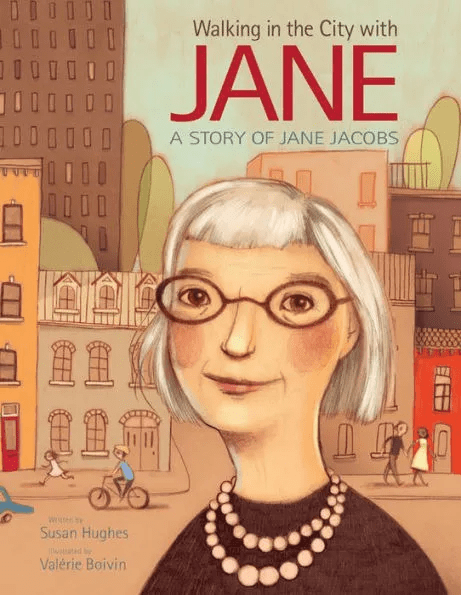
When I was living practically under the Williamsburg Bridge (Manhattan-side), I used to gaze around at the visual noise – the whizzing cars, the windows filled with quinceañera and communion dresses, the competing signs in Chinese, Spanish, and Hebrew, billboards, people moving every direction with purpose, a million miles and hour – and wonder what Ben Franklyn would have thought about it all. Would he have felt at home? Or would he have worried he had gone to hell?
This book starts with a promise – a promise that little Jane Jacobs refuses to make to her teacher. She refuses to promise to brush her teeth every single day for the rest of her life because she can’t be certain that she would remember every single day and she didn’t want to make a promise she couldn’t keep. She even tries to convince the other children not to make this promise. And gets sent to the principal’s office.
My kinda gal.
Jane walks around her home town, having conversations with her imaginary friends – Ben Franklyn amongst them – about what things like traffic lights are, and how they work.
Definitely, my kinda gal.
As an adult, Jane moves to NYC and walks around all the different neighborhoods, exploring and observing, learning about the city. I bet Jane Jacobs knew that, if you are lost in Central Park, you can look at a lamp post to figure out where you are – a piece of NYC trivia I didn’t know until recently.1
Jane gets married and has kids and teaches her kids to appreciate the “street ballet” of the New York City streets. She sees a city as its own ecosystem, as something to be appreciated for itself and not just a place for people in bedroom communities to drive to in cars, work in at office buildings, and exit at night. She learns what makes the city tick.
I think the one thing the remake of West Side Story got right2 was the setting: the West 60s being torn down to make room for Lincoln Center, a community torn apart by eminent domain, ripping apart the people who live there. If you’re a walker in NYC, you see this first hand. You’re walking along and suddenly you have to cross a street that’s too wide to cross in a single light: you have to wait on a median in the center. Or where there is no crosswalk for blocks and blocks and blocks. Having walked almost every street in Manhattan3 and through much of Brooklyn and parts of LIC and Queens, I saw that first hand.
Highways cut communities in two.
Jane saw this and when Robert Moses tried to ram a highway through Washington Square Park, she rallied the people and they stopped him. “There is nobody against this,” he snarls in the book, “NOBODY, NOBODY, NOBODY, nobody but a bunch of… a bunch of MOTHERS.”4
Moses loses.
Moses tried again later in a different neighborhood and, when Jane protested then, she was arrested.
So Moses built the Cross-Bronx Expressway and created the urban blight that you see in pictures of NYC in the 1970s – a neighborhood that looks like it’s been hit by a bomb, children wandering the streets, lost. Communities torn apart.
There is a law – like Murphy’s law – called the fundamental law of road congestion, which says that when you add more traffic capacity, by adding roads or more lanes to existing roads, you create more drivers and traffic actually gets worse.5 So what Moses was doing with all those highways was making congestion in the city worse, not better.
People tend to love neighborhoods like the villages (Greenwich, West, and East), SOHO, Tribeca, Little Italy, Chinatown, Tudor City, Beekman Place, Riverside, because they feel like neighborhoods: they have little blocks, small businesses, and vest-pocket parks. Not too many people love midtown or the Financial District because they have a lot of tall buildings and long blocks, they don’t encourage you to explore, to linger.
Sometimes wandering those horrible midtown blocks, one finds little secrets. Near the U.N., there’s a block which is lined on both sides with loading docks for the big high-rises and hotels on neighboring streets. You wander down the perpetually-shaded sidewalk, your ears full of the huge air conditioner compressors that vent onto the street, and about half-way down, elevated slightly and tucked in without fanfare between the service entrances to two huge buildings, is an unprepossessing low-slung two-story yellow wooden building with white trim. To see a wooden building in NYC is unusual, so you pause in wonderment, to read a small plaque outside. And discover that it’s a colonial inn and that George Washington slept there once.
We’re not going to find any plaques recognizing where Robert Moses slept.6
Nor, perhaps, Jane Jacobs. But, when you visit Washington Square Park, you can say a silent thank you to her there.
I love this book for introducing urbanism to children in a way that they can understand. And for providing a role model to small girls, who too often try to fit in by doing what they’re told.
As the strident ladies who used to protest at the end of the block when I lived on the upper west side used to call all day every weekend day until I couldn’t stand it anymore, “Stand Up! Fight Back!”7
Sometimes the city sends you what you need to hear.
- Each lamp post is numbered with a code that tells you the nearest street and whether you’re on the East side or West side. ↩︎
- The rest of it didn’t measure up to the original. ↩︎
- I made that a goal one year. ↩︎
- The illustrations in this book are priceless. ↩︎
- Hey a real footnote: http://www.nber.org/papers/w15376 ↩︎
- Except, I found, at R. Moses state park, which I believe he named after himself, although I could be wrong. ↩︎
- They were protesting a little magazine called, Penthouse, if I recall accurately, and their pickets featured a cover showing a naked woman in a meat grinder. The tall buildings carried the sound of their voices down the block and echoing through my windows which had to be open because my apartment didn’t have air conditioning, and even then New York was hot in the summer. ↩︎
 Change+Management