
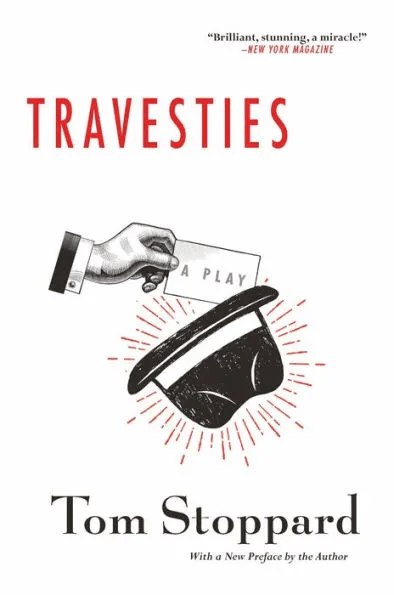
Oh man, Stoppard speaks well.
This play has 8 characters and only two sets. I realize this makes it seem simple but hold onto your hats.
The 8 characters include Lenin1 and his wife; James Joyce; Tristan Tszara (the dadaist2); Gwendolyn and Cecily from The Importance of Being Earnest3; Bennet, who was the British Consul General stationed in Geneva during WWI but is here Carr’s servant; and the aforementioned Henry Carr, who starred in a production of TIOBE arranged by Joyce in Geneva during WWI, and after the one-and-only performance, sued Joyce for the cost of his costume, and who worked for Bennet at the Consulate.
This play is a fictionalized Carr’s cognitively-challenged reminiscences as an old man, obsessing about the lawsuit and the events leading up to it, but also the world of Geneva of the teens. Joyce and Gwendolyn speak as if they stepped out of his Ulysses, Tszara cuts up words and pulls them out of a hat to reinvent them anew, and pines for love of Gwendolyn, Cecily is a librarian who tells everyone to shush and eventually marries Carr. People speak entire scenes from The Importance of Being Earnest – but in limerick. Characters monologue for pages about the causes of WWI and politics and freedom and tell each other that they are wrong.4 Because of his age, Carr’s memory is slipping so sometimes scenes are repeated with variations, triggering around Bennet telling Carr that he has placed the newspapers on the sideboard, for example, and Carr asking if there is anything interesting in the news, over and over again, with different results each time, as if they were in a dadaesque poem.
You’ve seen works by Tom Stoppard, I’m sure. He wrote the script for Shakespeare in Love, and his craft is there in the wordplay. His works often pluck characters out of obscurity – Rosencrantz and Guildenstern from Hamlet, for example. People talk at each other and around each other and use words as tools to convey meaning, rather than just noise to fill the soundtrack or move the plot forward. Characters pretend to be other people or become other people or are mistaken for other people; building to chaos and often followed by a great unmasking.
I wish I could have seen this in production.
What strikes me now is Carr’s elderly dementia, and how his memory doubles back on itself, weaving truth and fiction in a kind of dream state. My father-in-law is suffering from this kind of dementia now, compounded by loss of hearing. Often when we ask questions or tell him something, he cannot hear us and answers a question that was not asked, and then starts monologuing on a topic that only in his mind is related, telling and retelling stories from his youth in WWII Philippines, or his glory days at University, or when he worked for the U.N. The stories, like Carr’s, often shift with repetition; sometimes he is the hero, sometimes the victim, sometimes secret forces machinate against him. Even when he is not speaking, I think his mind is weaving these tales, for he sometimes calls my husband during the workday and asks his help – since we live in New York – to get in touch with his supervisor at the U.N., to let him know that he is sick and needs to extend his PTO. Will it be alright, he asks with grave concern, do I have enough PTO to cover it? Yes, my husband assures him seriously, the time is there and your boss said, “Take all the time you need: we want you to get well.” So much more effective and less confusing than trying to persuade him to remember that he retired over 30 years ago.
It’s funny and frustrating and heart-breaking: not just that he was so obsessed with his job that he worries at 94 about having enough PTO to cover his absence – but that he also cannot remember his children’s successes and, the crowning glory of his pride if he could but remember, that his eldest grandchild is graduating from Harvard, not – as his secret fears emerge and worry – going to drop out and have babies as so many of his young female relatives back in Manilla have done.
And that poignancy comes through in Travesties, too. You recognize that something is off in the play, the over-the-top wordplay, the repeated scenes, you’re not quite sure what is true and what is only true in Carr’s memory: did Joyce really produce a performance of the Importance of Being Earnest in Geneva during WWI? (Yes.) Was Lenin really in Geneva then? (Yes.) Was Tszara? (Yes.) Did they really all speak in limericks and dadaesque poetry? (?) Did Carr really marry Cecily or is that just another dream? (No.) At the end, when she emerges, elderly, to remonstrate him for bending fact, it appears that they did fall in love, did marry after all.
Or at least in this play they did.
- Yes, that Lenin. ↩︎
- How to sum up Dadaism for those unfamiliar with it? Okay, I’m going to give this a shot although I am not an expert and will probably get much of this wrong. Dadism was an artistic movement that originated in Geneva during WWI and rejected logic and reason and embraced nonsense and irrationality as a form of protest against capitalism and decorative art. Dadaist works encompass performances, art, and music – and poetry. Eschewing the things that experts say define poetry – meter, rhyme, structure, and so on – Dadaists did things like cut words out of newspapers and set them down in the order in which they were drawn out of a hat. Most importantly for this play, to quote Wikipedia, “For Dadaists, the existing system by which information is articulated robs language of its dignity. The dismantling of language and poetic conventions are Dadaist attempts to restore language to its purest and most innocent form.” ↩︎
- This play has the honor of being woven into other author’s works, most notably Connie Willis in, I think it was, To Say Nothing of the Dog. (But I could be wrong about which book it was.) ↩︎
- Reminds me of an evening I often refer to as the Dreadful Dinner Party. Many years ago, I tried to have people over for dinner parties once a month, which encouraged me to at least clean house and pretend to be a grown-up that often. This time, we had a couple who I liked as individuals (well, I liked the wife, the husband was a bit of a jerk). They were both lawyers and this was – to date myself – during the impeachment of Bill Clinton for lying about hanky-panky (although it should have been for lying about abuse of power over an intern who wasn’t in a position to say No). During wine and cheese, the topic came up and they argued about it through soup, salad, main, palate cleanser, dessert and coffee. Non-stop. Without allowing anyone else to get another word in. And, what was worse, they agreed with each other on the outcome, they just wanted to argue about the process. ↩︎
 Change+Management