
Picture this: you’re hiking through fields in Cumbria, Northern England. Rolling green hills. Every now and then a coppice or stream. Remote roads. Sheep in the distance, graffitied haphazardly with what appears to be brightly-colored spray paint, orange for this flock, green for that.
You notice that, although you have hiked quite a ways off the road, someone has repaired a stacked-stone sheep enclosure. Cool, you think. Because you read a book once that mentioned the land laws of England1, you turn to your companion and remind them that, for much of England’s history, land like this was held in common, shared by the people of the nearby village. There were no walls around the commons and sheepfolds, like this one, gave shepherds a place to enclose their sheep for sheering, for example, or other purposes. Although there had always been a glacially growing tendency for the wealthy to try to coopt these shared lands by enclosing them to keep their own animals in and keep out people (and sheep) who were used to sharing the land, it wasn’t until the 1800s that industrialization caused the glacier to become a torrent, causing widespread rural disruption and unemployment. Most of the rural sheepfolds then fell into disuse and weren’t maintained, ending up a disorganized pile of stones loosely approximating their original shape. It’s unusual to see one like this, out here in the middle of nowhere, in such good condition, you say. Your companion, perhaps out of breath from hiking uphill, merely grunts.
When you come down the other side of the hill, you notice, beside the stacked stone wall that runs along one side of the road, another restored enclosure. You remind your friend that these used to dot the landscape along major roads, giving shepherds driving their sheep to market from, perhaps, the Irish ferry, a place to enclose them for the night. This one, you remark, as you come closer, seems to contain… a perfectly placed boulder… You look about, wondering how it came to be there. It probably wasn’t there originally because it would have prevented the sheep from entering.
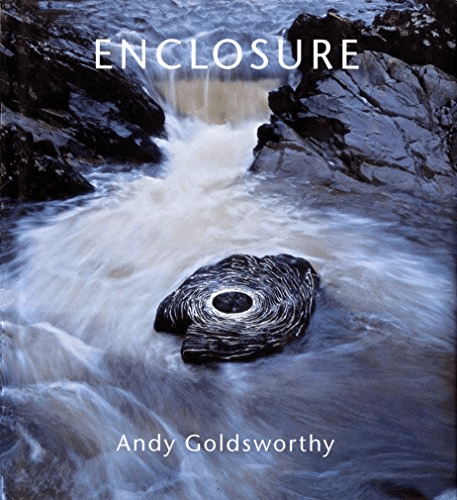
As you proceed on your hike, you find yourself in woods, with a quickly rushing stream beside you, brimming cold with melt. On a dark rock in the middle of the stream, you notice something white, swirling like the water around it, forming in the middle, a perfectly round hole that seems almost three-dimensional. It’s eerie, clearly unnatural, although it seems organic. Pushing aside memories of The Blaire Witch Trial, you look around and don’t see anyone watching. There are no human signs, labels, like you would find in an American park, telling you that This Is Something. Leaving the stream, and clambering among the rocks, reflecting to your friend that perhaps you are the first people to walk this way, you discover another strangeness: a long serpentine white form, pointed like an arrow, hanging down from rocks like a wool icicle. Beautiful and strange.
And then you remember: Andy Goldsworthy has been here. This is his work.
Goldsworthy, who most New Yorkers know from his wall at Storm King, works in organic materials, building sculptures that evoke to me, at first glance, a sense of permanence and timelessness – what could be more permanent than a stone wall? and more timeless, traversing centuries. The simple beauty of Goldsworthy’s work, and the use of organic materials, require time to create: you don’t just hang them on a wall and walk away, job done. On longer reflection, they evoke an ephemeral sense: that this could change, will change, as seasons pass and it interacts with the natural world. The woolen icicle, shaped one night from wet wool, then left to freeze outdoors, then hung, will not retain its shape. Birds will steal pieces for their nests. Wind will blow wisps away. It will fall, in clumps on the ground, be stolen by voles and mice to line their holes; what remains will burrow into the dirt beneath, eventually dissolving into the soil. Even walls, as anyone who has hiked in New England can see for themselves, require maintenance. Left to their own devices, over time, stones fall, frost heaves, animals rub against them, trees push up from beneath or fall from above, and the neatly stacked stone slumps, still forming the idea of a wall without the pristine beauty of a maintained wall.
And so, to capture Goldsworthy’s work, photographs which fall flat beside the three-dimensional scale of his work. But serve the purpose of recording it with journal entries from the artist himself, allowing those of us who do not hike in Cumbria, to appreciate its simple beauty. To review its evolution, from a small, perfectly round hole in a ground outside a London gallery, set aside only by the fence enclosing it, protecting it from well-meaning maintenance workers; to a small, perfectly round hole inside that same gallery, now surrounded by a heap of dirt, apparently flung outward by whatever burrowing creature may lie in the darkness below; to walls, and cairns; to the wall at Storm King. And finally, to Goldsworthy’s works in Cumbria, where he sought a commission to rebuild the eroded stacked stone walls, adding boulders as punctuation marks, and spreading wool and peat, and even his shadow on frozen ground, to create other, more fleeting art pieces for shepherds and farmers perhaps to enjoy as they work, and even for the sheep to participate in creating.
The book does not extend as far in time as the installation that I saw a couple of Christmases ago, when visiting a friend outside of Boston. She and her husband took me a local museum that they enjoy, with a small indoor exhibit, and a vast outdoor sculpture garden and there, on the back side of the museum, tucked into the hill beneath the driveway, along a path that leads you from one sculpture to another, to my delight: a small milk house, made out of perfectly stacked stone. Cool. Dark. Quiet. Peaceful.
A Goldsworthy.
- Or perhaps just James Putnam’s introduction to this book. ↩︎
 Change+Management