
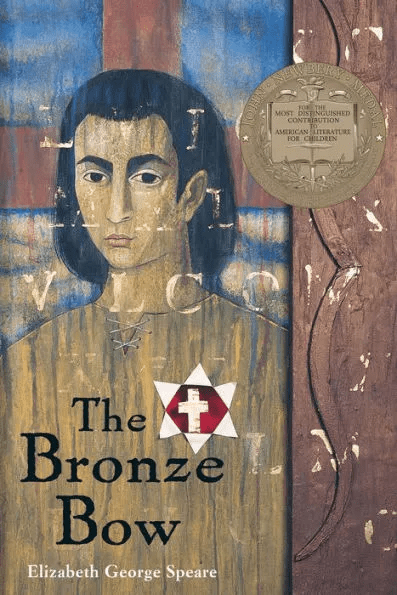
This book starts with a boy, Daniel, who is 18 and lives in Galilee in about 30 AD. It’s been five years since Daniel ran away from the rural village where he had lived all his life. In the hills outside of town, Daniel was taken in by a band of young men who prey on merchants traveling through the wilds. Their leader, Rosh, complains about the Romans and says he plans to do something about them someday.
Daniel hates the Romans with a burning passion because Roman soldiers ruined his life. They crucified his father and his uncle; his father’s death caused his mother to die; and his young sister, Leah witnessed her father’s crucifixion and now suffers from PTSD in the form of a crippling case of agoraphobia.
One day, two kids from Daniel’s village run into him when they hike up into the hills for a picnic. Joel and his sister, Malthace, come from a moneyed family. Joel is studying to become a scribe, a Pharisee like their father. Their family has just inherited a mansion in the city and they are moving there. Joel has heard that Rosh is raising an army to take back Israel and he wants to offer Rosh his support. Rosh recruits Joel to act as a spy for him in the city.
When Rosh later sends Daniel to meet with Joel and gather information, Daniel offends a Roman soldier and is attacked. Too injured to return to Rosh on his own, he seeks refuge and Thrace and Joel secretly nurse him back to health. The three of them pledge to work together against the Romans, selecting an emblem from a biblical verse about a bronze bow – a bow too strong to be drawn by a man without the aid of god – and Daniel returns to the hills.
Then Daniel’s grandmother dies and he is forced to return to the village to care for Leah. He becomes the new village blacksmith but, wanting to do more for his country, he forms an underground resistance. He recruits a group of village boys who wear the bronze bow emblem and meet to talk of revolution, of the messiah, and to hector the Romans with little annoyances while they wait for Rosh to call on them, to lead them in battle.
As a blacksmith, some of Daniel’s customers are Romans and he must serve them with outward politeness or risk bringing violence down on his sister and neighbors. He bides his time, hating them under his skin, while producing the little repairs they need. One soldier, in particular, seems to have an unusual number of minor repairs and, when Daniel realizes that the man is using his visits to the forge to form a friendship with Leah, he cuts it off, causing her to retreat from the progress she has been making against her mental illness.
Throughout the book, Daniel has come into contact with a wise rabbi, hearing him speak first in his village, noticing him preaching on Daniel’s visits to Joel and sometimes witnessing what people call miracles. When Leah continues to decline, Daniel seeks him out and asks if he will help Leah, and receives more than he expected.
Although written in 1961 and set in the Galilee in 30 AD, this book could take place almost anywhere that there are generations of conflict. It could take place in today’s Palestine, in Gaza, in Israel, in areas of the US where there is conflict between left and right, between the races. The message is universal: you will never find a world of peace while your heart is filled with hate.
The other message it sends is about following false prophets. Rosh speaks big, about how he will drive away the Romans, how he takes from the rich to give to the poor – but somehow the only person who profits from his raids is himself. Rosh never seems to get around to taking on the Romans, and the people who suffer as a result of his actions are the villagers and the men he leads. Some people are like that: they tell you want you want to hear, talk a big game, but somehow they never seem to deliver; it’s all about them, what they want, what you can do for them; in the end, you are the one that suffers.
Although the wise rabbi isn’t a main character in the book, I like the way that Speare portrays him: as a thoughtful man, a little tired, physically a little frail. His words confuse people – they aren’t quite sure what he means, and you see people in the crowd assigning their own meanings to what he says. People tell Daniel that the teacher performed miracles on them – one man, for example, claims that he healed his son’s inflamed arm. To Daniel, the arm still looks inflamed but the man angrily claims that the pain is gone and that the boy will be able to work now. Did the rabbi really heal the arm? Or is the man just seeing what he wants to see, the way that Daniel sees Rosh as a big hero? Daniel doesn’t know and the rabbi doesn’t say one way or another.
Daniel is confused because finds himself drawn to this man’s teachings although the rabbi doesn’t call himself the messiah, he doesn’t seem to ask people to follow him against the Romans, and the things he says seem to promise hope. Hope’s not what Daniel is looking for – Daniel wants a messiah who will lead him in vengeance against the Romans, not what this rabbi, Jesus, offers.
This book has been banned in some school districts because, I have read, people don’t like the way it portrays 1st Century Jews; and because they feel that it idealizes Christianity. I don’t see that myself and had written several paragraphs on why, but figured, in the end, my thinking would probably offend everyone in one way or another, and cut them. This is just a blog about reading great books; not a place to share my views on religion.
But I will be glad to offend you in a different way.
There are many books out there that we won’t like for one reason or another. That’s not necessarily a reason to ban them. As a woman, I find the books of David Eddings particularly offensive. I would never buy them for my nephews or other boys. But, to find them offensive, I had to read them, and I have specific reasons for disliking them which I have mentioned before and will not rehash today.
At the same time, I continued to sell them in the bookstore I managed. I didn’t pull them off the shelf or pretend, when a woman wanted to buy one for her son, that we were out of stock. I didn’t tell a mom that the books were offensive toward women or argue with the mom about how she should make her son read a different SFF writer instead, perhaps Anne McCaffery (which would have pissed off any teen boy in the mood for Eddings).
I was tempted, however, to casually suggest that perhaps mom could read the book alongside her son, you know a shared mom-son thing, so they’d actually have a safe topic to discuss over dinner, something he was interested in that might actually get him to talk to his mom about something, anything.
That’s the best way to deal with kids potentially reading books that you disagree with: by letting kids read them if they want to. By reading them yourself. By asking questions to help kids recognize parts that might offend people. And by discussing with your kids the parts that you find problematic, providing context, and using that as a teaching moment.
Because you know kids. If you ban something, they will find a way to read it behind your back. And then you lose the opportunity to share another point of view with them.
To parent.
 Change+Management