
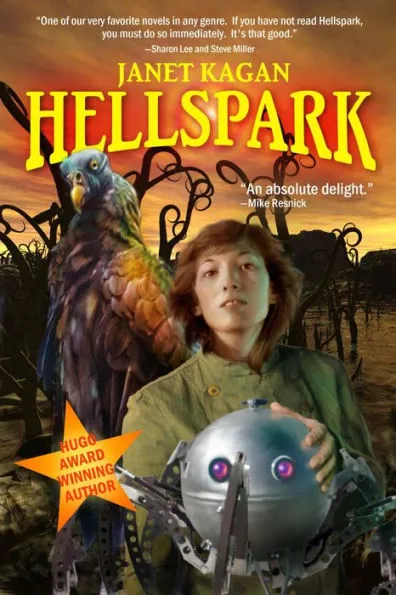
It isn’t often that one can identify a science fiction book that has direct application to the business world, but this one does. Long-time readers of my blog may have read before about my love of this book – it’s one of my very favoritest of all time and one that I re-read at least once a year. Sometimes I finish it with a happy sigh, then turn back to page one and read it all over again.
The story focuses on Tochul Susumo, who is a Hellspark. Before the planet of Hellspark was destroyed, the Hellspark people were merchants who learned to communicate and negotiate with customers from the wide variety of planets that humans had settled. Eventually Hellspark also became a job title, referring to the work they did, which I see as a form of change management.
You may have been in a meeting or workshop where the facilitator asked participants to cross their arms; then to cross them the other way, with their other arm on top. Then they used that as analogy for how uncomfortable change can be when you’re not used to it. Hellsparks have their own version of that: they alternate pronunciations of “Hellspark” – switching naturally between “Hells-park” and “Hell-spark” – something they don’t think about, having learned it at a young age, but which is jarring to people from other cultures, as a reminder that, to Hellsparks, everything is fluid, changeable – nothing is set in stone. Hellsparks live perpetually in the slushy part of change between one fixed state and another. Hellsparks are not afraid to pluck the pin of high-change and risk inviting sweeping change into their lives.
When the book starts, Tochul Susumo responds to a call from a potential client: a participant in a planetary survey team has been killed, supposedly by one of the animals on the planet the team is exploring. Some team members think that their teammate was killed by another team member (fingers pointed all around). Some suspect that the motive was to cover up the fact that one of the native species is sapient, which would preclude human exploitation of the planet and it’s resources. When Tochul arrives on the planet, she recognizes that each member of the survey team comes from a different planetary culture (even two from the same planet, one male, one female, have completely different planetary norms) – and the person who was charged with teaching them how to communicate and avoid cultural taboos did not do their job effectively, or at all, it seems. Tochul, brought up from a young age to excel at navigating cultures, uses her skills to get the team to work together effectively, increasing productivity, and allowing her to solve the mystery. The solution hinges on the same problem that prevented the team from working together.
Tochul takes the complex business of getting along with people you don’t understand, and makes it simple, so the team can take action and get results. She travels around the universe in a spaceship learning about different cultures and problem-solving. Often the problems she solves aren’t the ones that the people invited her to solve: in an early chapter, a friend teases her that she accepted a contract for agricultural equipment, which she then delivered – much to the purchaser’s consternation because what they really wanted was armaments, they just falsified the language in the contract to elude interplanetary laws – and now they’ll be forced to stay home and grow crops instead of attacking their neighbors. Tochul Susumo is very much a trickster character along the lines of Coyote or Anansi: clever, bold, not above using deception as a means to an end; there’s often a sting in the tail of her tricks. And sometimes she gets stung by them herself, which causes her to laugh just as loud.
She is aided in her work by the AI system on her ship, which takes on the persona of a small child. It’s a clever author’s device to allow the introduction of backstory and information that you want the audience to have but don’t want to narrate. It’s also an interesting perspective on AI: instead of being something controlled by white-collar tech bro’s who – too drunk on can to consider should – force-feed their beta a bunch of information, let it absorb all the good and bad that humans have created, without context, and let loose their MVP on the world to define its own morals, assuming that they can crowd-source corrections. Instead of that, Kagan’s AI is nurtured 1:1 by a woman as if it were a child. When it throws temper tantrums, she doesn’t cut it off and excise the part of it’s brain that demonstrates autonomy – or claim that it’s mistakes just indicate that it needs more data – she Hellsparks it into a different headspace that allows it to learn and grow. [In this year’s re-reading, Kagan’s approach to her AI is the thing that stands out to me the most.]
So why do I like this book so much? If I could, I would be a Hellspark: I’d travel around, getting to understand different cultures, problem-solving by helping communities and teams navigate and adapt to different cultures so they can get along together, productively.
If anyone’s hiring Hellsparks, let me know.
 Change+Management