There has always been evil in the world.
Even in the earliest myths and folktales, there are those who lack empathy and prey on others, seizing and raping those weaker than themselves, torturing and killing them without remorse. Later there were Grimm’s Fairy Tales and legends of werewolves.1 Before Jack the Ripper – often erroneously called the first serial killer – there was the Killer of Little Shepherds and, before him, there were others. The legend of Elizabeth of Bathory (accused by political rivals of spiriting away local maidens to bathe in their blood) resonated, not because it was true – the general consensus now is that the rumors were started by men who wanted, and eventually received, the lands she ruled), but because people knew that there were people in the world who were evil enough to do such things.
There has always been a low-level background number of psychopaths, eating their way through the world around them.
The second half of the 20th Century has become known as the Golden Age of Serial Killers2.
I feel I have to state this explicitly since I told a very literate friend about this book over the weekend only to discover that, although he knew this author, he had never heard of the Golden Age.
There are a number of things that feed into this Golden Age: the number of men stalking women and children during this time; the rise of the global media; the installation of the interstate highway system, which made it easier for serial killers to travel outside their local area; and – in the early ’80s – the acceptance by local law enforcement that such a thing as a serial killer existed and the starting of task forces that crossed the usual law enforcement boundaries.3
Following the Golden Age, the numbers dropped off precipitously. There are still serial killers out there, torturing and killing people who are smaller and weaker than themselves, but they’ve returned to background noise, especially compared to the number of spree killers that have been haunting schools, grocery stores, churches, and other places that people congregate.
So why is that? What was so different about the Baby Boomer4 generation that produced so many serial killers? There are a number of theories: the return from WWII of psychologically damaged soldiers who shared stories of committing violent war atrocities in Germany and the Far East with impressionable young sons and nephews; illustrated “True Detective” porn, which glorified the torture and murder of women and was easily accessible to young boys; the rise in crime reporting (“the statistics just got more accurate”); the urbanization of America, bringing more people together, which leads to more conflict5; better forensics; and law enforcement policies.6
Or maybe there’s another reason.
“Every great psychopath wants a floating bridge.”
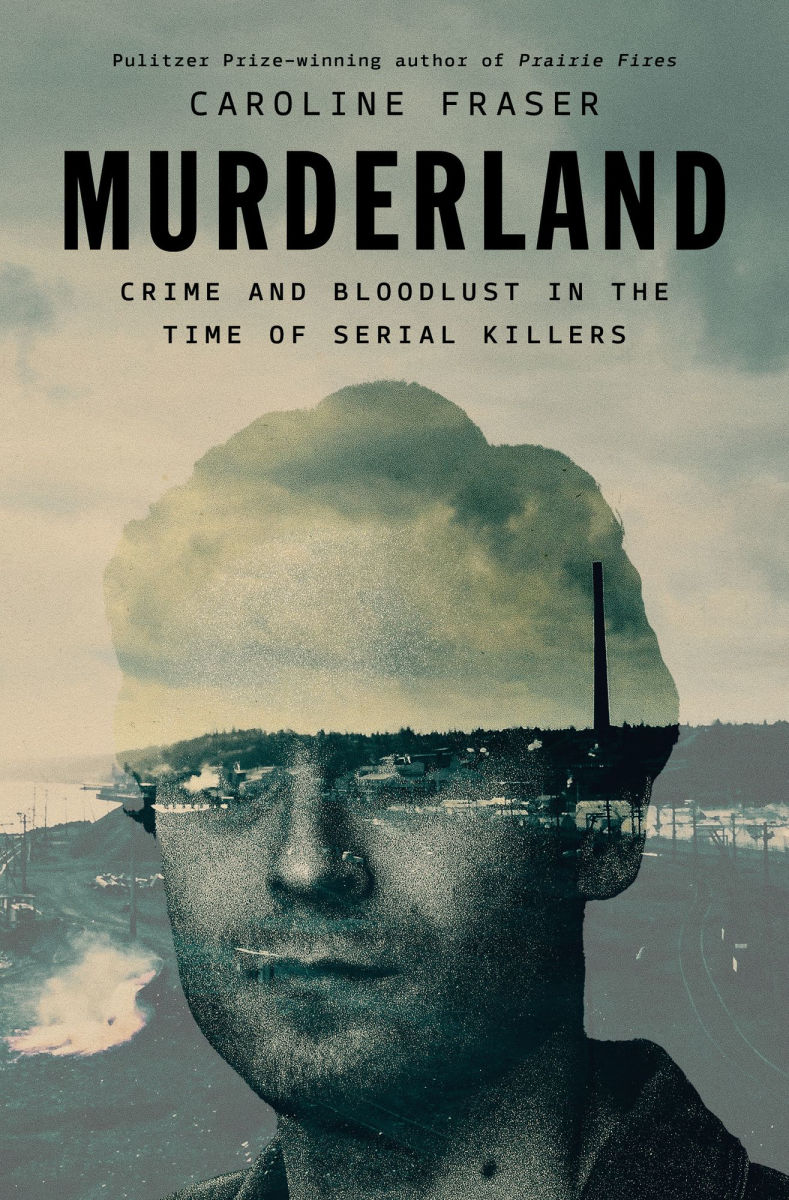
Caroline Fraser’s new book, Murderland: Crime and Bloodlust in the Time of Serial Killers starts, not with a serial killer, but with a bridge.
The Lacey V. Murrow Memorial floating bridge connected Seattle to Mercer Island, an island in Lake Washington.7 The bridge haunts the book, built in 1940 and collapsing in 1990. The bridge had been a killer since its inception. Poorly designed and following the maxim that, when you build more capacity for traffic, you create more traffic, the bridge included a bulge in the middle requiring drivers to swerve midway across. That, combined with poorly-marked reversible lanes that switched direction during the rush hour, made it, according to this book, a most deadly stretch of freeway. The number of deaths on this one short bridge – just about 6.5 miles long – exceed the number of deaths on I-5, a freeway that stretches from the Canadian border to the Mexican border, spanning mountains, cities, and desert valleys.
Think on that for a moment.
The bridge precedes the serial killers throughout the book. Although it is clear that the bridge is killing people, the Seattle and Washington State authorities are unwilling to close or replace it. It was built and paid for as part of the Highway project, a federal project, and neither the state nor the local government have the funds to replace it with something safer.
And so, interspersed with the body counts racked up by the serial killers in the book, the bridge’s victims are counted and named. Ironically, one of the bridge’s victims, discovered only after the bridge collapsed, is found to be a young woman that disappeared years before and was assumed to be a victim of one of the local serial killers.
Who commits the crime and bloodlust in the time of serial killers?
The bridge is just one of the recurring killers in the book. Soon after, we are introduced to Ted Bundy, who moved to Tacoma, the area just south of Seattle, when he was three years old. But this early introduction to the man who went on to become quite possibly the second most famous serial killer (after Jack the Ripper) is just an excuse to introduce Tacoma, an industrial disaster area, home to the largest arsenic factory in the country, and smelters that process gold, silver, copper, but mostly lead, spewing industrial waste across the area, and raising lead levels in the bodies of families and children who live there. There and other smelter-rich areas like Idaho, Colorado, El Paso, Helena, West Yorkshire, and Southeast Kansas.
Areas where clouds of led and other chemicals pollute the neighborhoods, killing animals, coating yards, and infiltrating homes and schools.
Lead is not a good thing for children. You may have heard that it causes neurological problems, learning problems. It also causes a tendency, among men, towards violence. MRI scans, according to this book which is exquisitely footnoted, show that “lead exposure in childhood is linked to brain volume loss when their subjects reach adulthood, and that the effects are particularly notable in men.8 [author’s emphasis] […] the loss shows up especially in […] the prefrontal region responsible for the executive functions, regulating behavior. […]Another Cincinnati study links [these] structural abnormalities […] to higher levels of psychopathy.”
So a third killer in the book (1: the Lacey Murrow bridge; 2: individual serial killers) is the company that owns many of these smelters: ASARCO, the American Smelting and Refining Company, now known as Grupo Mexico, where it spreads its polluting murder to another country. As the author says, “Corporations can be people9, and people can be killers, ergo, corporations can be killers.” And ASARCO / Grupo Mexico, and a Canadian smelter, Teck Resources, have a lot to answer for.
What’s a Smelter?
I mentioned this book to another friend over the weekend, a coach who encourages people to reduce their stress by getting out into nature, and he asked, “What’s a smelter?”
I was a little surprised but should not have been. He’s younger and doesn’t perhaps remember “the good old days”10 when the industrial heartland and much of the Pacific Northwest lived under a pall of smog, and even in New York City, if you left your windows open, you came home to black grit from manufacturing smoke and leaded gas coating all the surfaces. There were days in New York and New Jersey in the ’80s, when you blew your nose, your Kleenex turned black. There were areas along I-5 in Washington State, where you rolled up the windows and still held your breath because of the smell from the smelters. There are rivers and lakes in Idaho and Wyoming that look beautiful on the surface but, on the bottom, are feet deep in industrial waste from the smelters. A fact that comes home to roost as climate change and overpopulation is drying up those bodies of water, bringing people and fauna into contact with that waste. It’s a ticking time bomb.
Smelters, to answer my friend’s question, are the factories where they bring raw mineral ore, and heat up the ore to extreme temperatures to concentrate and remove the desired minerals, often iron, copper, and – back when they had convinced everyone that these were good chemicals that you wanted in your home, around your children – lead and arsenic. Smelters pollute the environment by spewing gases through smokestacks that contain particulates (that black grit I mentioned above), by spewing slag (the unwanted leftover minerals) into nearby bodies of water11, and by leaving behind contaminated buildings and properties where the smelters used to be.12
More Killers
So far, we’ve tallied three killers that the author weaves into her book: serial killers, smelters, and the deadly bridge.
Here are some others: her father, whose abuse kills her love for him and drives her mother to an early death on Mercer Island; Christian Science, which brainwashes an entire generation of young people into believing that sickness and death are an illusion through Richard Bach’s Jonathan Livingston Seagull and Illusions; the billionaire owners of all the smelters, who rake in the cash and avoid culpability, much as the Sacklers avoided accountability for the Opioid epidemic their companies fostered; and the government (local, state, and federal), who granted exceptions to smelters, covered up the danger of the emissions, and ignored the dangers to the their communities.
This is a book of rage, from the first page through to the last, peaking in the middle much as the pattern of serial killers peaked during the Golden Age. The author states her facts clearly and firmly, helping you recognize the danger, the links between all these killers, tracing Bundy’s upbringing to the influence to Tacoma’s smelters, Ramirez (the Night Stalker) to El Paso’s, BTK’s to the smelters of South Kansas…
Until you are as enraged as she is.
People will probably fight this book’s conclusions.
People with interests in Mining, Smelting, Oil & Gas, and other polluters. When European colonists first came to the Americas, they were afraid of the wilderness, of the vast forests and wide prairies, the high peaks, and the wide waters. They saw them as something that needed to be eradicated and tamed: the herds of buffalo were systematically and deliberately wiped out, something many people don’t realize now, when extinctions happen without planning everyday. The modern environmentalist movement started not because people in power valued what nature gives humans – fresh air, fresh water, a carbon store that lowers temperatures, a bulwark against wildfires and, yes, a way to recharge our mental health – but because those in power liked to hunt and realized their prey had been eradicated.
Others may fight as well: there’s always the risk that, when you link crime to mental illness, that the justice system will misfire and say, “Well, they couldn’t help it so let them go.” I am not advocating that. Even if you committed a crime because you suffer from mental illness, you are still responsible. Even if you kill your children because of post-partum depression, or kill the guy sitting next to you on the bus because you suffer from Schizophrenia, or open fire on a crowd because you have PTSD, or you have whatever is causing all these teenagers to shoot up schools, you are still responsible.
And that goes double for psychopaths: people who stalk and kidnap and rape and murder do not get a pass even if their brains are messed up from lead gas and lead paint and air pollution. Yes, your brain is messed up; yes, your parents were probably absent or abusive or both; yes, you may have suffered from a blow to the head but you still get to go to jail and stay there forever, as far as I am concerned. Studies show that violent psychopaths cannot be rehabilitated. They may charm you or fool you into believing that they have been, but they are not and, if you believe that they are (like that criminal mental health facility in Canada once did), you will find out that you are wrong (just as they did, to their sorrow).
Prairie Fires
Last year, I read – and loved – one of Caroline Fraser’s earlier books, Prairie Fires, a biography of Laura Ingalls Wilder, a book that won a Pulitzer and a bunch of other literary awards. I wanted to compare this book to that book because this book is so full of fury13 and my memory is that the other book that it is not. Unclear, I decided to refresh my memory of it by reading the review I wrote last year, when I was writing one book review per day.
Alas, for some reason, I didn’t write a review of that book. So now I feel a need to read it again and write about it.
Reading Experience
This book reminded me of other books that I enjoyed: Bill James’ Popular Crime (probably because of the persistent march of murder and violence) and Kate Winkler Dawson’s Death in the Air (which deals with a serial killer operating in London during a deadly coal-fired smog that smothered 12,000 people during one week in 1952). I reviewed both of these books last year, if you want to learn more about them.
I read this book (both of Fraser’s books, actually) on paper. With this book, I almost (but not quite) wish I had read it on e- because it would have been easier to go back to bookmarked passages and highlighted quotes. But the brain processes reading on paper differently than it processes what you read on a computer or a tablet. I’m a fast reader – I can read two books on a cross-country flight and remember them in detail – but I am even faster on e- than I am on paper but e- has a distance that paper doesn’t. I also don’t read e- in bed unless I’m traveling (no internet in the bedroom14). I had the feeling, when I chose to buy this on paper, that I’d want to take my time with it, and I was right.
And I own both these books in hardcover, which are too heavy to read in bed (this one clocks in at 466 pages), which means that I have to read them sitting in a chair, an experience I don’t often have but would like more of.
I appreciated all the statistics in this book, things like, how many PPMs (parts per million) of Arsenic and Lead it is safe for children to have in their bodies (hint: zero), and the history of smelting in the Pacific Northwest. When I finished reading, I was craving a scientific study looking at tooth enamel isotopes of convicted rapists and serial killers15, drawing a stronger correlation between pollution and serial killing. Fraser includes some good graphs, showing the correlation between violent crime in general and the levels of lead in the atmosphere, but I felt like I needed that one more study, which probably hasn’t been done.
It also made me think of the work of authors from other countries, Micki Pistorius in South Africa, for example, and the offshoring of polluting manufacturing to third world countries, which experience their own brands of violence, for example, the rising violence in India against women, and whether there could be (or maybe already is) more research there.
Food for thought.
- Werewolves = Serial Killers like Vampires = Blood diseases (like TB and Aids), Zombies = Political Unrest, and Aliens = Fear of Change. ↩︎
- If you Google it, you will find that everyone defines the timeframe differently, some going back as far as the 1950s, some extending forward to 2000; I think 1970-1990s is what most people assume. From this book: “Throughout the 1990s, nationwide there are 669 serial killers. In the 2000s, 371. From 2010-2020: 117.” You get the picture. ↩︎
- Prior to the 1980s, if three or more victims were murdered the same way, there was still a tendency by law enforcement to see them as separate events, probably carried out by the typical murderers, such as a spouse, even if the media linked them. This hampered criminal apprehension, as did the reluctance to share information between, say, the LA Police Chief and the Sherriff of the County of LA. Look at what happened with the Manson murders, for example. ↩︎
- The dates roughly match, given that most Serial Killers start killing in their 20s or 30s and stop when they’re in their 60s or 70s, if they escape detection that long ↩︎
- I’m going to disagree with this one, since many serial killers operate in small towns and rural areas. ↩︎
- Prior to the awareness about serial killers, it seems to have taken quite a bit to lock up a young man who stalked, kidnapped, sexually abused, or raped a child or woman. They just didn’t see the link between that behavior and the future behavior of the criminal. And yes, I am talking about men here. There are women who are serial killers but they generally use different M.O.s, and their crimes didn’t really go up during the Golden Age. The Golden Age was a male thing. From the book: “Only 8.6 of serial killers in the United States are women, and the number of “lust killers” among them is smaller still.” ↩︎
- An island that my family visited often the first time that we lived in Washington State. I remember it, from those visits, as an island filled with new houses, glamorous houses, vertical, with textured white walls, high ceilings, wood accents, champagne-colored wall-to-wall carpeting, and fixed windows strategically placed to capture views of nature and not the neighbor’s house. They used to call this the Pacific Northwest Style. My parents made pilgrimage to open houses in these neighborhoods religiously on weekends when my father wasn’t working, dragging us reluctantly along, making architectural notes for the dream house they one day wanted to build. After their divorce the second time we lived in Washington State, my mother declared bankruptcy, got her father to give her a bunch of money, and built a house exactly like what I described above. And then left town to travel the world with the Foreign Service, returning a decade later to settle down for a few years before her second divorce. After she finally moved to a small town in Eastern Washington to be near my sister, and then died instead, my sister took her kids to see the house they remembered from their early childhood, only to find that the new owners had torn it down because, although it looked glamourous on the surface, it was so badly constructed and maintained that the foundations had rotted away. This was the house my mother had been so reluctant to sell because she hoped her girls would share it together some day. ↩︎
- Lead doesn’t have the same physiological affect on women’s brains. ↩︎
- If you don’t recognize what she’s referring to about Corporations being People, look it up in Wikipedia. ↩︎
- This is the Great America that some people want to go back to. And are doing everything possible (if not legal) to bring back. ↩︎
- Later, when that became unacceptable, they sold it off as something to pave roads and parking lots and driveways with. ↩︎
- In Tacoma, since the smelter sat along the water, it is now prime real estate. It was purchased and turned into a housing development in the 2000s. ↩︎
- The word Fury derives from the Greek, Erinyes, the goddesses of vengeance who pursued those who swore false oaths. Also known as the Gracious Ones. ↩︎
- Owing to a previous owner who lined both sides of the long wall that separates the living room from the bedroom with floor to ceiling mirrors, which blocks the Wi-Fi signal. ↩︎
- And serial killers who were put in jail for other reasons, such as the guy who copped a generous plea deal in the first season of the New Yorker podcast, In the Dark, and never had to serve time for actually raping and murdering young boys. Which is a little like convicting Al Capone of Tax Evasion: it gets the job done but allows him to evade responsibility. ↩︎
 Change+Management