
The Spirit of Christmas, as Found in Laura Ingalls Wilder’s Books
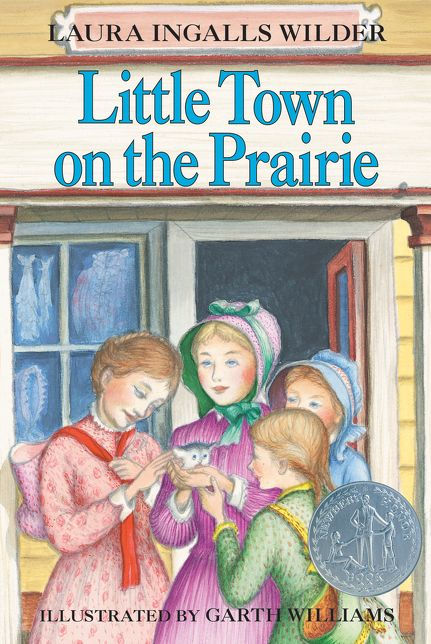
This post continues my December series on how Laura Ingalls Wilder writes about Christmas in her books.
In Little Town on the Prairie, the Christmas theme starts in the early fall. While helping Ma pack for the family’s move into town for the winter, Laura discovers, hidden away in Ma’s dresser, a beautiful copy of Tennyson’s poems, in a book with a shiny gold cover. The book falls open and Laura glimpses a few lines of The Ancient Mariner: ” ‘Courage,’ he said, and pointed to the land. ‘The mounting wave will roll us shoreward soon.”
Then, in a flash, Laura realizes that this must be a Christmas present that Ma bought while escorting Mary to boarding school, and that it must be a present for Laura, the oldest girl still at home! She quickly pulls the clothes back over the book, hiding it again, and shuts the drawer. Ma rushes in and sends Laura to a different room to pack things up there.
Throughout the fall, the words Laura read resonate through her memory, at first with curiosity – what will happen on that shore? – but then she thinks of them so much that the thrill she got reading them for the first time wears off and, though she remembers the words, it is without anticipation.
Or perhaps her irritation is because the family cannot afford to bring Mary home for the holidays and this will be their first holiday apart. Although Laura and Mary fought like cats and dogs when they were little, Mary’s absence is like a sore tooth that Laura cannot help touching again and again. As the season progresses, the family ships Mary a Christmas box containing beautiful handmade gifts that Ma, Laura, and Carrie have been working on since Mary left; a length of blue ribbon from Grace who is too young to make presents by hand; and a $5 bill from Pa.
There’s no snow that Christmas, the wind has a desolate sound, and the world seems grey and bare with Mary so far away and not coming home soon. Without Mary, Christmas Day doesn’t feel like Christmas: Grace receives a doll with china hands and face; Pa makes it a bed out of a cigar box; Laura and Carrie and Ma sew sheets and blankets for the doll, and dressed a nightgown and nightcap for it. Laura and Carrie go in together on a silver thimble for Ma and a blue silk necktie for Pa. But, aside from the work that the family did together on Grace’s gift, the presents are listed without joy.
Laura’s only gift is the book she has been looking forward to – but even that feels disappointing, “for in the land that seemed always afternoon, the sailors turn out to be no good. They seemed to think they were entitled to live in that magic land and lie around complaining… They wanted dreamful ease.” Laura slams the book shut, furious (with the sailors, she says) and without heart to read any of the other poems.
Then a letter arrives from Mary and that, they agree, was the best gift of all.
The next summer, Mary doesn’t come home.
And when Christmas returns again, Ma and Pa still cannot afford to bring Mary home for Christmas – and the family “would not try again to have Christmas without Mary.” Only Grace and Carrie receive presents that year. On Christmas Day, Ma confides in Laura that she and Pa don’t know how they’ll afford for Mary to finish school the next year. As much as they all miss her, they know that this is the only opportunity that Mary will have to travel away from home, to study, to stimulate her mind and meet new people, other young women who are blind, like she is, to gain skills that could help her navigate her life.
So, although Laura is sad that Mary is away from home, she is already anticipating the disappointment of Mary having to return home before she can finish her studies, of a life not lived to its fullest potential. Bummer of a Christmas.
Then there is a knock at the door.
It’s the school superintendent and a homeowner from a neighboring settlement who needs a schoolteacher. Before Pa even arrives home from work, Laura is evaluated and provided with a teaching certificate, and offered a job in the neighboring settlement.
Although Laura is only 15 – and has no interest whatsoever in teaching school1 – accepting the job will enable Mary to “have everything she needs, and she can come home next summer!”
Laura’s emotions on the last page of the book seem to be a mixture of stunned surprise (that the superintendent would give her a certificate), of dread (she really does not want to teach school), and of pride that she will be able to contribute as an adult to Mary’s care, and help give her sister the greatest gift she might ever receive. And, at the same time, by giving her parents the ability to keep Mary in school, give them a gift far greater than Laura has ever been able to give them before.
Christmas, in Little Town on the Prairie, is about disappointment, about missing those you love and cannot be with2, and how that disappointment worms its way into all aspects of your life, even your love of reading.
It’s also about sacrificing, the gift of sacrifice, of putting the needs of your family before your own wants.
I’ve been reading a lot of stories online lately about people whose families ask them to sacrifice something on their behalf – take care of children or parents or let them cook Thanksgiving dinner or something. Often the people asking are siblings of the people being asked. And the people being asked, are resentful: she always does this; he never does that. And the online comments (by strangers) inevitably say, “NTA, set boundaries. Tell them to get screwed. You don’t have to look out for anyone but you.”
Yes, it’s important to set boundaries. Yes, you need to practice self-care.
But there’s also something beautiful about choosing to do something for someone in need, and it means even more if that something is not something you would choose to do. When my sister’s children were young, she asked me if something happened to her and her husband, I would take care of her kids. Now, my husband and I enjoy being DINKs. We like being Aunts and Uncles and not parents. Choosing to be responsible for children on a daily basis for years on end is not something we would select for ourselves. But, if my niece and nephew were left parentless, we would step up, change our lives, and care for the kids. Luckily all of our nieces and nephews are now adults, or almost adults, and we give a sigh of relief as we lift our martini’s high. But we would have made that sacrifice if faced with it.
We don’t always get to choose the circumstances that impact our lives. Sometimes bad things happen to us, to our families, and approaching adversity with grace and gratitude and generosity can sometimes transform a hideous experience into something with meaning.
 Change+Management