
The Spirit of Christmas, as Found in Laura Ingalls Wilder’s Books
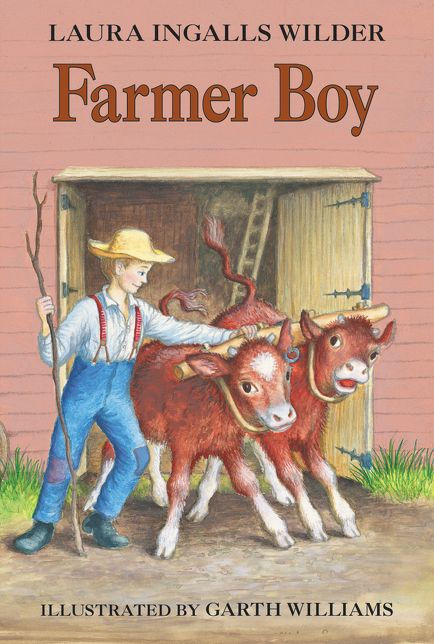
This book, which features Almanzo’s childhood stories, is a departure from the saga of the Ingalls family. The Wilder family, a prosperous and respected farming family in upstate New York, illustrates a contrast between the life of a struggling pioneer family and an established farmer’s life. I hesitate to even call Almanzo’s father a farmer: he farms, yes, he grows a field of pumpkins, but he mostly raises cattle and pure-bread horses. The Wilders live in a solid house, with fine furnishings and a pantry full of rich food. Their property includes several large, solidly-built barns that stay warm even in winter. The children wear clothing made specifically for them, and solid shoes, and go to school, even in winter. They have enough money to house and feed the school teacher without imposing on their own comfort or reflecting on the additional cost. These people are, compared to the Ingalls family, fabulously wealthy.1
This book gives us an idea of the kind of life that Pa may have dreamed of for his family, although he also had a wandering foot. Even when the family is settled in the Dakota Territory in Little Town on the Prairie, when Pa mentions migrating west to Oregon, perhaps, where there are fewer people, and Laura’s heart leaps up at the thought of traveling again, Ma smites that idea down with a firmness she usually reserves for the girls: the family is well-settled, with a farm in the country and property in town, where her girls can go to school and get an education, and the family can go to church on Sunday, and Ma is not moving and starting over yet again. To some extent, Ma and Pa have very different ideas of what they want from life.
Christmas, in Almanzo’s childhood memories, is more like what most Americans expect from Christmas now. Distant family are coming for Christmas dinner and Almanzo – too young to assist his father and his brother with threshing – helps his sisters and mother clean the house, with chores that the Ingalls girls’ poverty spared them from, like polishing silver. Almanzo’s mother prepares a feast that the Ingalls family, even at their most comfortable, could only dream of: roast goose and a suckling pig, with sage dressing, cranberry jelly, fried apples and onions, mashed potatoes, mashed turnips, baked squash, fried parsnips, candied carrots, fresh-baked bread, rich fruitcakes, cookies, mince pies, pumpkin pies, and cream pies. Quite a contrast from the Ingalls’ traditional holiday dinner of baked beans.
On Christmas morning, the children wake up in the dark, and tumble downstairs to dig through their stockings, pulling out store-bought caps, silk mufflers, horehound candy, mittens, oranges, dried-figs, jack-knives, gold lockets, garnet earrings, lace collars and lace mitts, fine leather wallets! And then, in a scene straight out of my childhood, Almanzo’s father, awoken by the children’s gleeful squeals, ominously asks if the children know the time. They turn to the grandfather clock – the family can afford a grandfather clock – and see that it is 3 a.m., a full 90 minutes before the time that they usually rise for morning chores. Luckily cute little Eliza Jane2, who must be father’s favorite, wishes him a Merry Christmas so joyfully that father just chuckles.
After chores, breakfast, the arrival of two families of cousins, and the huge Christmas dinner3 described above, the boys go outside for a giant snowball fight. Then the boys were called inside so that the cousins could thaw out before the long ride home through the cold evening. The boys are given more food – cider and apples – but have to eat it standing up in the dining room so that they don’t drip on the parlor floor. So the Wilders also have separate rooms for sitting with guests vs eating, and the sitting room has a carpet that is too fine for wet, muddy boys to stand on.
Finally everyone goes home and “Christmas is over.”
From this story, we learn that Christmas means abundance: there is no sacrificing the children’s gifts in service of the family, of hand-me-downs from wealthy strangers, of being glad that Pa ate the Christmas candy so he didn’t starve to death while trapped in a blizzard. There’s no question of Christmas being saved by a generous neighbor from cancellation due to a roaring stream that prevents Santa’s arrival. And many of the gifts are purchased, not hand-made, as were the simple gifts from Little House in the Big Woods.
First published in 1933, the book may have formed a fantasy for family for children during the depression, just as the huge Hollywood productions did then. Released between Little House in the Big Woods, which introduced Laura and her family and their one-room cabin in the woods where Pa made a living hunting and with a little light farming4, and Little House on the Prairie, in which the Ingalls family has prosperity within their grasp and leaves it behind because they have settled on territory ceded to American Indians. In those books, the girls are delighted with simple gifts, one stick of candy each, a pair of mittens or a tin cup. What a contrast!
- In this book. In later books, we learn that a crash deprived the Wilder family of their wealth, and that Almanzo’s father relocated to Minnesota to try to make a new start for himself, luckily after his children had grown and were supporting themselves. ↩︎
- Who is a total bitch in Little Town on the Prairie. ↩︎
- The word “dinner” used to mean a midday meal, as opposed to “supper” which was an evening meal. ↩︎
- I say “light” meaning he didn’t really make a living off it, but Pa would have called it heavy labor, having had to cut down trees and remove stumps to use it as farmland. ↩︎
 Change+Management