

Although Christmas is filled with parties and feasts and bright lights and upbeat music and gift-giving and families getting together, it is a season where many people experience sadness and loneliness. People cannot afford to get together with families or are separated by their work or by rifts or by the deaths of their loved ones. Parties don’t include everyone and feasts – following hard on the heels of Thanksgiving – leave one feeling bloated and regretting indulgences. Lights and upbeat music seem cheaper and more annoying every year. And gift-giving leads to disappointment, as gifts demonstrate the giver’s complete lack of understanding, on the one hand; and the recipient attaches far too much meaning to gift itself and not enough on the thought of the giver and/or the practicality of the gift. The month of December – and increasingly, the months of November and even October – ratchets up hopes and expectations in such a way that one cannot help but be disappointed on the day itself.
Chief Superintendent Jury, Martha Grimes’ Scotland Yard detective, lives in an eternal Christmas spirit. So much so that, in my mind, all of her books take place at Christmas, although I know that’s not true. Jury is often melancholic in a nostalgic sort of way: a woman’s pale hand against a dark fabric remind him of his mother, whom he found buried under rubble following a bomb attack during WWII. There is always a small child, often a brave, bold, girl, who is overly independent, caring for herself and adults in her life and often pets; she adopts Jury, speaking to him in a code of her own. There is also sometimes an older girl maybe 11 or 12 or 14, a beautiful and remote child, who moves through the world like someone ethereal, and often comes to a bad end in the book. Jury’s downstairs neighbor, Carole-Anne, whose physical description is that of a Christmas Tree Angel, and she works at a store called Star Dust, which seems to sell magical trinkets and fortunes. And then there is Jury’s friend Melrose Plant, a wealthy ex-aristocrat (he gave up his title), who functions as a sort of Santa Claus, using his wealth and influence to make things happen that would not otherwise happen – all while feeling sorry for himself because the women he likes all like Jury instead.
And then there’s the mysterious woman that Jury spies from afar in each book: he is drawn to her, maybe they have a drink together, or just exchange a distant, chilly smile. These women are all in the 30s, with long brown hair, who apparently shop at Eileen Fisher, and have names like Helen or Ellen or Vivian. And you get the feeling they are the adult version of the teenagers that die so unpleasantly.
Whew. And I haven’t even gotten to the story here. For all these themes and characters, however, each book is distinct enough that it doesn’t feel like you’re reading the same book over and over as you work your way through the series.
So let’s take this one: it is December (of course) and Jury is lurking about a graveyard (of course) in a small town between London and Newcastle. He spies a beautiful, chilly woman also in the graveyard and, when she stands up from stooping over a particular gravestone, she seems faint, and he offers to walk her home. They share some whiskey and sandwiches, and agree to meet again later. But, when he returns, she has died – or rather, she has been murdered. And Jury is the mysterious stranger that was seen with her. He finds himself drawn into the investigation. Poking around on his own, he learns that Helen had been spending time in Spinneyton, at a “run-down little place out in nowhere” called the Jerusalem Inn.
After a depressing trip to a local orphanage – Jury himself lived in an orphanage after his mother’s death – where he meets a spunky young girl who he manages to charm through disinterest and candy, and an interview with the headmistress who would feel right at home in Annie. Out in the middle of nowhere, with “small cliffs of snow” hemming in the icy road. At the Inn, a run-down pub with a hodge-podge manger scene and a snooker table, Jury meets another waif, Chrissie, daughter of the female pub-owner. Chrissie, like the earlier orphan, has far more personality than the romantically-deceased Helen. Chrissie is persistently rescuing her doll, who has been recruited to substitute for the baby Jesus figurine who has previously gotten smashed in a bar-fight. There’s a young man, Robin Lyte, a teenager really, who clearly has a learning disability, he is described as slow or simple, also an orphan, his history a mystery.
After Jury returns to London, Melrose Plant shows up at the Jerusalem Inn with his entourage, and somehow ends up staying at the estate of the local aristocracy, where he meets Tommy, heir to the estate and local snooker champ, when he can escape the heavy hand of his overprotective and traditional guardian.
Why was Helen so interested in this run-down bar? Who is Robin Lyte and what is his relationship to Tommy and to Helen? Is Robin Helen’s son? And why would someone kill her to try to keep her from finding out?
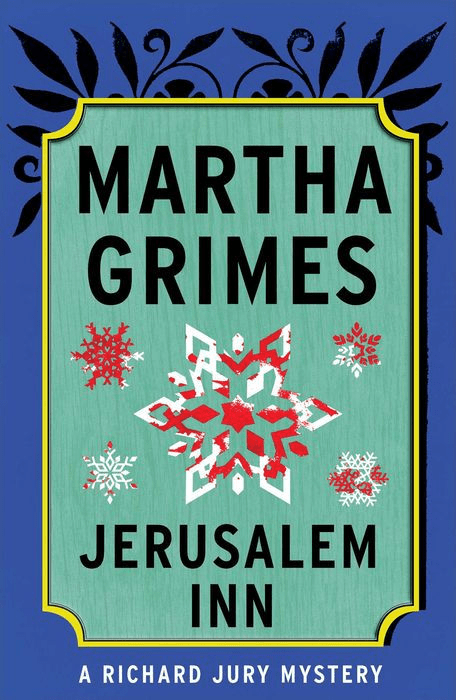
And why, I wonder, when previous covers were as beautiful as the one shown above, would a publisher allow it to be reissued with a cover as bland and dispiriting as this? You would think that they no longer want to sell books.
 Change+Management