
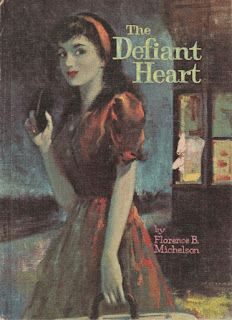
14-year old Lila Hogan, has lived her whole life in the city. Since her parents died, her grandmother cared for her but now her grandmother is gone, and there is no one left on her father’s side of the family and so she is forced to move to the Midwest to live with her mother’s sister.
Having grown up in the city, Lila is very independent and is used to jitterbugging in malt shops with boys and such. Her grandmother and father were – if I am remembering accurately – Hispanic (gasp!) or maybe Italian (gasp!) and Lila has beautiful long, thick shiny black hair.
But when she arrives at her aunt’s, she learns that her hair is wrong, her clothes are wrong, her attitude is wrong, and her father was wrong to marry her aunt’s beloved sister and take her away to the city. Lila, who has a bit of a temper, storms off and meets a handsome teen guy who talks her down off the ledge, before being swept away by his Queen B of a girlfriend, the most popular girl in school, and the daughter of Lila’s aunt’s best friend. Luckily, Lila’s cousin turns out to be alright, offering to help her cousin adjust to the new rules and expectations that she’ll be up against. And Lila’s uncle’s sister, who is a cool aunt to her, advises her about living in such a different culture.
Lila makes a series of mistakes that turn her aunt further against her: the family goes with the aunt’s best friend’s family to a waterpark. The friend’s daughter pretends to befriend Lila and encourages her to join a beauty pageant (“C’mon, we’ll do it together. It will be fun.”). Somehow, after the girl hands Lila her swimsuit, they get separated in the changing rooms. Lila can’t find the skirt that her aunt requires her to wear with the suit in order to meet her standards of modesty but things are chaotic and, before Lila knows it, she’s on-stage parading about in her swimsuit.
And down in the crowd, fully dressed, is the best friend’s daughter, who has raced off to find the family to stop Lila (“I told her it was a bad idea but she insisted!”). Furious, Lila jumps down from the stage and attacks the girl, scratching her face – and earns a reputation as a wild child, a problem, vicious. Clearly, the aunt says, her father’s blood tells.
By the time school starts, Lila’s life is hell. At school, the other kids avoid her, her reputation poisoned by the best friend’s daughter. At home, her aunt watches her like a hawk and criticizes everything about her. Finally, the aunt’s prejudice is so overt that her husband steps in and puts a stop to it.
In the end, Lila makes friends who believe in the real her, her aunt comes around and even storms out of her best friend’s dinner party when the friend criticizes Lila one time too many. Lila, in return, cuts her hair in the bob her aunt has been encouraging since day one.
This is another of the Whitman Teen series from the early 1960s, which featured teen girls confronting situations that require them to change and grow up. Each of these books shares a theme of unfairness, so much so that you can almost hear the lead character protest in that whiney teenaged voice, “That’s so unfair!” (In fact, I suspect it was part of the writer’s brief that they had to have the main character use those words at least once.)
And I think that is what makes these books feel so successful – and that makes Teen books in general stand out: there is a great sense of unfairness. Is it fair that Menolly is punished for being good at music and then for impressing a dozen fire lizards? Is it fair that Anne Shirley is always falling into trouble, just because she has a more romantic mind than Marilla Cuthbert? Is it fair that Ender is picked on by bullies because he is different? Is it fair that Katniss is cheated against? Or that Harry’s muggle family makes him live beneath the staircase?
Nope, not fair.
Which is something you begin to recognize as a young adult: life is not fair.
It’s not fair that the boy you like doesn’t ask you to the dance, that someone else gets the role you want, or that the teachers expect you to be better in school because your big sister was or that your little sister gets all the attention. It’s not fair that other seniors get accepted into every school they apply to and you end up at a safety school or that your parents can’t afford the school you want to go to. It’s not fair that you have to live in a dorm where the food sucks, and take those stupid core courses that are so boring.
It’s not fair that, after graduation, it’s so hard to find a job, and then you get hired but it doesn’t pay what you think you should make, and you end up sharing a tiny apartment in a questionable neighborhood with six roommates. It isn’t fair that, even though you have so many great ideas, your colleagues don’t put you immediately in charge because you’re the new kid, and you have to go into the office when you don’t want to, and you are expected to be on time and stay all day, and sometimes work late. And sometimes, when layoffs happen, they happen to you and you have to start all over again.
Yep, not fair.
And then, at some point, given the right influences, you stop focusing on how things aren’t fair for you and start thinking about how things might not be fair for someone else, and you start working to correct that.
And just like that, you’re a grown-up.
Given the right influences.
 Change+Management