
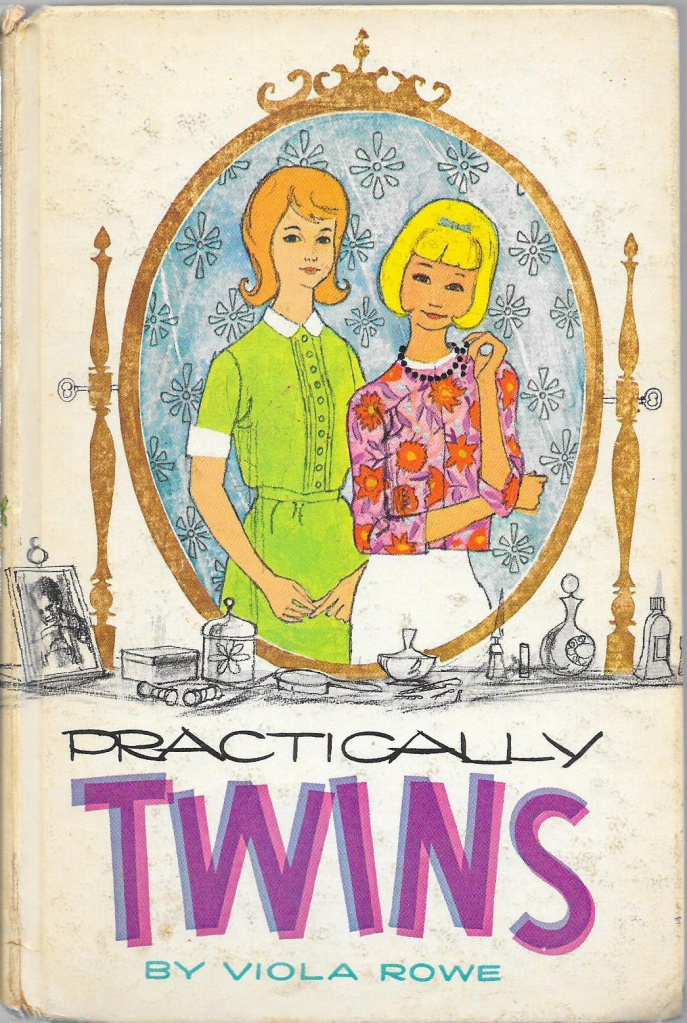
In this teen book from the early 60s, 15-year old Mary Ann McCann has a close relationship with her father, although he is often traveling on business and she is left home with her grandmother, her mother having died when she was little. One day, her father returns home with a surprise: he has married a woman from California, a widow, with a daughter just Mary Ann’s age. They will be coming to live with them in their 3BR ranch in suburban Illinois (?)1 – which unfortunately means that Mary Ann’s beloved grandmother must move out to make room.2
Despite all that change, Mary Ann is excited to meet her stepmother and step-sister. Her stepmother is an immediate hit. The step-sister, a perky, extroverted blonde with blue eyes and an adorable Californian wardrobe, and is named Jan. “Oh, I’ve always wanted a sister,” Jan squeals, “and even our names go together – we’re practically twins!”
Uh, Mary Ann is an introvert with long brown hair and brown eyes, who dresses with Midwest conservatism (well, she was being brought up by her grandmother!). But she appreciates the thought and commits to giving it a try.
The girls share a room, Jan’s side of which looks like a hurricane hit it and the parents complain that Jan leaves her handwashing all over the bathroom.3 The spare room – formerly grandmother’s room – is set up as a homework study, where Jan plays her favorite Elvis record, “Love Me Tender” over and over again, making it difficult for Mary Ann to study. Mary Ann tries to make Jan feel welcome by introducing her to her friends and Jan manages to attract the attention of the boy that Mary Ann has always liked a little bit more than a friend. Jan is popular; Mary Ann is studious and quiet. The parents throw the girls a party, Jan gets to dance with Mary Ann’s crush and Mary Ann is stuck with a football player (probably an offensive lineman) who murmurs her name over and over into her hair, “Mary Ann, M’Ann, Mmman.”
The party, from Mary Ann’s perspective, is not a success. And the awful nickname sticks at school.
Then report cards come in and Jan’s grades are not where they should be – she has, like the grasshopper, spent too much time partying and not enough time studying. Her mother threatens to ground her if she doesn’t pick up her grades. And Mary Ann’s father scolds Mary Ann, “You should have helped her.”
The whole thing seems very unfair to Mary Ann.
Over Christmas break the girls are assigned to write an essay and their father gives them a typewriter to “make homework more fun.” Mary Ann is thrilled; Jan, seeing it for the left-handed present that it is, not so much. Mary Ann teaches herself to type and types her essay. Then, feeling a little passive-aggressive as Jan is invited to party after party, Mary Ann types a second essay, “just for fun” and drops the crisp pages in the trashcan in their study. Jan steals the essay, submits it as her own – and gets caught.
Both girls get grounded.
Jan, claiming she has a cold, moves into the spare room and the temperature in the house drops significantly. Finally, one day, Mary Ann is reading and Jan is supposedly doing homework and playing her favorite record over and over, when Mary Ann finally realizes why the song irritates her so much and tells Jan: the lyrics are telling the listener to give their love in order to receive love; but the singer should be the one to make the first step. Jan replies that she just likes the tune and never really listened to the lyrics.
But something about that exchange signals a turning point. Mary Ann’s grandmother comes to visit, which forces Jan to move back into the girl’s room to make room. Mary Ann confides in her grandmother who gives her some grandmotherly advice. Mary Ann finds a boy who likes her for herself and her irritating nickname (Mmman) fades away and suddenly it doesn’t matter so much that Jan attracted the boy she liked and stole her friends.
I inherited this book from my Aunt Helen, along with the whole rest of the Whitman Teen Series. I liked this series, although I suspect they wouldn’t appeal to teens now, who are used to reading dystopian fantasies in which kids kill each other off. But it resonated with me because I was the bookworm with the long brown hair and my sister was the perky, extroverted blue-eyed blonde who competed with me over boys I liked. We weren’t in high school at the same time, so we didn’t compete over grades, but we did get in a fight once over a boy in which I turned the hose on her and hit my mother, who was carrying a lasagna at the time. It took us decades to form a relationship.
This series of books is interesting. Each features a teen girl facing a situation that she never dreamed she’d be up against, and trying to figure out how to deal with it. In one, a popular girl who lies in Caramel, California is forced to move to Monterey after the death of her father puts the family in a financially challenging situation. Her popular friends, with Barbie-like convertibles, tell her she’s no fun anymore because she can’t spend money and play all the time like she did before her family became poor. But she makes friends with an Hispanic (gasp) family that lives down the hill, and finds a new set of friends, and she discovers that she has a talent for interior decoration that she never would have dreamed of before.
Or the one with Minna Vail who lives in a Northern California shore-town, where she is often cast as the leader of the grunions, a troop of children who perform gymnastics and play tricks during the annual mermaid parade – but she wants to be seen as a mermaid, not a childish grunion, and attract the attention of the handsome upperclassman who is the King of the Sea (or Neptune or something) each year. Then one of her friends develops a disease that almost kills her and leaves her paralyzed, Minna steps in to help but can’t help but feel that her friend who was already spoiled is now unbearably spoiled. She turns to her childhood buddy, a cut-up who plays the Octopus every year. In the end, she manages to get earn a place on the mermaid’s float but gives it up to her paralyzed friend and resumes her role as the lead grunion, and recognizes that the Octopus is more her style than King Neptune.
You can still find these books around at book and garage sales. The packaging is fun, with cover art printed directly on the covers and stylized front and end papers. The one for this book, shown above, is a little cartoonish but the others are more artistic and – when you finish reading the book – you can lie on your twin bed and gaze at the cover and imagine yourself through the book all over again.
- Sorry, pretty sure it was Illinois and I know it was in the Midwest but don’t have the book handy to check the exact location. ↩︎
- She goes to stay with one of her other children’s families, who have a new baby. It’s not like they kicked her to the curb, but she’s far enough away that Mary Ann doesn’t get to see her very often and – this being the 1960s – it was still a long-distance call, so Mary Ann doesn’t even get to speak to her grandmother on a regular basis because it was expensive! ↩︎
- This is the early 60s. Sisters shared bedrooms and the whole house had a single bathroom or maybe one full bath and a half-bath off the kitchen. ↩︎
 Change+Management