
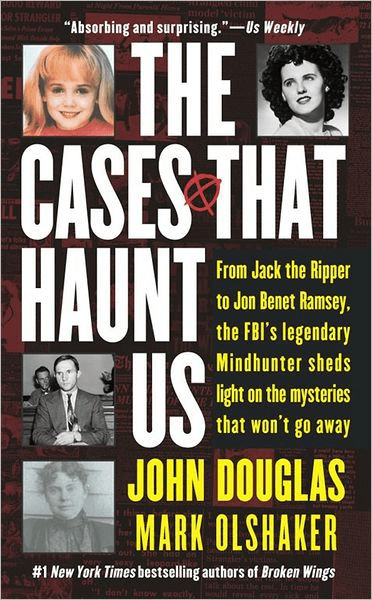
John Douglas, if you didn’t know, is one of the agents that helped establish the FBI’s behavioral sciences unit – in other words, he’s a profiler.
In this book, he looks at some of the biggest cases, the ones that you’ve heard of, even if you’re not really a true crime buff: Jack the Ripper, Lizzie Borden, The Lindbergh Kidnapping, The Zodiac, The Black Dahlia, Lawrencia Bembenek, The Boston Strangler, and Jon Benet Ramsey. Okay, so Lawrencia Bembenek – and maybe the Zodiac – are not on the scale of the rest of the cases, that assumption kind of dates the book a little. But it’s a fun read anyway.
For Jack the Ripper, Douglas goes about talking about how he would have developed a profile for the ripper (he actually did for a TV show, once), and then he looks at the known suspects and rules out the ones that authors tend to love (Royalty! A doctor! That Crazy American!) and narrows in on a suspect that reflects his profile. Makes sense.
For Lizzie, Douglas rehashes what we know about the case. This one is harder because it’s hard to reconcile the evidence against Lizzie against the facts of the case. He examines the known suspects and votes for Lizzie. This one was harder for me to accept.
Douglas comes down hard that Hauptman was responsible for the Lindbergh baby’s kidnapping – or at least, partially, in partnership with someone else, perhaps he built the ladder and drove a getaway car or something. Okay, I buy that. I never understand why people seem convinced that Hauptman was framed – that seems specious to me. This one is interesting because I learned some additional factoids about his guilt that I hadn’t realized.
In the Zodiac chapter, Douglas recounts the case and talks about the evidence. This one is interesting because he includes the Riverside case in the Zodiac’s count, which I’ve heard others say they don’t see the evidence for. Douglas sees it as one of the early murders, a serial killer’s “training” murder (my words not his). It makes sense, if true, because serial killers don’t just spring up and start killing people the way that the Zodiac did in his first established case where he attacked a man and a woman together: they start with lower-risk crimes, sometimes with breaking & entering, or rape, torturing of animals and small children who he would have complete control over; then they progress to the elderly or smaller women, women who might not be missed; and then they go on to people who have the strength to cause an injury to them, men, couples. Sometimes we don’t find out about their earlier crimes until the serial killer’s identity has been established. A number of years ago, I read about a crime in NJ – someone broke into an animal shelter and committed absolute violent mayhem, slaughtering the animals. At the time, the police dismissed it as teenage hijinks but all I could think was that, someday, a serial killer would be identified and they’d trace this back to him.
Okay, Black Dahlia: again, Douglas recounts the tale, including details that I hadn’t read before. He comes to the conclusion that we’ll probably never know who committed the murders and warns that serial killers like this – he describes another, similar crime, that hasn’t been officially linked to this one but he suggests could be – are rarely the celebrities so favored by true crime authors. The main point of this chapter is the sad story – so much romanced – of a girl who decides to go to Hollywood to become a star, becomes homeless and dependent on the kindness of strangers, and then gets killed.
In contrast, the story of Lawrencia (“Bambi”) Bembenek features a strong, working-class woman, the daughter of a cop, who becomes a cop herself. When she is pushed out of the force, she becomes a key witness to police corruption – and makes herself a target of her former coworkers who see it as a betrayal. Then her husband’s ex-wife is murdered with his gun, and she becomes the suspect. She is arrested, escapes to Canada, and finally – to be able to see her elderly parents again – agrees to return and plead guilty to manslaughter if they drop the other charges. That happens, but it destroys her credibility in the corruption case.
The Boston Strangler story is a pretty routine recounting of the tale. Douglas’s theory is that DeSalvo was responsible for some, but not all, of the murders. There’s no new evidence here and I have to say that, in Popular Murders, Bill James points out some interesting facts that might support his theory over Douglas’s.
Douglas puts Black Dahlia, Bembenek, and the Boston Strangler all in one chapter and I have to say, I find that the weakest chapter in the book, next to the concluding chapter which purports to tie the other chapters together and give them meaning besides as a collection of popular crimes. This chapter feels tacked on, as if Douglas’s editor told him the book wasn’t rich enough, that he needed to eke it out with more material. I learned some new information about Bembenek but the other two are pretty standard recountings.
Jon Benet Ramsey is probably the strongest chapter – Douglas was directly involved in this investigation, called in by Ramsey’s lawyers to help provide a profile that could assist police in locating Jon Benet’s murderer. The chapter is rich with detail and insights into what went wrong with that case.
It’s an interesting book to read – it’s always interesting to read his books, but they are surprisingly dry sometimes. He’s definitely a just the facts kind of guy, not interested in creating a compelling story. He comes closest with the Jon Benet chapter. That said, the book is easily readable and worth reading if you like this kind of thing.
 Change+Management