
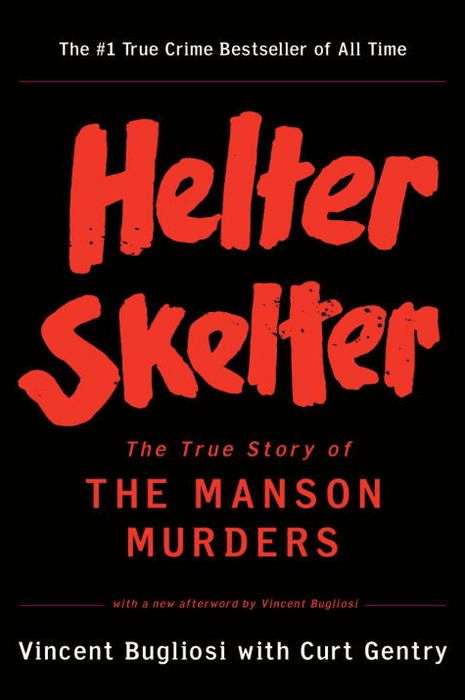
You know this story: a small group of hippies break into Roman Polanski’s home in the Los Angeles hills while he’s in London; kill his pregnant wife Sharon Tate and a male friend of hers (THE celebrity hairstylist); and a coffee heiress and her boyfriend who had been subletting the home while Polanski and Tate were abroad working and stayed on so she wouldn’t be there alone; and a guy who had dropped by to visit a guy who was subletting the pool house (but not the guy subletting the pool house who survived). Oh, and the killers write things on the walls in Tate’s blood.
Who would do such a thing?
And then the next night, another group of hippies invades the home of a supermarket owner in a very different neighborhood (less celebrity, more bourgeoise), and kill him and his wife, and write Helter Skelter on the walls of their home.
We all know this story. Even my parents – who were not true crime readers – had this book in their collection.1 And I just never was interested enough to read it. A few years ago I saw Once Upon a Time… in Hollywood2, and that sort of filled in a few gaps for me (although it feels a little mastrubatory of Hollywood to produce a movie giving a Hollywood actor and stuntguy a happy ending in this situation). So, why, after all this time, did I suddenly decide I needed to read Helter Skelter?
Blame the My Favorite Murder podcast. Listening to this podcast reminds me of the friends I grew up with – so many shared experiences with the hosts. Anyway, one of them was talking about a book called Chaos, which is also about the Manson murders, and she made this interesting comment about how it explained so much that didn’t make sense in Bugliosi’s book. So then I felt like I needed to read both Helter Skelter and Chaos to see what she was talking about.3 Tomorrow, I’ll write about Chaos.
In any case, I’m not going to spend a lot of time re-hashing what happened with the murders or the trial – I want to talk more about the book than the plot. We all know the plot – it’s become canon, the way Columbine has. Or, at least Bugliosi’s plot has. To a certain extent anyway.
So let’s talk about the book.
I have to say that I was expecting it to be poorly written. It comes at the start of the modern true crime genre, long after In Cold Blood, but only because the crime happened long after that book. It’s actually very readable but it does feel like there is a bright line between the sections that Bugliosi wrote himself and the sections that it feels like he left to Curt Gentry.
The first part of the book – the discovery of the murders, the stupefaction of the police force, everything up to the courtroom scenes – sound like they are written by Gentry, based on news reports and maybe Bugliosi’s notes, with Bugliosi himself skimming the draft and saying, “Put me in here – this is where I told the cops how to do their job yet again.” But, once you get to the courtroom, I feel like Bugliosi becomes more involved. There’s still a good deal that was taken from news reports and the record, but a lot of it has Bugliosi’s fingerprints all over it. For crying out loud, he spends as much time describing the sentencing phase as he did the trial itself.
Bugliosi was a certain kind of guy, the kind of guy who is so insecure about his masculinity that he has to continually tell you how much smarter he is than everyone else, how much Manson admired him, how much he runs circles around the other lawyers on the case. If he was running for office, he would constantly be telling you how much bigger his crowd size was than the other lawyer’s.
The motive that Bugliosi came up with to explain to the Jury why Manson and his followers committed these insanely gruesome crimes, seems designed to make you think, wow, Bugliosi must be a genius to put all that together: Manson had his followers commit murders against the white elite that the Black community should have been committing but were too stupid (his thinking not mine) to commit, so Manson had to show them how it was done, in order to force an apocalyptic race war in which the white race would be wiped out – with the exception of Manson and his followers who would take refuge in a golden underground cave while the fighting was going on – all so that Manson and co. could return to take their rightful place as the Masters over the Black race (his thinking not mine) and live a paradisiacal life.
I finished this book thinking to myself, Good God, Manson was insane and the people who followed him were clearly naïve idiots, to be taken in by him. But people do believe crazy things, as I think we’ve all noticed especially over the last 10 years or so. And even before that, with Jim Jones, and David Koresh, and Heaven’s Gate. Persuasive megalomaniacs get up in front of people and spout the craziest ideas; and people desperate to hear what they want to hear believe them, because they want an easy answer.4 Which is what I think Bugliosi wanted you think, followed by, “It’s a good thing Bugliosi figured all this out so he could draw a clear picture for the jury and put these sociopaths away for life.”
The book itself is an easy read. It’s a compelling story. And I learned things from the book that I hadn’t realized about this crime from what I had seen and read previously.
That said, this just isn’t a true crime that I’ve been curious about. Manson just seems, I don’t know, kind of disgusting. I never wondered, as I did with Jim Jones, what happened, what made him tick. I didn’t really care about the victims, celebrities just don’t interest me. And I didn’t get a feeling there was more to it than I what I had absorbed through media, without intentionally reading or watching more about it.
So I learned some more reading this book, and I was surprised by some of the details – the police refusing to work together and, in fact, being told that the two crimes were only related because one was a copycat of the other until that genius, Bugliosi, straightened them out. I didn’t realize the absolute hold that Manson had over the women who killed for him. And I didn’t realize the whole motive that Bugliosi explained.
So, worth reading? Sure.
I will say that, after writing about Chaos tomorrow, I’ll be ready to go back to my usual true crime fare of serial killers and leave the Manson crew behind. Still of little interest to me.
- I was going to say that I suspected my dad had acquired it while he was in Vietnam but I realize now that the crime itself happened long after he had returned home, and the book was published after that. So he must have picked it up somewhere – I first remember seeing it on the shelf in the mid-70s and it was a pretty dog-eared copy by then. Chaos says that everyone was obsessed with this murder, the way an entire generation was obsessed with JonBenet Ramsey – that the pre-baby boomer generation used this book to understand the hippies that were scaring and disgusting them. That’s my parents – the pre-boomers – so I could see my dad reading this. ↩︎
- I didn’t set out to watch it. I just happened on the channel in an interesting scene and got sucked in without realizing what it was until they got to the end of the movie and then I was like, What Am I Watching? I Don’t Think This Ended This Way… ↩︎
- Two books about Manson in a row – don’t say I never did anything for you. ↩︎
- If you meet the Buddha on the road, kill him. ↩︎
 Change+Management