
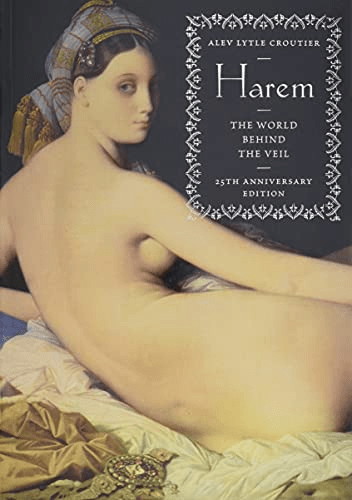
Continuing the 3-day series I started yesterday on Women’s History, this time we explore the harem, where women of the middle east were secluded from the rest of the house, from the Middle Ages through the early 20th Century. In these spaces, the only men the women met included only eunuchs, their husbands, and male blood relatives. The author tells the story of his grandmother who, at age 14, married a man her father’s age (40 YO), and went to live in his harem, with the women of his family. When he died 10 years later, she and her sister went to live in her brother-in-law’s harem. When war erupted, they escaped to a neighboring country, finally being released from the Harem in the early 20th Century.
And then what? I would wonder. She had been uneducated when she married her husband and had lived among female family members her whole life. So then, released from seclusion with limited means to earn a living, then what?
These stories from her family history inspired Croutier to learn more about these separate living quarters, in the middle east, where her family was from, in India, in China’s forbidden city. To look at the connections to polygamy and what people assume about these places. How the women spent their time in these places, the community and the oppression. The wives, the daughters, the slaves that were brought in, purchased at slave markets or found left behind or hiding when war had ravaged neighboring countries. The costumes they wore, the role of the baths, the food they ate and how it was prepared.
The book explores the roles that the women of the harem held, and the varying amount of power they held – and how these shifted when the sultan died. The author looks at how these manifested in the houses of the common people.
The most interesting section is where the author explores the Western obsession with the concept of the harem. From early explorers who were shocked – shocked! – to learn about the existence of harems; to European men who decided this sounds like a lovely idea, don robes, and dive in; to the Hollywood’s exploitation and obsession with the harem and polygamy.
This book is fascinating and well-researched, well worth reading.
 Change+Management