
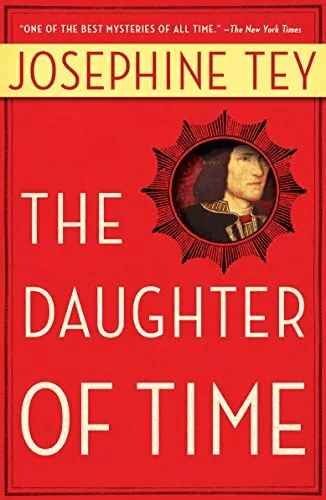
In the introduction to the Scribner paperback edition of this book, Robert Barnard points out that each one of Josephine Tey’s books is so different from each other. She uses the same detective (in most of them) but each one takes a different approach to framing the story. In contrast, you know that Miss Marple will stumble across a crime, often because she is somehow involved, a friend or neighbor becoming a suspect or a victim or a witness. Miss Silver, on the other hand, will get hired: she will interview the client in her peacock blue drawing room, wearing her bog-oak broach, and make a decision whether she trusts the person who is telling her their tale of woe. And Carr, of course, will give you an impossible murder in a “locked room.” But each of Tey’s novels has a different pace, a different slant, a different way of telling the story. Yes, they’re mysteries, but they are anything but formulaic. (Similar to Barnard’s own works.)
In this one, Inspector Grant has been injured, ignominiously falling through a floor whilst in pursuit of a fleeing suspect (how often do you hear of that happening to a golden age detective?). Trapped in-hospital with a broken leg, he is depressed, feeling useless without a case to work on and everyone too busy with their lives to sit and entertain him. Luckily the glamourous Marta Hallard drops by just long enough to diagnose the cause of his depression and then sends him a huge manila envelope of historical portrait prints. The novelty of looking at the different faces, trying to match the visages with the names, and reflect on their stories, manages to keep Grant from annoying the nurses for an entire afternoon.
And then one last portrait, which had fallen to the side, overlooked at first, catches his attention. The face speaks to him, he doesn’t recognize it, but he can tell there’s a story behind it. When he finally turns it over, he is surprised to find it labeled, Richard III. Richard III? He flips it back and looks more closely, reflecting on how he would never have associated the man in this portrait with the Richard III we mainly know from Shakespeare’s crook-backed self-proclaimed villain, who murders his nephews and seizes the throne, only to be humiliatingly defeated and killed on the field of battle in the end.
Grant’s curiosity is piqued. He sends out an SOS for history books, consuming children’s textbooks, canonical tomes of history, Sir Thomas More (the accepted expert on Richard III), novelistic biographies of Richard’s mother. But the facts aren’t adding up in his policeman’s mind – something seems to be missing. The canonical More, it turns out, was only five years old when Richard ascended the throne, and was raised in the home of man who had opposed Richard becoming king and was, in fact, involved in a plot to put another man on the throne. Not exactly the most reliable of historians.
Growing frustrated by his forced immobility, Grant is rescued again by Hallard, who sends him a young American man, the boyfriend of her co-star in her latest West End hit. The boy is the son of a rich furniture baron, who wants his wayward son to quit wasting time chasing musical comedy starlets and settle down to sell chesterfields. To justify his continued stay in London, he boy has been doing research at the British Museum.
Grant’s obsession about Richard III gives the young man something new to research.
Together the two of them take the rise and fall of Richard III apart and put it back together again in a way that makes sense as a case that Grant could send to court with confidence and win.
It gives the boy a purpose in life beyond haunting his girlfriend’s dressing room or selling end tables: he has determined to write a book.
“Unless you want to write it,” he offers Grant.
But Grant has solved his mystery and his leg has healed enough that he can finish his convalescence at home and eventually with family in Scotland (the prompt for Tey’s next book), and then return to his job which he loves. He doesn’t need to write a book about it.
But Tey did. I wondered if she herself had stumbled across the mystery of Richard III, found herself swept up in historical research, and exorcised it in the way that she knew best: through her the writing of this book.
It’s not unusual for mystery writers to get involved in real-life mysteries (and this is the second book where Tey does this). Often their imaginations are captured by headlines and stories overheard whilst they are waiting in line, or historical mysteries. Cornwell wrote about Jack the Ripper. P.D. James wrote about the Radcliffe Highway Murders. People often brought Arthur Conan Doyle mysteries to solve, which he did.
What I appreciate about Josephine Tey’s approach is that she leveraged her popular work as a mystery writer, couching Grant’s discovery of the historical facts about Richard III with the same deliberate unfolding that she unfurls the mystery of a young man killed in a queue or of an artist killed in rural Scotland or the sinister disappearance of a beautiful young man. Rather than trying to break into the closed world of the historians, who probably would not have appreciated a lay person – and a woman at that – infringing on their territory.
And, to be honest, more people have probably read her honestly fictional treatment of Richard III than they would a new historical treatment.
 Change+Management
Pingback: Winding Up the Week #420 – Book Jotter