
A few years ago, I was working on a project in Mexico. My colleagues and I went out to dinner with some of the clients and were seated at an outside table, just off the street. Although it was late at night – long after 10 pm – groups of children were wandering the streets, and requesting money from us and from other diners. These were not teenagers, these were children, in a very nice area. It was one of the things that surprised me about Mexico that probably shouldn’t have. And it’s a problem that a lot of countries have, and that some areas of the U.S. are having.
And it’s a problem that the U.S. has experienced before.
Back in the mid-1800s, New York had a problem with children: thousands of abandoned and orphaned children ran wild in the streets. Boys and girls of tender ages made money shining shoes, selling papers, and as sex workers, caring for each other when there was no one else to care for them. A sudden and dramatic increase in immigration after the War of 1812, coupled with the onset of the industrial revolution, caused the first real gulf between the 1% and the poor – sound familiar?
The problem was exacerbated by the prevalence of maternal deaths during childbirth and the rampant substance abuse that created homes that were less safe for children than the streets themselves. It was also very easy for children to become separated from their parents if, for example, the parents went ahead to begin earning a living and the children followed later; and, in one case, when a child went to a parade and got separated from their parents.
The predominant assumption about poverty, at the time, was that it was a sign that the poor person had done something wrong – had sinned or failed morally. So it make sense that the city’s first approach was to arrest the street children and sent them to adult prisons and workhouses, which just released them back onto the streets as adults without skills or communities besides the criminal gangs that they connected with while imprisoned. Clearly this solution wasn’t working.
In the 1840s, a young city missionary arrived in New York and, appalled by this approach to caring for children, rallied a bunch of bankers and launched the Children’s Aid Society with the mission of making sure as many children were cared for, educated, and provided with work skills.
A noble cause.
He started with a Newsboys’ Lodging House, where hard-working newsboys – the original gig-workers – could pay pennies a night to stay; and followed by a Girls Lodging House. These houses provided beds, meals, and a reading room, baths, haircuts (and de-lousing, if necessary), clothes, and shoes. The children were offered classes in reading, writing, and math, which enabled them to ladder up to better-paying jobs. And, most importantly, they had access to a network of wealthy adults that could provide access to employment, health care, and other opportunities. Although they were subject to some proselytizing, the approach was to treat the children as small adults, able to make independent decisions for themselves.
The next step was to try to place children in “good Christian homes” where they would be treated as a member of the family and influenced by the behavior of the family members. A challenge for the Children’s Aid Society (CAS), however, was that many Americans didn’t understand this as a model for caring for children. What they understood was the concept of indentured servants: where a child and an adult contracted – sometimes involuntarily on the child’s part – that the child would be in the adult’s custody until age 21; during which time the adult would teach the child a trade, feed them and provide them with shelter. The CAS’s version was closer to foster care: the child would be treated as one of the family; the CAS or the parents (if living) retained parental rights; and the child learned job skills, but not in exchange for food and board and being treated like a human being. It was a little confusing to adults who had grown up with an understanding of indentured servitude.
In its original form, children already in custody were placed with country homes, mainly in the Northeast and Pennsylvania but also across the country, especially as the railroads made it easier to reach further flung areas. Eventually the policy evolved into our modern foster care and adoption industry.
Finding homes for the children, at first, was challenging and expensive: the CAS placed advertisements and screened the people who responded, trying to match individual children with individual situations. Afraid that the cost-benefit analysis wasn’t scalable, they eventually turned to a new matching model: they’d advertise the date that they would show up in a community with a bunch of children, and then let the parents pick the children out of a lineup at the parish hall, for example.
Some of the children were volunteers, some rescued from prison or workhouses, some were spirited off the streets and found themselves participating without understanding what they were “volunteering” for. Some of the children adjusted well – for example, if they had escaped abusive homes or were too young to have “formed strong attachments” – but others were disoriented by being removed from the city streets that they at least understood.1
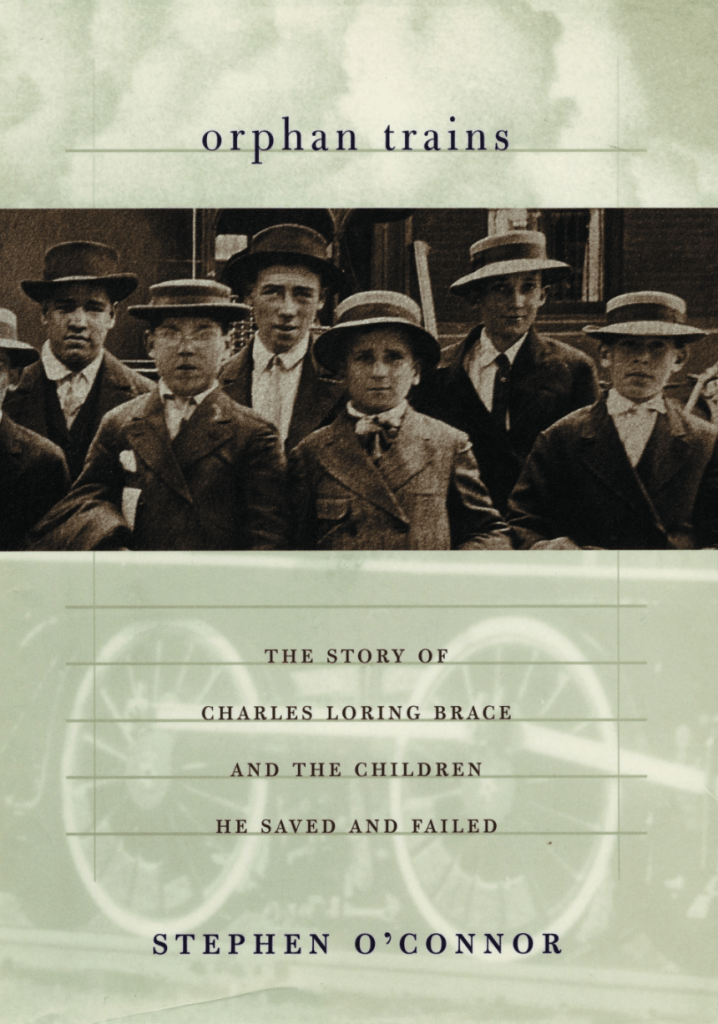
This book is a compelling history of the Children’s Aid Society and the effort to assist children who needed help in New York City. It weaves in individual children’s stories, success stories, yes, but also stories about children who were abused, lonely, and – in some cases – desperate; and children who didn’t want to leave the city and were taken away without their or their parent’s consent.2
For another perspective on this same topic, one that brings the stories to life, you could also read Karen Cushman’s Rodzina, about a 12-year old girl who finds herself on a cross-country train with other “orphans” looking for homes. It’s a beautifully written book that tells the story of this experience from a child’s point of view.
- I think about some work that my husband did a few years ago that helped underserved inner-city high-school students become attractive to and get recruited by colleges, most of them outside the city. They had good luck placing the kids in schools across the country, but it was often disorienting to these young people, many of whom had never been outside NYC, and were shocked by the food, the culture, the way people spoke. Unfortunately, this made some of them unsuccessful at college. I don’t know that this was at a higher rate than most 1st year college students, suffering homesickness, but it was disappointing to those of us who had worked so hard to give them an opportunity that they were unable to take advantage of. We needed to do better. ↩︎
- If you believe that the poor are moral failures, and you see yourself as saving a child from that immoral influence, you don’t much care about consent. ↩︎
 Change+Management