
There are very few universities where you could go to major in Retail. When I was working in retail, it always amazed me how the people who worked there had grown up in retail, but had not majored in Retail, because you couldn’t major in Retail. You could major in Marketing1, you could major in HR and/or get SHRM certified, you could get an MBA2. But most people who are leading retail start on the salesfloor and work their way into the corporate office, then move up, move to other organizations, get promoted, go back to school for a graduate degree, get promoted again.
And so there is very little professionalization of Retail. If, for example, you’re going to work in Medicine, there are degrees in Nursing, in Medicine, in Hospital Administration. There are standards and practices; if you go from one hospital to another, there is some similarity of how things are run.
Retail organizations, however, are started by entrepreneurs. They start small and grow. They pull in people who grow to specialize in operations, in merchandising, in planning & construction, in real estate, in retail financial planning, in workforce management. And everyone knows what they know, and that’s really all they know: the way they’ve always done it. If you want to sell a retailer, say, workforce management software, you’re going to have to overcome a strong sense of “how we do it around here” that will force you to customize within an inch of your life because the people buying the software only understand the way that they’ve always done things and that seems “right” to them. New ideas frighten them.
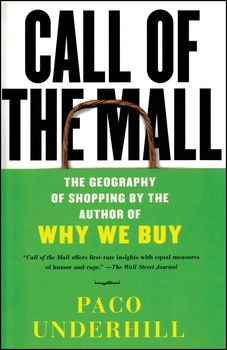
Which is why I always enjoyed reading Paco Underhill’s books. He understands retail from a scientific perspective, having started a firm that went out and actually watched people shop, and then wrote about what he learned. Did you know that, when people enter a store, they tend to move to the right? So, if you lay out your entrance accurately, you can leverage that behavior to guide them towards things that they will buy. I learned that from Underhill’s first book, Why We Buy.
This book talks about that thing we call the mall. The great mall life of the 1980s – with Tiffany and Boy Bands in the center court – is long gone, but malls are still with us, as often as people claim they are dying. Some of them have been renamed Lifestyle Centers; one I can think of in Houston (I think) contains a hotel, city hall, a school, and the police station; others are still malls, dreary horrible places with variations of the same stores over and over, polluted by the horrible smell of food court food. Or, if you are in Vegas, the empty and unaffordable luxury stores that connect casinos. Or, in airports now, there are malls – and if you are in the new JFK, these are luxury stores, too, interspersed with winebars and mini-me versions of Manhattan restaurants. I saw a lot of malls in my former life as a retailer and a consultant to retailers. I know my malls.
I was amazed, when I served the obligatory 2-3 days in Buenos Aires a few years ago on my way to Antarctica, to discover how much the porteños really dress up their malls. Wandering about, we found a charming older building – one huge building like a huge built up tent, really, with little shops selling fruit and vegetables from neighboring countries3, clothing, jewelry, baked goods, interspersed with tiny bookstores.4 But other malls in Buenos Aires, my goodness, marble floors and tall columns and painted ceilings with clouds and cherubs, and then the same mall stores. So different from the malls I saw while I was in Culiacan, Sinaloa in Mexico, which felt so much like low-rent malls in small towns, with tiny little hole-in-the-wall stores selling phones and phone cards – and yet, their parking lots are shaded by solar panels, killing two birds with one stone. Part of me envies Underhill’s team, traveling around the world learning about all the different ways that malls can be redefined.
This book starts with a history of malls, how they evolved, who builds them, and why they continue to hold on. Then he moves, as you would move, towards the mall, describing the location, the exterior design and the economics and politics that drive that design, the experience of the parking lot, the “community” feel that many malls aspire to and why, how people move through malls (the physical pace), the placement of stores – ever notice when you enter a mall you pass stupid little stores that you are very unlikely to shop in? – and escalators and restrooms and information desks, and then how people shop within the anchors5.
And finally, how we shop within the stores. In one story, he visits a department store with a retail executive who is also a woman. She points out how her favorite entrance to the mall (through this store) dumps her right into “two of the most highly trafficked areas of the store”: cosmetics and shoes, right across from each other, and remarks how it is unlikely that the (male) executives probably didn’t understand the connection because the connection was not in the products themselves, but in how women shop for those products:
“You’re standing in the shoe department, you’ve told the salesperson which styles you want to see in your size, and now you’re waiting for her to come back.6 You’re not going to keep looking at shoes because you’ve already done that – you did it before you sent the clerk away to get your size.[…] So now where do you look? You look across the aisle at the cosmetics counters. You see all these things you want to try. And especially if you don’t find anything in the shoe department. You can walk right across the aisle and find something else.”
It is thoughts like this that most retailers don’t recognize because they only know what they know. And it is insights like this that make me love reading Underhill. Now, does it need to be cosmetics? Depends on your customer demographics – I personally would wander over to jewelry but not to cosmetics because I hate being sprayed with perfume.
Underhill goes on to look at how stores in malls sell to young women vs older women and how the people who plan promotions misunderstand mall customer demographics and how to sell to them, and how men shop. Then he goes jeans shopping with a young woman at an upscale mall on Staten Island and reveals a little secret about one of the most popular chains selling denim today: they sell jeans for men and for women and they design their stores to be deliberately confusing, where you cannot tell which gender’s jeans you are looking at, because they want you to have to ask, because then a sales associate has a chance to engage with you and close the sale and, with an average price of $150/jean (copyright 2004), you need closing.7
The most effective store where I used to shop was a small and crowded shop, not conducive to browsing. But on my first visit, the owner engaged me and helped me put together several outfits and I left having spent much more than I meant to. The shop was near my bus stop and I dropped in maybe once a month. It was definitely shopping therapy, a way to feel better about myself when I had had a stressful day. Each time, the owner put together outfits for me and made it fun to get dressed. You rarely find service like this anymore. Eventually the owner left, her associate just didn’t have the same flair. The store closed, the building was torn down, and another building of cheaply built “luxury” rentals replaced it.
Perhaps rather than trying to confuse people into letting a sales associate help them, stores could provide more personal shopping services, like I received at this tiny shop.
Anyhow, if you want to understand malls, shoppers, or shopping, read yourself a little Underhill.
- Which I feel like a lot of people do, if they don’t want a STEM career, not that they really want to do Marketing. ↩︎
- Which is pretty useless in my mind unless you want to become a consultant or go into equity, or maybe become a CEO at a company that you didn’t start – and only because they won’t take you seriously unless you do. ↩︎
- Because, for some reason I didn’t understand, Argentina doesn’t grow fruits and vegetables, or perhaps I misunderstood? ↩︎
- Argentinians, having suffered from censorship for so long, love their bookstores and have many many many of them, from huge theatres repurposed as literary temples (a la Barnes & Noble, down to the colors and fixtures), to tiny little stands in tents on street corners, selling five or six titles, to true mall bookstores with bright fluorescent lights and piles of bestsellers and picture books. New York used to have a lot of bookstores; now most of those stores are gone. ↩︎
- The big department stores, usually, although I’ve known some malls where the anchor was a 1000 sqft bookstore, the last bastion of national retailers who had otherwise deserted the mall, which was now tenanted by mom and pops and empty storefronts. ↩︎
- Occurs to me that this may seem quaintly strange to women who have only shopped online or in help-yourself stores like DSW. ↩︎
 Change+Management