
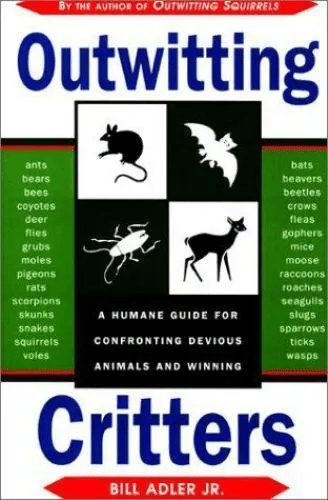
They don’t make books like this anymore.
Literally, this kind of book is no longer published because when people have trouble with pesky critters, they pick up their phone and ask the internet for a solution.
Back in the old days, when you needed expert advice in an area where you had little experience, and you didn’t want to pay for professional expertise (or disagreed with the solutions that those people generally defaulted to), you went to the bookstore and looked for a book like this, that would help you solve your problems.
Now, however, the web is filled with people who are eager to share their experiences, how they solved a problem very much like yours, and to tell you that you are doing everything wrong. On the other hand, even an expert can learn new tricks and the advantage of the web over a book is that the web could reflect updates, while a book is static.
I can’t even remember why or how I ended up with this book. I certainly don’t come into contact with the critters described in the book.1 Perhaps I was interested by the idea of outsmarting animals, as opposed to eradicating them. Having grown up in areas where we did come into contact (and sometimes conflict) with critters, and with friends and family likely to come into contact with them, maybe it seemed plausible that the information could come in handy.
That said, there is good reason why a book like this could be useful. With the overpopulation of the most invasive critter of all – humans – people are moving further and further into areas that had, in the past, been left to the animals. And, as animals begin to recover from the widespread extermination imposed upon them by a belief that man’s relationship with nature was a war, that man had to conquer nature by destroying flora and eradicating fauna, those animals are spreading into areas where they once traditionally roamed, and attracted by our groceries, garbage, and small pets.
For example, here are the author’s tips for “Cajoling Coyote”:
- Don’t let animals (or children) travel alone at night; confine animals in barns, sheds, or enclosed pens overnight.
- If you have to let pets out in the evening, walk them.
- Keep the brush around your house cut down close; keep the yard clean so it doesn’t provide cover for rabbits, mice, or squirrels, giving the coyote reason to hunt.
- Keep your garbage secure so it’s not an advertisement to feed at your house.
- Don’t feed coyote, that is, don’t feed your pets outside.2
Simple, practical, easy to take action on.
And yet many people wouldn’t take these actions. My mother’s dream home was in the woods, she loved that her house was surrounded by woods that came right up to the house. It’s what made it enjoyable for her; so she wasn’t going to cut back the brush to leave her house in a big empty spot. And that same brush was what made the house a magnet for the coyote that followed the deer downhill as the top of the mountain was clear-cut by logging, and the coyote ate our cats, which had been indoor/outdoor cats: outdoor during the day, indoor at night to keep them safe. Except that the coyote figured this out and often attacked during the day.
In every choice you make, you have to accept the consequences of that choice. There’s no point in getting mad about the consequences. If you shout fire in a movie theatre when there is no fire and then get trampled by panicking theatre-goers, you own the fact that you got trampled.
Anyway, it’s an interesting book. The chapter on deer reminds me a little of a similar section of a book called Shark Attacks, which details extensively the different methods that Australia experimented with to keep sharks off their beaches (with about as much success).
If you’re plagued by pests, you could do worse than reading this book. Or if you are interested in why these pesky creatures do what they do, this is an interested book to read.
- Living in NY apartments, the main critters that annoy me are insects, most of whom I or my neighbors inadvertently bring into the building, often in the packaging of or the objects themselves that we purchase. Case in point, the scale that I purchased that became the source of an infestation of cockroaches. I hate cockroaches. Another time, following a flood of biblical proportions in a pre-war building that I lived in, the building re-plastered and painted my apartment – after leaving it vacant for months while I camped out at my boyfriend’s apartment – and tiny black bugs about the size of the head of a pin, emerged from the walls in droves. I moved. Sometimes, when there is construction in the building, and although we live many floors above the ground, our cat catches a large mouse (or maybe rats?). Who knows how they get onto our floor. ↩︎
- He explains in greater detail that, even if you bring the pet’s food bowls inside at night, crumbs and scent may remain, attracting coyote. ↩︎
 Change+Management