
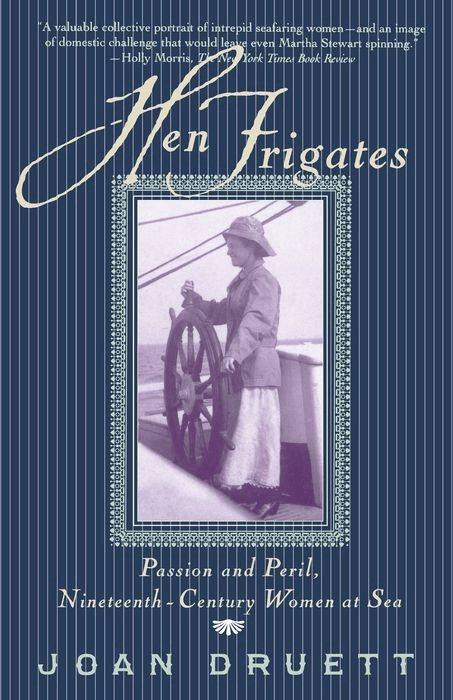
So far this year, I have written about books where women go into space and who traveled across the US in wagon trains, and now I am going to write about women on the great sailing ships.
Throughout modern European history, women have been discouraged from sailing. Sailing was a man’s business, rough work, elbow to elbow with dirty, smelly, men, sleeping in a hold awash with testosterone. Clearly no place for a woman.
And the men liked to say that women brought bad luck. At best, we spoiled their fun. At worst… well, Mary Celeste – or worse! Our job was to stay at home and pace the widow’s walk, waiting for our seafaring man to come home and hopefully not share the VD he picked up visiting other women in other ports.
Or at least that’s what we’ve been told.
When someone is invisible – a black person in a golden age mystery or a woman in the history of European (and countries of European colonization) seafaring, a working woman in the early 20th century – there is an assumption that they didn’t exist. Or existed in such small numbers that they could be called the exception and not the rule.
Druett became interested in the history of women seafarers when she stumbled across a gravestone for a whaler’s wife on Rarotonga in the Cook Islands. Startled, she grew curious and started tracing the woman’s history – and discovered an unrecognized trove of information about women who went to sea.
Druett writes about women who marry young and leave with their whaler captain husbands on “a trip around the horn”1 for their honeymoon. She draws from their diaries describing life aboard. With great good humor, the chapter titled, “Sex and the Seafaring Wife” starts with a description of seasickness. Women, because they were discouraged from the fresh air and exercise that their husbands and children received. Cooped up in a cabin – with no sight of horizon line, and privy to the fragrances from the bilge and – on whaling ships – the smell of the catch – they suffered alone. One captain, “considered [his wife’s] freedom from seasickness suspiciously unnatural” and dosed her with ipecac. What a guy!
In the chapter about rearing children on ships, she shares the tale of 15-year old Emma Armstrong who had been born at sea and raised at sea and, when Yellow Fever struck the ship at sea, killing her mother and most of the crew, and debilitating her father, sailed the ship (and $200k cargo) safely to port. The next chapter, “Small Ladies”, she shares another story of a teenaged girl who captained a ship – this one as the result of mutiny! Her father had been killed while they were at sea, the first mate was a drunk, and the second mate tried to make unwanted advances on her. Instead of fainting, she fought him off, rallied the crew, threw the alcohol overboard, and slept beside the wheel all the way to port, where she had the second mate arrested and thrown in jail.
Being at sea did not excuse women from their expected sphere – cooking, tending the sick, injured, caring for children – all while doing what the other sailors were doing – dealing with storms, pirates, and becoming becalmed. Sometimes there were good times, dropping anchor beside other ships with women aboard or exploring foreign ports, sometimes taking up residence there while their husbands continued on without them.
There is a tradition in science fiction of transposing to outer space some of the great sea adventure stories – Robert Lewis Stephenson, Daniel DeFoe – as well as stories from wagon trains and mountain men. What they don’t transpose is the stories of women who had these same adventures.
I guess outer space hasn’t been ready for us either.
- I haven’t been “around the horn” but I have crossed the Drake Passage, which is what makes going around the horn so scary – it’s the most turbulent waters in the seas. It was invigorating, but we were there when it was, well, not quite “Drake Lake” but, the crew told us, definitely not “Drake Shake.” Nevertheless, most of the passengers hunkered down in their rooms, close to their toilets, and the crew was kept busy cleaning up after them. That was on a large, modern ship – I can’t imagine crossing it on a sailboat. ↩︎
 Change+Management