
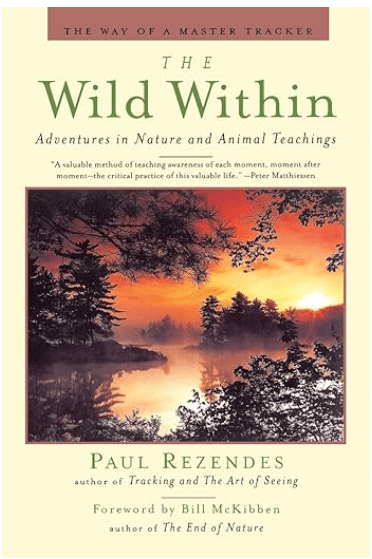
Several days ago, I wrote a post about a book by another tracker; it wasn’t a positive post. Partly because that was how I felt about that book but partly because of how I feel about this book, which I loved.1 Similar books because they are both about tracking; different books because this one is so beautifully written.2
Paul Rezendes is a ex-member of a drug-dealing motorcycle gang who was arrested, convicted, and sentenced to suspended jail time, which he didn’t end up serving. Instead he left his gang life, took up yoga, studied the works of Krishnamurti, started an ashram in Massachusetts, and then began applying mindfulness to tracking. He founded a school for mindful tracking and, years after finishing this book, left the school to focus on his practice as a wildlife photographer.
The book opens with a compelling story where the author is leading a group of tracking students (specifically, the class is studying how to track predators). They are tracking a bobcat. The pace of the chapter moves slowly and deliberately – like a man tracking a bobcat – describing what the tracker sees, hears, smells, how things connect together, and what the bobcat’s tracks tell them. They follow the tracks up a cliff and across a series of icy ledges. “Stay present,” Rezendes warns his students. There’s a steep drop off to one side and, if one of them fell, getting them out of there to medical care would be, at best, tricky. They make it safely past the tricky part of the trail and discover a spot where the bobcat stopped to rest.
“I’ve found more bobcat lays than I can remember, and almost every one had a scenic view,” Rezendes remarks in passing. And then goes on to describe the view. Page 11 and I think that was when I fell in love with this book. The idea that a wild animal can enjoy a scenic view is not an assumption that we readily make. Do animals enjoy views the way we do? What do they even see? Is it the panoramic view that the bobcat enjoys, or are they focused on other aspects of the view, the movement of birds that can indicate the presence of a deer they can scavenge? Or do they have access to scents beyond our poor noses there – or sounds beyond our hearing? Or something natural but so far out of our diminished perceptions that we just miss them entirely?
The class follows the trail further and come across the remains of a deer, two days old, and ravaged by scavengers from the bobcat to coyotes, weasels, and chickadees. The class is disturbed but Rezendes is philosophical: the deer came from the forest, consuming the trees of the forest, the nuts, shrubs, herbs and fungi, and now that it is dead, its remains are returning to the forest through the animals that are consuming it. He also talks about how the bobcat was drawn to the deer. “Whatever happens to the bobcat at a given moment changes everything else for the rest of the bobcat’s life. The vast matrix of timing that affected the movement of the deer had affected the movement of the bobcat, too… It becomes clear that no movement on this planet is separate from any other movement.” Adding further down the page, “Who we are now is all that has happened before us, happening as us, in the now. Who we are moves us into the next moment and the next.”
I find myself tempted to continue tacking on quote after quote from the book, it is so beautifully written and so deep, connecting philosophy, nature, mindfulness, tracking, and the poetry of beautiful language in a way that is entrancing. His work reminds me of Diane Ackerman, Pema Chodron, and the writers of Outdoor magazine in the way that they describe the awe that comes from viewing the vastness of nature.
I remember, after I read this book in 1998, researching his tracking school and trying to persuade myself that I could do this, that I would enjoy it. I might enjoy it. On the other hand, I knew myself too well. I was not in great shape. I hadn’t hiked in years. I owned no gear, would not have had the right shoes or the right clothes or the right backpack and – since there is no bad weather, only bad gear – would have been miserable. Although I later got into much better shape – easily doing an hour of yoga + an urban walk of 10+ miles in a day – when I signed up for a walking tour in Quebec and then a forest bathing class at Kripalu, I proved my earlier instincts accurate. While I struggled to keep up in Quebec, I loved the hikes, immersing myself in the wild autumn mushrooms, the bright fall leaves, and the beautifully still lake that we visited on the day that another hiker fell and suffered such injuries that they had carry her out of the woods and take an ambulance to the hospital, where she spent the night, the guides who had stayed with her returning back to the B&B where we were staying around 4 a.m. As much of a city slicker that I was, I was present in the woods through caution and self-defense, in a way that the other hiker was not. I was aware that I was at risk, and took care to place my feet carefully and use the pack and poles that more experienced hikers had provided me, while she dangled a pole carelessly in one hand and her bag from the other, looking back over her shoulder to laugh at something someone had said to her, while skipping from stone to stone across a small stream.
I am not going to continue writing about this book now. I’m going to end this post and go back to reading the book. If you haven’t read it, you can still easily find it. It’s not available on e- but you really need to read it on paper anyway.
It’s too beautiful to read on e.
- Like how my current cat compares poorly to the best cat in the world, who almost never scratched me, who had an amazing sense of humor, loved meeting people on the subway and loved loved loved gong to the vet, and never yelled at me or threatened the catsitter like this one does. I have to keep reminding myself how hard it must be to be a cat living with someone who once lived with the best cat in the world. ↩︎
- My sister was complaining about the audio book of a mystery she’s listening to now (because she’s a mom with a full-time job she only really has time to listen to books instead of sitting and reading – given, she lives in a small town where no place is literally more than 10 minutes away from any place else, so it must take her forever to finish a book). She liked the idea behind this book, the plot, the characters, and her complaint is that it’s so poorly written. Where are the editors today? She asked. Why aren’t editors doing their jobs? I didn’t ask what mystery she was listening to because then she started a rant about AI and I zoned out for a few minutes. ↩︎
 Change+Management