
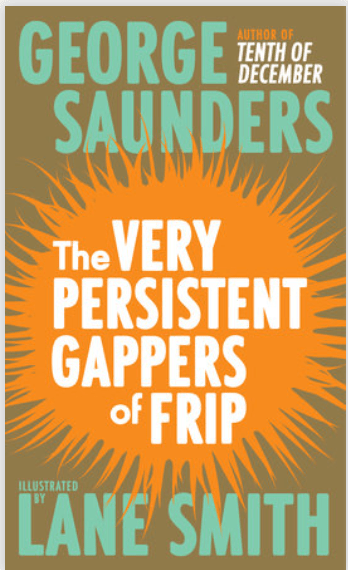
Illustrated by Lane Smith1
I feel it is incumbent upon me to admit that this is the only George Saunders book that I’ve actually read.2 I do own another book of his but I haven’t actually read it. It’s here somewhere but, well, it’s hardcover. Hardcovers are hard because a) not portable, so can’t read them on a train or plane; b) too heavy to read in bed, which is when I mostly read p-books.
Anyway, I read this slim volume during the holiday season and gave copies to at least three other people as gifts. The book is copyright 2000, and you know what happened in 2000. The moral of this story is just as relevant today as it was then.
The book tells the tale of three families who live near the sea. Once the families supported themselves by fishing but one family, several generations ago, switched from fishing to owning goats. And the families have persisted in owning goats despite a plague of gappers, creatures from the sea who are obsessed with goats. The gappers come out of the sea each night and attach themselves to the goats in such numbers that the goats fall down to the ground and cease eating and grow skinny3 and anxious, and stop giving milk. The children of the three families are responsible for brushing the gappers off the goats every day, gathering the gappers up in bags, and emptying the bags off the cliff into the sea. This exhausts the children so that they are too tired to play or sing or do anything other than sleep.
The child who lives in the house closest to the sea tells her father that they should move away but her father is stuck in the past and just keeps saying how things have always been this way and will always be this way.4
The gappers, however, do not live in the past, refusing to change. In fact, one of them develops a brain larger than the rest and persuades his fellow gappers that it will require less effort for them to concentrate on the goats closest to the sea, and ignore the goats of the houses furthest away from the sea. And the next day, the girl in the house closest to the sea has to work three times harder than she had before, and the children in the other two houses get to sleep in and play and sing.
The little girl asks the people in the next door house if they would help, but the mother takes a holier than thou attitude. Clearly, if they are not plagued with gappers as she is, it is because she is not as talented and special as they are. And then the lady of the house hires some men to carry her house to the far end of her property, so that they won’t be at risk of catching the little girl’s bad luck.
Then the little girl gives her goats away to people who live far inland, away from the gappers, and takes up fishing instead. The other children tease her for fishing. The family whose ancestor switched everyone from fishing to goat-herding feels threatened by the change and complains.
And then the gappers, who aren’t stupid, move to the next closest goats available, those of the neighbors who moved their house. Now the neighbors in the furthest house take on the holier than thou attitude, saying that that they don’t have to worry because they are not the kind of people who get gappers. But then the neighbors in the middle house move their house to a vacant lot further inland. And the gappers switch to the third neighbors’ home.
The third neighbors move their home beyond the second neighbors home; and then the second neighbors move their home further still, and they keep this up until both houses are in the swamp and everyone, including the goats, has to sit on the rooves of the houses.
And the little girl saves them all. By being practical, and kind, and willing to change, and not blaming people for circumstances outside their control.
I feel like there’s an empathy gap here now. Americans are all in danger of becoming like the neighbors in this book. Here’s an example: the last time someone you knew left the organization where you worked together, how did you respond? Did you drop them a nice note? Or respond when they reached out to you? When I left a company where I had worked since college, I could count the number of people there that reached out to me or responded when I tried to keep up the positive relationships we had formed over the many years we had spent together, on one hand. It was as if I were the little girl who lived closest to the shore and leaving had drawn the gappers to me. Since I had only ever worked for that company, I didn’t have any personal experience of what it felt like to leave someplace you had worked forever – and this experience made me realize how unsympathetic I had been in the past, how easy it had been to say “I am so busy, I’ll call them back when I have time” – and then never have time. Now I make it a point, when I hear that people I know are leaving organizations, to reach out, to connect, to offer support, no matter how busy I feel. It’s a simple thing to do. And, with the number of white collar workers being forced out of their jobs right now, empathy is the least thing you can offer.
This book is beautifully told and beautifully illustrated. It’s easy and fast to read, and still wildly available.
 Change+Management