
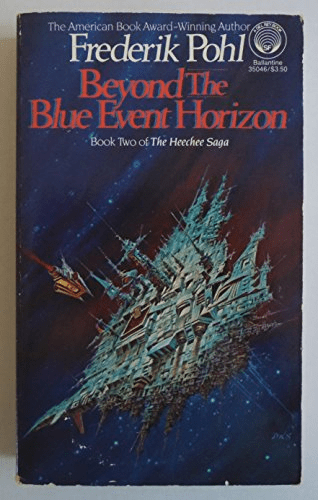
So yesterday I wrote about and then re-read Gateway, which is book 1 of the series that this is book 2 of: The Heechee Saga. And then, because that was so good, I started reading this one – and didn’t put it down until I finished reading it at noon today. Unfortunately, although I now want to read book 3, I have to work tomorrow, so it’s unlikely that I will write about it tomorrow because it will take me several days to finish it.
Although this book takes place in the same universe, in roughly the same time period, and shares some of the same characters, it’s a very different book. Book 1, as you may recall, focused on Robinette Broadhead, his adventures taking out – and avoiding taking out – the alien Heechee ships that humans had recently discovered and were still trying to figure out how to navigate. Book 1 is about the dangers of exploration and the nature of fear: would Robin and his girlfriend have the courage to go out on a ship without knowing where it would take them, when it would come back, and what dangerous things they might find when they get there. Having the courage to set forth could mean endless riches – or a long, death that lingers on forever. And, for Robin, the fear of facing his guilt when he returns from a trip and [spoilers] that his girlfriend does not.
In this book, Robin – now more psychologically functional and physically rejuvenated by the purchase and installation of body parts from people who desperately need funds – has married a beautiful and intriguing woman who is a machine learning1 genius. He is unbelievably wealthy, splitting his time between an estate on the Hudson River and a home in Hawaii. He owns food mines in Wyoming, enormous fish farms, and investments in a number of capital investments. Robin’s investments are not as healthy as they have been, due to a mysterious phenomenon that they call the 130-day fever – which causes people to experience hallucinations so violent that they lose complete control of their bodies and vehicles and other dangerous machinery for about 8 hours.
But Robin still has enough money to sponsor a journey to the Food Factory, a Heechee ship that turns comets in the Oort cloud into food. It’s not tasty food but, with the Earth experiencing a shortage of food for all but the 1%, it’s a desperate need. No one has been to this ship before, and Robin has invested in a non-Heechee ship that is carrying a husband and wife, her teenaged sister, and her elderly father, with the mission of attaching huge engines to the Food Farm and tow it back to Earth. When the book opens, this family has been traveling together for years, their only contact with others a very slow relay back to Earth, someone sends them a message, it arrives days later, and they then send a reply which arrives, again, days later. The closer they get to the Oort cloud, the longer the relay takes.
The family is surprised, upon arrival at the Food Factory, to discover a teenaged boy there, living on his own, who offers to show them wonders beyond the food, including human memories that have been recorded in a way that makes them interactive, faster-than-light communications, and what the boy calls, “the dream couch.” The family is even more surprised to discover that the Food Factory is not the boy’s home – he lives a couple of months away on yet another Heechee station and he regularly travels between the two stations in a Heechee ship. And the things he tells the family about that station sound even more wondrous – including what he calls “the old ones” who are, perhaps, the Heechee themselves.
The book switches perspectives between the boy, the family’s adventures, and Robin’s challenges. Robin’s wife is injured – killed, really, and brought back to life by the miracle of “full medical” – during an airport bus crash during a 130-day fever; the widower of the woman who originally discovered the Food Factory has filed an injunction against Robin’s exploitation of it because he claims that her agreement with The Gateway Corporation entitles her to a full share of any profits; and Robin’s food mines on fire (again, a result of the 130-day fever). Later in the book, additional perspectives are introduced, but I won’t give those away. I will say that the title – which has been overused for movies having nothing to do with these books – doesn’t really apply until the last chapters.
Yesterday, I discussed the accurate predictions that Pohl made in Gateway and I feel I can address the predictions in this book that are different from those. First, the use of AI is highly accurate of where we are going with this thing. The food shortages due to climate change and depletion of topsoil was also accurate. And the recording of people’s personalities so that you can interact with them after death is also something happening now. The ending reminded me of David Brin’s uplift wars, with the idea that the Heechee had been tinkering with the early development of potentially sentient species to help them develop.
Despite all the hard science fiction, the book is compelling to read and highly plausible. The characters are differentiated enough that you don’t get lost. Although Book 1 was entirely from Robin’s perspective, this book switches perspectives easily and, again, you don’t get lost. And the interactions with the Old Ones are totally plausible.
I think I’m going to text my niece and tell her she should read these. She read Stranger in a Strange Land this spring and liked it, and I’m trying to help her find other science fiction books she’ll enjoy.
- That’s what they used to call AI. ↩︎
 Change+Management