
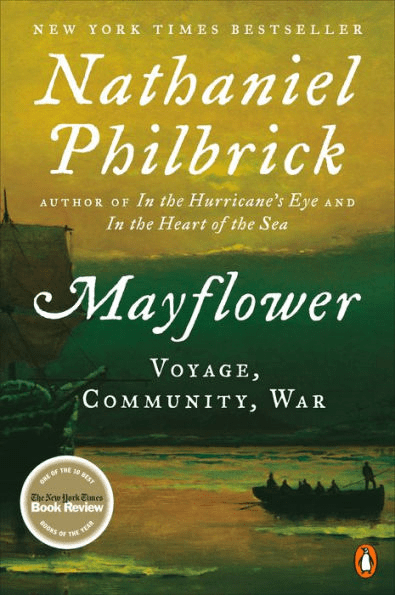
This is a book that my husband bought. HIs taste in history books runs towards the Constitutional Congress and this topic was adjacent to that, perhaps. The Constitutional Congress… meh, not really my subject. And I put off reading this book although he insisted for ever before finally giving up. I don’t remember what made me finally pick it up and read it – and I loved it.
Because I’m a sucker for a great story about a people yearning for freedom, for a new chance in life, for a better place to live, a place where they could make decisions for themselves without the government banning their way of life.1
The pilgrims on the Mayflower were people like this. These weren’t adventurers or rich people of power or the people who worked for them, soldiers, craftsman, who set out to carve a world out of a wilderness – and then returned home or sent home for women, and children. The pilgrims were comprised of families – fathers, mothers, children – traveling together in search for a place, a community, where they could be free.
They started in England, as Separatists, people who believed in a form of worship where Christians could speak directly to and with their god, in church, not relying purely on priests to act as intermediaries for them. This was in direct conflict with the Church of England at the time, which was a hierarchical form of Christianity, with priests reporting to bishops and up the line, to the King, who was at the top. The Church of England was a new religion, less than 100 years old perhaps, and fighting to maintain superiority against not only their major rival, Catholicism, but various flavors of Protestantism. The Separatists raced against time to escape punishment from the King of England. They had to sneak out of England for, according to the king, their religion made them ineligible to settle the new world.
The voyage they set out on was not a given. Jamestown – the official first colony of the English crown – a typical settlement by a rich, powerful man and his servants, soldiers, and craftsmen, searching for gold rather than looking for a home, foundered. Resupplied with additional people, they foundered again.
And so they snuck out and moved to Holland. Philbrick makes the point that the qualities that made them strong – their faith, their community spirit – are the same qualities that carried them through times of trouble, of which they had many before leaving Europe. And that the qualities that they overused – their focus on their inner lives, for example – made them vulnerable to people who didn’t share their faith.
Including the captain they had hired, had paid, to carry them across the water. The captain also added non-separatists to their company, diluting the purity of the community that they were striving to build. His work turned into a fiasco that launched them for the new world, not in the spring or early summer, giving them time to build homes and gather food before the winter set in.
Well, you know the story.
Or think that you do.
Somewhere I have a photo of me, aged 5 maybe, dressed in a handmade dress that reached the floor in unrelenting grey, with a little white apron – perhaps cut from white paper – and a little white hat, perhaps also cut from paper. I am squinting into the sun on our house’s back deck, with a big smile and my arm around my best friend at the time, also dressed like that, and we are both holding daffodils. We were getting ready to march in a parade down the main street of the little town where we living just outside of, with our classmates, in honor of some holiday (it could not have been Thanksgiving for the sun was shining, so perhaps the spring).
For a long time, this and the rock is what I knew about Pilgrims.
Later I heard another side of the story, about the displacement and eradication of the native peoples.
And I was happy to read this book that treated both sides of that story.
If you are an aficionado of the Pilgrim story, this is a book for you.
If you, like me, like stories about people traveling across vast distances to settle in a world strange and different, populated with people that you don’t understand, facing hardship and starvation, storms and illness, this is a book you will enjoy.
If you are trying to understand, who were these people, and how did things go so terribly wrong, this book will shed light on those questions.
It’s very easy to read, engaging, fast-paced, and full of little stories about the pilgrims, those they met when they came to these shores who helped them and later fought against and with them, and the people who followed them in later ships and in later generations.
Give it a shot.
- Sorry, watching political speeches and I think it’s creeping in, perhaps. ↩︎
 Change+Management