
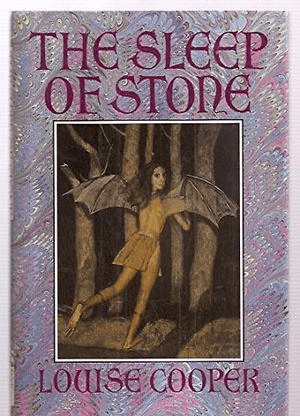
I am going to go out on a limb here and speculate that, not only haven’t you read this book, you are very unlikely to ever read this book. If you have had a burning urge to do so, I suggest that you stop reading now for this is a Spoiler Alert.
I have no idea where I found this book – I probably bought it. I know why I acquired it – it bears a slight resemblance to a short-story that I wrote before this book was published, in which a “monster” from the sea falls in love with a prince, changes herself into things he loves in an effort to win his affection, and sacrifices herself for his love in the end.
In this book, a creature – an ugly creature with skin too pale, hair dark and wild, owls’ eyes, face like a skull, teeth like needles and, oh yes, wings, gossamer wings that unfurl from between her shoulder-blades – from the mountains falls in love with a handsome prince. She follows him, turning himself into animals and birds in an effort to enjoy his affection. In her mind, he is as much in love with her as she is with him. But only in her mind.
She knows he is engaged to be married, to a princess from a neighboring kingdom, but persuades herself that he is trapped in his engagement, that he really loves her, not his fiancée. And then she spies the fiancée on her journey through the mountains – her mountains – to the prince’s kingdom by the sea. The beautiful – and seemingly empty-headed, in my mind – girl is everything that the monster is not: blonde, blue-eyed, graceful of form, warm, and beloved by all who know her.
The monster is not impressed. But how can she rescue her prince? She creeps down from the mountains and moves from shape to shape, from shadow to shadow into the castle and up the spiral staircase to her rival’s bedroom. Taking cover in the window-well behind the drapes, she waits until the girl falls asleep, then slithers across the floor to study her face, her form, trying them on for size. But the girl awakens and her screams bring succor. By the time her parents and the prince and his father arrive, the monster has vanished into the shadows again. The princess is given a sleeping potion and the prince’s old nurse is called to watch over her sleep.
When the princess returns to sleep and the old nurse herself dozes off, the monster creeps from her hiding place and returns to her studies. Alas, the old woman awakes and begins chanting folk spells at the threat against her charge. Maddened by the pain, the monster attacks physically and tosses the old lady out the window.
Oops.
She tries to justify the murder in her head and in her heart but there is no fighting it – she is a murderer now and she feels guilt. And yet, all is fair in love and war… isn’t it? Persuaded by the purity of her love, the nobility of her mission to rescue her beloved prince from forced marriage, she persists.
But the truth is that the prince loves his fiancée. He has known her all his life, their parents could see the spark between them from an early age, and he loves her more and more each day he is with her. The monster is wrong.
He does not love his stalker.
As the days count down to the royal marriage, the monster continues spying on the bride and practices her features, her graceful walk, her sweet voice.1 The girl, sensing the malice that is stalking her and catching glimpses of the monster in the bushes or shadows, grows more and more hysterical, until her mother finally confines her to her room, potioned to sleep.
Which makes monster’s job all that easier.
Finally, the night before the wedding, all the castle is asleep – except perhaps the fathers and the prince who sit up late, drinking – and the monster’s last chance arrives. She emerges from the shadows, looks down at the drugged girl, and tries to work up the courage to toss her out the open window to the deep seas crashing against the rocks below. But she can’t bring herself to do it; and she can’t keep the girl prisoner, forced to tend her for the rest of their lives.
Then she remembers a spell that will turn the girl to stone, alive but entombed in rock, safe. She flies to her mountain cave with the girl, lays her sleeping form gently on her own bed, and speaks the words of enchantment. Then, safe in her work, she returns to the castle, and assumes the girl’s form.
When morning comes, she allows the ladies in waiting to dress her in the wedding dress, and style her hair. When her mother asks her how she is feeling, she answers in the girl’s words and voice, although something catches the mother’s attention – not much, not enough to make her speak up. Then.
And it works, she manages to make it into the grand hall, to stand in front of the priest, beside the groom, with no one guessing that she isn’t the girl he is supposed to marry. She speaks the words that binds her to him. But when it comes time for him to speak the words, he hesitates – and then repudiates her: she is not the girl he is affianced to. She is a fake.
They manage to avoid a war when the girl’s mother seconds his concerns and reveals the sham by asking her a simple question: when she was twelve, her little sister died. What was the sister’s name?
And the monster cannot answer.
Her disguise slipping, as the courtiers back away, she proclaims her love: she is here to save him from the arranged marriage. She knows he loves her – he told her so in all the animal and bird forms in which she had befriended him over the last three years. But no, he tells her, she is mistaken. He didn’t love her the way that he loves the girl he meant to wed. He wants his bride back and demands that the monster return her.
The monster loses her temper then and everyone flees as she destroys the great hall, smashing glass and hurling furniture about, driving guards from the room, and finally setting the whole place ablaze with flame. The king with his most loyal henchmen manage to drive her into another tower and imprison her in a stone room with no windows.
Exhausting the known methods of safely making her talk, the prince finally rides for the greatest sorcerer, a hermit whom no one has seen for years. Begging, he vomits out the story, and – when the man hears the monster’s description – agrees to come to his aid. Together they rush to the castle and evict the witches who have been chanting against the monster. The sorcerer’s spells flies and, against her will, she is brought to stand before him, to share her name.
And then, it turns out, she is not the last of her kind as she thought. The sorcerer is of her kind, a half-breed, whose mother loved his father as the monster loves the prince – except that his father loved his mother back. Broken open by his sympathy, she explains her love, what she has done. She admits her mistake: the prince does not love her. She is willing to give his beloved back to him.
And the sorcerer reveals, with compassion, that the only way to reverse the spell of stone is for the monster to take her place in the rock. The prince, who has snuck into the room and overheard, asks the monster to give her life to reunite him with his love.
“Without her, my life will mean nothing.”2
Nothing without his love3, she agrees to commit suicide. She takes the prince and the sorcerer to her cave in the mountains where he is so repulsed by the sight of his beloved turned to stone that he retches.4 The monster speaks the words, the princess gradually returns to flesh, and falls into the prince’s arms.5 It takes slightly longer for the monster – her heart breaking as she watches the touching reunion of the lovers – to turn to stone. Long enough for the prince to thank her, place his mother’s locket about her neck, and give her a pitying kiss on the cheek.
At which point, she dies, her final whisper following them as they leave the cave, “I shall always love you.”6
Hundreds of years later, the sorcerer returns to her cave and, with nothing more to live for, wraps his arms around her stone form and speaks the words that turn himself to stone with her.
I think another reason that I bought this book is the author’s name – I suspect I thought it was a book by Susan Cooper (not Louise Cooper), author of the series, the Dark is Rising, which is awesome, and which this book is not. In fact, I was a little surprised to find it on my shelf, and even more surprised that, as I read it, I had no memory of having read it before.
It is that forgettable.7
And, in any case, I like my story better. It has the same theme, of a girl so much in love with an unattainable man that she is not good enough for, that she is willing to change who she was to become who she thought he wanted her to be, and dies as a result. My story ended with her blood on his knife and her heart in his hand. And far off over the land, the hush hush, sob sob, of the sea of the sea of the sea.
 Change+Management