
This week, my literary grazing has been focused on the middle ages, so you know I had to get to the Knights Templar at some point.
Here is my summary of the known facts about the Knights Templar:
- The Knights Templar were a company of European knights who went to the Middle East as part of the crusades. (In the middle ages.)
- When they started, the company was composed of maybe seven men; but they grew to be a very large company indeed with over 1,000 locations throughout Europe.1
- They were officially endorsed by the Catholic church.
- Originally their stated purpose was to escort pilgrims to holy sites in the Middle East.2 Part of the safety and security serves that they came to offer pilgrims was financial: for a small fee, you could deposit your wealth with representatives of the order in Europe and, when you arrived in Jerusalem, order representatives located right there on the Temple Mount3 would pay it out to you. That way, you wouldn’t get robbed along the way. This was a new concept and the origin of the concept of modern banking.4
- Eventually, this banking extended to loaning money to people who weren’t going to the Middle East but could just use a loan.5 In particular, the King of France was rumored to have borrowed heavily from the Templars who, by this time, were a very large and very wealthy organization, indeed.
- The Templars were accused of heresy by the Catholic church6 and the King of France led the charge to arrest the Templar leaders and round up (or kill, if you twisted his arm) the rest of the knights. There was a coordinated effort to simultaneously raid all of the Templars locations throughout France (and the King tried to enlist other countries in joining him on this endeavor), similar to a huge FBI sting.
- Although the dissolution of the Templars basically canceled the King of France’s debts (to them), the rest of the moneys that the Templars were rumored to control were never know to be found.7
- The leaders of the Templars and any other members they could round up were convicted of heresy and put to death.
- There are a lot of rumors and theories about the Knights Templar.
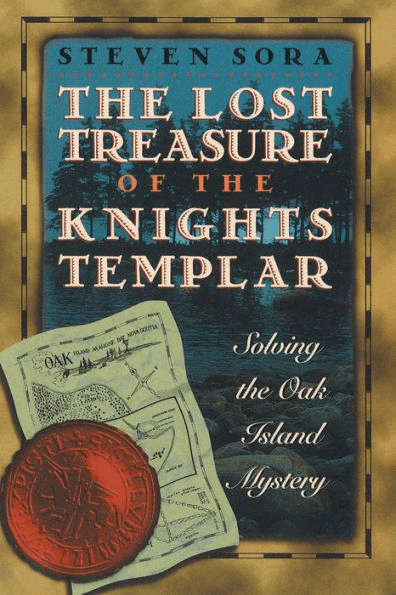
This way I phrased this last fact is an understatement. Case in point, this book.
Now this book has a cherished spot in my collection. The author tells a great story. He makes the Templars come alive. But he’s obsessed with the Oak Island Mystery.
If you’re not familiar with the Oak Island Mystery, here it is in a nutshell: Oak Island is an island (duh) in Nova Scotia. In the 19th Century, someone started digging a hole there. Diggers claim there are some mysterious things about the hole: strange markings, layers of man-made structure – logs, coconut fiber, charcoal – and (perhaps) booby traps, tunnels that extend out to the coast and flood with the tides. The pit collapsed. Workers died. Why would someone go to such trouble? Rumors spread that treasure – pirate treasure – was buried there. Or maybe it wasn’t pirate treasure: maybe it was Shakespearean manuscripts.
Or maybe it was the missing treasure of the Templars…8
Sora is a great storyteller: he weaves together the stories of the Knights Templar and Oak Island well. It’s a fun ride. I’m not persuaded, but I’ve read this book several times and always have a fun time reading about it. His theory is that the Templars who managed to escape the King of France’s raids took refuge (with their treasure) in Scotland, at the home of the clan Sinclair, one of whom was a ship’s captain who sailed to Nova Scotia.9 He secured the treasure there, well out of reach of the authorities who were still carrying out the papal fatwa.
But… but the theory is not what makes this book so enjoyable – what makes it worth reading are all the diversions and divagations that Sora takes to get there. We hear about Captain Kidd, the First Nation peoples living in Nova Scotia, why Shakespeare’s original manuscripts might need to be hidden in a pit in North America, Niccolo Zeno who had a map to the new world long before Columbus, Henry Sinclair’s voyages, the influence of the Knights Templar on the battle for Scottish Independence featuring Robert the Bruce, the Arc of the Covenant, Rennes le Chateau10, and too many other rabbit holes to list here. And yet he weaves them together in a way that makes sense11 and is fun to read.
If you want a fun read, give it a shot. But remember: don’t get carried away and start believing this stuff. You’ve got to keep your feet on the ground.
- They had to leave the Middle East because the Crusades were a failure. Wars in the Middle East are a bad idea – a lesson Europeans and European descendants never seem to figure out. ↩︎
- An interesting note: the people they were protecting pilgrims from weren’t the Muslims living in the Middle East; they were other Europeans who saw pilgrims as easy pickings. Case in point: the Children’s Crusade, a pilgrimage of children – young children – who banded together to cross Europe and set sail for the Holy Land. Most of these children were killed or exploited before they left Europe; the rest were sold into slavery by the Europeans hired to ferry them across the Mediterranean. You want to lose your faith in humanity, read about the Crusades. ↩︎
- Location, location, location! ↩︎
- I need your help. I saw a book many years ago and made the mistake of not buying it. In hardcover, it had a red cover with a white cross on it and it was about how the templars founded Switzerland as we know it today – crazy, right? I wish I had bought the book when I saw it but it was a $27.95 hardcover and I couldn’t bring myself to pay $27.95 for a “fun read” and I’ve been looking for it ever since. If you remember what this book’s title is, please post in the Comments. ↩︎
- Loans with interest were against religious law in those days (usury) but everybody did them. Often they ended badly for the people who were loaning the money. ↩︎
- At the behest of the King of France because he was shocked, shocked to find heretics in France. Funny how important religion becomes to men of power when it serves their ends. By the way, this is during that short period when the Pope was based in Avignon, France. Funny coincidence, right? ↩︎
- To the King’s regret. ↩︎
- Hundreds of years, countless books, and several seasons of TV later, they still haven’t found any kind of treasure in the pit. But they keep trying! ↩︎
- In the 1300’s. Long before 1492. ↩︎
- More on this with tomorrow’s book! ↩︎
- Literary sense, not factual sense. ↩︎
 Change+Management