
Nope.
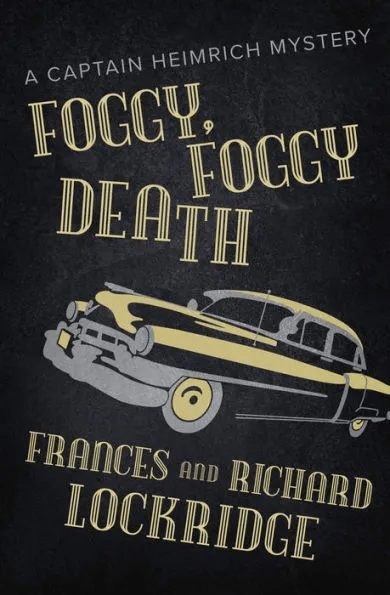
It’s always a shame when you really like an author and then discover a book (or books) that just don’t live up to what you expect of them. The later books in this series are so good – and these earlier books just show how far the Lockridges later developed as authors.
This early book takes place in a mansion on a ridge right up on the Connecticut – New York border. The mansion was built by an imperious millionaire1 who names it High Ridge. Never mind that there is an established town nearby with the same name and that it will confuse guests, who will end up in the wrong place. As long as it is no inconvenience to the millionaire, she doesn’t care.
It is winter and the house – the whole surrounding area – is encased in an impenetrable fog. Fog so thick that you can barely see the taillights of the car in front of you. The millionaire’s son, his wife, and his two young children are visiting, along with the children’s nursemaid and a friend of the wife’s. A male friend.2 He’s a conductor – of a band3, I assume, not an orchestra. He’s obviously been having a little thing on the side with the wife – you can tell, just by how he enters the room and the reactions of the family members.
Also present is Karen. Karen’s mother and the millionaire were friends since before Karen was born. After Karen’s mother died, Karen accepted a role as the millionaire’s secretary. Karen also had a crush on the millionaire’s son, Scott. But Scott, when he was stationed abroad during WWII, met and married his wife, Marta. He married her and they started a family. And while he was away, she spent time with a lot of male friends.4 Poor Scott, Karen thinks repeatedly, as she deals with Marta’s nastiness, and gives a little of her own back.
When the book starts, everyone is just standing around staring out at the fog, and sniping at each other. Marta is supposed to drop Karen at the train station and then go see some people near the train station about a pure-bred puppy. The conductor makes his goodbyes and disappears into the fog. Marta goes out to the kennels behind the garage about 50 feet from the house – just far enough that you can’t see the garage through the fog – to check on something about the dogs. The children make an appearance then go back upstairs with their minder. A man rings the doorbell: his car has broken down, may he use their phone to call a garage to send a repairman? The agree, give him a drink, he says goodbye and disappears into the fog. Karen goes upstairs to pack for her weekend in NYC.
But when Karen comes back downstairs, Marta still isn’t back from the garage. Then the nursemaid runs in – the little boy has disappeared: she thought he had left the room to go to the bathroom but he didn’t come back and she’s looked everywhere and he’s just gone. The household goes into a panic, running out of the house willy-nilly, the sounds of their voices calling the boy’s name echoing through the fog, directionless, as sounds in fog often are, seeming to come from one side of you then the other. Karen runs out into the fog, thinks she hears Scott’s voice calling from nearby, changes to run in that direction, gets disoriented, stumbles into a nearby wetland, and discovers Marta, drowned. Still disoriented, she finds a different path back to the house, one that intersects the driveway, and is discovered by the man with the broken down car. He hasn’t left. After a delay, they return to the house together, which is lit up and surrounded now by cop cars. Karen assumes that Scott found Marta first, returned to the house and called the police. She’s wrong.
Actually, the cops that are there are returning one of the millionaire’s cars, which – unbeknownst to the family – had been stolen. The cops had caught the car thief, red-handed with the car and the millionaire’s jewelry box, chock full of jewels. Another round of cops shows up then, in response to a call about the missing boy – this is close enough in time to the Lindbergh kidnapping that it echoes through the start of this book. Those cops include Captain Heimlich, the detective in this series. Karen and the stranger tell him about Marta and the wheels of justice begin to turn.
Throughout the book, the characters – Heimlich included, although you never know about him, even in these early books, he’s a deep one – wander about as if in a fog, almost connecting but not quite. The little boy is returned (“he fell asleep in the back seat of my car” the stranger tells them unconvincingly). The car thief is imprisoned in an empty servant’s room, then escapes, wanders unseen through a house full of state troopers, steals from several rooms, spends a few minutes alone with the small children, then gets murdered.
It is revealed (spoiler alert) that the little boy is actually the stranger’s child with Marta. Marta was going to leave with the stranger and the child; all the stranger wanted was his child. No wait, the nursemaid says she was going to leave with the stranger and the child, and they were going to sell the child back to Scott. No wait, the conductor says returning out of the fog, Marta was supposed to elope with him, and they weren’t bringing the child. No wait, Scott says, he was going to bribe Marta to leave him with the jewels. No wait, says the millionaire, I saw the nursemaid out by the garage acting suspiciously, I saw her with my very own eyes from this very window.
Or perhaps Scott was going to get his wife away from the house and murder her, as a different husband was revealed to have done to his wife in a recent, highly-publicized case, Heimlich suggests. Scott confesses to Karen that he hated Marta and wanted her out of his life; he planned to bribe her with the jewels but what if she had refused to go? He wouldn’t know what he would do…
Karen, in agonizing monologues, tortures herself wondering what he would have done. But insists to Heimlich that Scott couldn’t have done it, wasn’t anywhere near Marta’s body, wasn’t the indistinct shape she saw with the car thief before someone pushed him down the stairs. Heimlich determines that the best thing to do is send everyone to their rooms and take a nap. While he sleeps, the tension increases, with everyone stewing. Outside the house, the temperature drops and ice forms on branches overhanging power lines, on the driveway and the roads.
Finally (spoilers), Heimlich calls everyone back together in one big group. They all start pointing fingers at each other. When the millionaire points the finger at Karen, Karen strikes back: the cufflinks that the stranger found on the floor next to the dead car thief aren’t Scott’s – she reveals – they belong to the millionaire! The millionaire did it!
And then a frozen branch breaks, takes down a powerline, the house plunges into darkness, and the millionaire escapes in one of her cars, sliding out on the ice-covered driveway and road, crashing through a wall and into an abyss. Heimlich reassures Scott that he shouldn’t feel guilty because his mother was the kind of person who would have murdered Marta even if she didn’t think she was saving Scott from his worst instincts. Then Heimlich reassures Karen that she shouldn’t feel guilty because Heimlich knew the old lady was guilty before Karen revealed the cufflink connection – he knew because the millionaire lied about seeing the nursemaid through a window out by the garage; the fog was too thick.
The book ends on an up-note with Scott confessing his feelings for Karen and Karen promising to be there for him, once he got his life straightened out.
Gag.
I don’t know why Karen likes Scott. The only positive thing you can say about him is that he loves both children, even though he knows he doesn’t share DNA with the little boy. Aside from that he’s kind of a wet fish. And Karen isn’t much better – doing her best to disappear, discovering multiple dead bodies, agonizing over Scott’s involvement, yet convinced that he didn’t do it.5
And Heimlich: while the house is under his supervision, the car thief escapes custody, steals from several rooms, and gets murdered. Then Heimlich takes a nap while on duty. Then the murderer escapes his custody – while Heimlich is actually in the room and again, the house is full of troopers, and gets killed escaping. Somehow, I don’t think that would fly these days.
You catch glimpses of the authors’ potential here – Heimlich noticed the impossibility of the millionaire’s testimony against the nursemaid, the subtle playing off of one suspect against another.
But this book is not up the standards of the later books, where Heimlich is more of a central character, and takes a more active role, and there’s a lot less inner monologuing and a lot more humor. I think that’s what I miss most in these books: they lack humor.
Life is short. I like things that make me laugh.
 Change+Management