
Many years ago, I read a short story in what I think was a monthly science fiction magazine with Isaac Asimov’s brand on it. It was the May edition and I want to say that the title of the story was Mother’s Day, although that may have been a different story because in my clouded memory, I believe all of the stories that month had to do with mothers or motherhood of some sort.
In the story, which took place on another planet or on this planet far enough into the future that it didn’t seem like this planet, people were expected to a conform to a certain definition of success. There was great social pressure about this, like there was in the 1950’s and is in certain communities now, and people who didn’t fit the model were socially ostracized; as well as being removed from their homes and squirreled away, out of sight.
The mother in this story has given birth to a child who has a neurodiversity (I want to say it was William’s disease, but I’ve googled around trying to find the story and, in the only one that I found that sounded similar, it was autism). The mother is shamed. The father leaves her. She hides the child away in her home, afraid they will take it away from her. One day, there is a knock at the door, and it is the authorities, who interview her about the child. She answers nervously and all is revealed.
Then it turns out that these are not the local authorities but representatives from the guild of astro-navigators, who inform her that her child’s “disability” is actually an advantage for navigating space. They have come to recruit her child to a life in the stars. The mother is relieved that she has dodged a bullet, elated that her child has the opportunity for a life where their differences will be appreciated and valued, and then sad that she will never see her child again. The story ended, on a ship, with the child proudly demonstrating their proficiency at astronavigation – and the mother nearby: she has been given a menial job on the ship that will allow her to remain with her child.1
This story inspired me to think about how neurodiversity can be an advantage in certain situations. And it made me curious about ADHD, autism, and other unique ways of seeing the world. I read something recently that said that dyslexia, for example, is an advantage in jobs requiring visual analysis (such as studying pictures taken from space of military bases in other countries) because people with dyslexia are better at pattern recognition.
So I became interested in autism and how people with autism see the world. I started with Temple Grandin, who is a very self-aware person with autism. She tells of how her mother sat her down at a young age and told her that she was going to have to work extra hard to get what she needed out of the world, and then worked with her at home to help her adapt and adjust until she could navigate on her own. What an extraordinary mother!
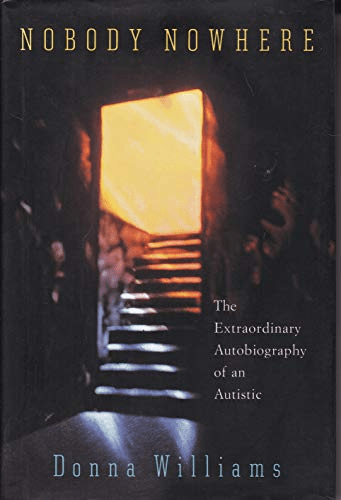
Donna Williams, who I moved onto next, had a very different experience growing up. Her father was absent; her mother and older brother physically and verbally abusive. Williams wasn’t diagnosed as autistic for a long time. People knew that there was something different about her and she went to a “special school” where she learned to imitate other people, “normal” people. She made up a persona who was a dancer, with particularly bendy joints, who was happy and cheerful and spoke to others. This persona made her mother happy, and allowed her into mainstream school, where she made a friend who seemed to have some autistic behaviors, too. (Or at least Donna thought she did.) When her friend made another friend, Donna didn’t know how to cope with having more than one friend, and separated herself.2
Isolated again, she took to wandering out of class to “go to the bathroom” and ending up on the playground alone while everyone else was in class; and found herself in “special” classes again. Her family moved and the attic in their new house became her room, with bars on the windows to keep her in, like Mr. Rochester’s mad wife. Wandering down a nearby street in her new neighborhood, she meets and makes friend with another 7-year old girl.
One night, sleeping over, the friend cuddles her like a teddy bear. The physical stimulus is too much for Donna and she begins to feel wrong. She lies on her back in her twin bed, blankets smoothly arranged around her, arms stiff down by her sides, trying to be as neat and proper as possible. But she’s taking up too much room. She lies on the edge of the bed, but she’s still taking up too much space. So she sits on the side of the bed, but still too much room. So she sits on the corner of the bed, hunched down, trying to make herself as small as possible. Her friend’s mother, checking on the little girl, finds Donna there and gently chides her, asking what is wrong. “I don’t want to go home,” Donna replies (with good reason). “But I don’t want to stay here either.” Unable to explain what she means, she keeps insisting that she wants to go. The mother replies that there is “nowhere to go” and these words echo through Donna’s head, perfectly capturing how alone and alienated she feels in the world.
This friendship, like others, goes nowhere.
In retrospect, as she writes the book, she recognizes her inability to be a good friend, to understand friendship. She also writes about coaching her younger brother – who had been diagnosed with ADHD – in how to block out the abuse in their home, and that he would experience in school, using techniques she had developed for herself. It’s at that point that she seems to become consciously aware of what she does and why.
She began to have night terrors and used to hide under her mother’s bed. I did this too, when I was that age. “Too old” to seek solace by cuddling in bed with my parents, I would crawl silently along the rough nylon carpet, and press myself against the end of the platform of their waterbed, the edge of their duvet hanging down over me, shutting me away from the monsters outside the window of my room.3 In the morning, I would slither out just before they awoke, back to my own bed, and fall asleep again, exhausted, only to be roused an hour later to go to the torture factory, where I was sure that I never did anything right socially and felt terribly misunderstood and rejected. Much like Donna did, but in a different way.
In high school, Williams became a problem student, acting out violently and refusing to learn the way that they wanted her to learn; or alternately, staying completely silent, refusing to speak or interact. She took to wandering the streets at night, unable to sleep, unwilling to go home, unable to go anywhere else. She disappeared inside herself, unable to make the shapes around her make sense. Partially this seems to have been a symptom of her autism, partially a result of the abuse imposed on her by her family, partially a coping mechanism, partially just depression and a desire to escape this world without any idea of where to go. She dropped out of school; her mother made up a story and sent her to another school, then another. Medicated with painkillers and “nerve tablets” and sleeping pills from three different doctors, she became even more unbalanced. How much of what she experiences as a teenager is the prescription drugs, or her self-medication, or the abuse or the autism, and how much is the natural infusion of hormones into your body as a teenager, it’s hard to tell.
Adolescence is a period in which I am convinced that many kids experience temporary insanity, their bodies changing radically, flush with hormones that causes them to act impulsively, to do stupid things like swallow tide pods, lie on the yellow line in the middle of the road, cross Deception Pass on the outside of the bridge, sleep with anyone who looks kindly at them, drink and do vodka bongs to excess, send pictures of themselves to people through their phones, join cults, cut themselves, and total their father’s car while stealing all of his real estate signs from the lawns of houses he was representing. Eventually we outgrow this crazy period in our lives, and become normal, voting people with desk jobs, who pay our taxes and sometimes even become realtors like our fathers.4
Williams somehow makes her way to university and graduates and then, lost for what to do next, marries a man just because he tells her best friend that they’re getting married, just to piss the friend off. She makes her way out of that relationship and finds a naturopath who diagnoses food allergies, adjusts her diet, and her physical symptoms diminish. She becomes somewhat stable and then leaves impulsively for England, where she began performing. She finds a friend, a man, whose father says he’s “a bit strange” and “a bit weird” although the son seems perfectly normal to Donna.
And then she starts writing about her life, her memories – this book – while researching endlessly at the library to find out more about what is is that her friend and she share, what makes them similar. She starts with schizophrenia, which she is certain that she has because she has named the personalities that she had created to help her navigate the world, sometimes refusing to be called Donna at all, since Donna was the “mad one” that her mother didn’t love.
And then Willams discovers a thing called autism. As she reads about it, she recognizes the symptoms, it feels familiar; she comes to realize that is what makes her different. She shows her book to a child psychologist that she stumbles upon, he asks her if he could show it to an expert in autism, and the book gets published.
She begins to meet other autistic people; she meets a child who is lost in his own world of sorting colored beads, running them through his hands. She sits down next to him with her own colored beads, sorting them herself, then adds hers to his, he pours his into hers – they begin communicating without words, without looking at each other. She reads what he’s saying through his body language. His mother walks in and silently observes, and begins to weep as she recognizes that her child, whom she thought was lost in his own world, oblivious to others, has been reaching out and communicating all along.
This autobiography is an amazing book. It was clearly written by someone who experiences the world differently – a series of memories, stories that flow into each other, and over each other, and around. Although she is moving chronologically through her life, describing things roughly in order, you come to realize after a few chapters that it isn’t strictly in order. She goes forward, explains different friendships, how she dropped out of high school, and then she’s 12 years old again. Her little brother is three then eight then five. Narrative seems a problem.
Imagery and emotion are not.
If you are interested in diversity and how others see the world, learn to navigate and survive, this is a great book to read. It’s different from reading Temple Grandin, who grew up in a nurturing environment, figured out what she wanted to do with her life at a young age, and marched forward with purpose to do it. But this story is just as beautiful and marvelous and absolutely worth reading.
Darn it, just writing this makes me want to spend all day rereading this book. And then the sequels. And then all my Temple Grandin books. And then Autobiography of a Face. And I can Hear You Whisper.
So many books, darn it, so many…
- A positive story for what it says about neurodiversity. Not so great for what it says about the female role in the world: the main character is defined by her role as a mother and the only job she can be given on the ship is a menial job, as if that is all a mother could do, if they’re not a mother. ↩︎
- Probably safer in the long run – two little girls are fine, three is a recipe for Slenderman. ↩︎
- My friends took me to see a lot of horror movies: Food of the Gods; Empire of the Ants; Sisters. The one that scared me the most, however, was the version of Frankenstein that I saw on TV where the doctor creates a lady Frankenstein, who always wears a velvet choker to cover up the scar where her head is sewn to her body. They are enjoying a grand ball, everyone dressed to the nines, laughing and dancing, when the monster, jealous, enters and rips off the choker, and then tears her head from her neck, and sends it rolling across the floor. Although he dies in the end of the movie, I was certain every night after that, for as long as we lived in that house, that he was crouched down outside my ground floor bedroom window, peering in at me. ↩︎
- I keep hoping that “the problem child” in my extended family, who I love so much, will live long enough to eventually outgrow it, if the parents will just leave them to find their way. ↩︎
 Change+Management