
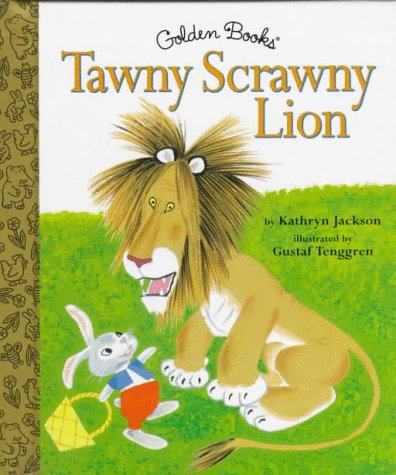
This is one from my early childhood. I can’t remember my parents reading it to me but I do remember lying on the floor in a blade of window-shaped sunshine, flipping the pages, looking at the pictures, and telling myself the story.
The story is simple: the lion is always hungry, although he chases and catches other animals – monkeys, bears, kangaroos, zebras, camels, and elephants1 – every day. The more he eats, the hungrier he gets. When the other animals try to discuss with him what an imposition it is to be chased and eaten every day, he blames them for making him so hungry by running so fast and so far.
Then a fat and happy little rabbit bounces up. He’s a little naive; so when the other animals suggest that he hop right up to the lion and engage him in conversation, he feels flattered by the responsibility, and does so. The lion is about to eat him when the rabbit invites him home to dinner with his fat little brothers and fat little sisters2 and the lion, realizing that a whole litter of happy rabbits is a much better dinner than one happy rabbit, agrees.
On the way home, the rabbit gathers mushrooms and vegetables and catches a fish3, all of which gets added to the carrot stew that his sisters and brothers have been preparing. And that stew smells so good that, before the lion knows it, he has eaten a whole big bowlful, which the generous rabbits then refill. The lion becomes addicted to the stew and gives up chasing and eating the animals, and the rabbit becomes a hero.
We actually had a children’s record with a song version of this story that I can still sing, from start to end, including the animals’ “hurrah!” at the end, when the lion declares, “from now on I won’t eat any of you!” And I have been known to sing it, when I am particularly hungry, much to the confusion of friends and in-laws who did not grow up listening to this album.
And, lest you think the album brainwashed me into vegetarianism, I will add that the only other song I remember from the record was about a man who had a “rumble-bumble-bumble” in his head and was cured by eating more roast beef. “More roast beef?!?” he repeats in disbelief, and his doctor tells him emphatically, “More roast beef! More beef,” he said, “will surely cure your head.” And it does. So don’t be saying that just because children are exposed to books about people who are different than them, they will be brainwashed by those books.
Anyhow, the lion is clearly not a real lion: the feline digestive system is not designed to process carrot stew.4 And he talks. And the animals wear clothing – the bunny and his brothers wear pants and jackets and his sisters wear dresses, and the bear dons an uncomfortable looking dress coat and stove pipe hat when he thanks the rabbit for saving them all – so they’re not animals at all.
What are these animals really? And what is really going on in this book?
Most children’s book experts say the story’s meaning is that you you can defeat threatening people by being friendly and generous.5 Gary Busey wrote a post where he says the true moral of this story is that murder is slimming.6 Bryan Caplan, on EconLog, claims that it’s an illustration of Deadweight Loss, and explores the idea that the animals could have a lottery system, tie up the animal who loses the lottery, and leave it for the lion to consume, thereby reducing risk and effort by the rest of them.7
But let’s look a little closer. We have a lion – the symbol of England. And then you have the animals: monkeys and zebras from Africa; camels from the Middle East; elephants from India; bears from Canada; and Kangaroos from Australia – all places where the British Empire had a big stake. And what does the rabbit symbolize? China, another country that the British Empire drooled over. So you have Great Britain chasing after – and consuming – all of these other countries; and China takes Britain in, all innocent- and naive-seeming, and feeds Britain what they want him to consume, instead of letting Britain consume them, until the British lion becomes fat and complacent. Clearly Kathryn Jackson was embedding a warning about empirical overreach and how to deal with tyrants. If the book continued, the lion might find himself in the rabbit’s pot!
Or maybe it’s just a fun kid’s book about sharing and generosity.
Yeah, I’m going to go with that.
- Where the heck did this lion live, anyway? ↩︎
- I don’t want to hear any kibbitzing about the use of the word “fat” here. The rabbits aren’t being shamed for being fat, the reason they are described as “fat” is because the increased calorie count made them more tempting to the hungry lion. This is why great white sharks prefer seals over surfers – seal blubber has a higher calorie count than those scrawny surfers. The sharks are often disappointed when they see a fat seal on the surface, and end up with a big bite of surfboard and neoprene and no blubber. No wonder they seem angry all the time. ↩︎
- And why it’s more acceptable for a rabbit to catch and eat a fish and less acceptable for a lion to catch and eat a rabbit, I don’t know. ↩︎
- The colon is too short to process vegetables. ↩︎
- And, I assume, a little oblivious. Because the rabbit is not being friendly and generous to defeat the lion; he is being friendly and generous because that’s his nature. ↩︎
- Well, it certainly would be to the person who gets murdered; eventually they’d be nothing but skin and bones. ↩︎
- Economists are so cute. ↩︎
 Change+Management