
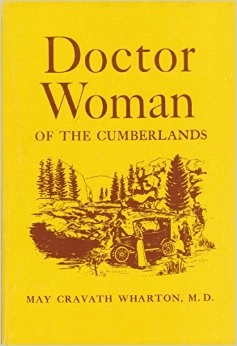
This book is, like the one I wrote about yesterday, an historical autobiography of a woman living in the rural U.S. in the early 20th Century.
Like Laura Ingalls Wilder, May Cravath Wharton’s early years were spent on a farm in Minnesota in the mid-19th Century, followed by a tree claim in South Dakota when their crops in Minnesota repeatedly failed. She gives a different perspective on South Dakota, waxing eloquent about rattlesnakes that she encountered as a child. But it was in Minnesota where she met a female doctor who inspired her to grow up to study medicine herself. It was not as unusual as I had thought to find a woman in the 19th Century who had gone to medical school – Wikipedia probably lists about 100 of them and Elizabeth Blackwell had already opened her medical school when May Cravath was born.
After graduating from college, Wharton aspired to a job in the missionary field of medicine but the fates conspired against her: she was young, a woman, and unmarried. She, instead, started a practice in Atlanta, and married an architect who had also studied the ministry. Her husband was appointed to a mission outside Cleveland and she was assigned the post of the mission’s doctor. Then they moved to New England, where she was in private practice again; followed by another ministry assignment for her husband on the Cumberland Plateau, which runs from West Virginia to Georgia, just as WWI was breaking out. When they moved there, she was 45 years old.
Her husband had been assigned as headmaster at a large, run-down boarding school, open the three months of the year when children weren’t needed for farming and the roads were still passable. May Wharton started by teaching there then opened a student health center. With few roads and rugged terrain, most families who lived in the Cumberland stayed local, living off their farms and hunting, retaining the accents and traditions that their families had brought with them when they emigrated. Sustenance farming didn’t pay much and even a routine doctor’s visit could cost a third of their annual income; so many of the children at the school had never received dental care, eye care, basic vaccinations.
And WWI meant the great influenza. While she was tending close to 100 sick students at the school, a young boy appeared and asked if she could help his mother – a call that saved the woman’s life and that of her three children. That led to a neighbor asking if she could help his wife (and children and, it turns out, him). She had barely treated them when another neighbor turned up at the house, asking if she could help his family. This, and her work with so many children at her husband’s academy, earned her the trust of the local community.
This was hard work: there were no hospitals there and no roads; she often had to hike several miles cross-country, in the long dresses of the time and carrying her medical supplies, at night, in weather, traversing streams on fallen logs. When there was no one to guide her, she got lost, sometimes straying as far as 35 miles in a day. The people she served were impoverished but proud and, although they couldn’t pay her in cash, they paid her with what they had: eggs, chickens, produce. When a mission finally donated funds for a horse, instead of easing her work, it gave her license to increase the number of house calls she was performing.
After just a few years there, her husband suddenly got sick while she was away fundraising for the area’s first hospital, and quickly died. In addition to losing her husband, she lost her home because they had been living in the headmaster’s house and a new headmaster and his family would need that home. And, as we saw when she had been younger, it was hard for an unmarried woman to raise funds for a mission on her own. Friends and family wrote urging her to accept offers in easier places to live, places with roads and established hospitals, and communities that could support them. She was packing to leave when she received a letter from 50 local families, asking her to stay, build a hospital, be their doctor.
So she stayed.
Eventually she built a little clinic, then a larger hospital and a TB sanatorium, and then a nursing home. She stayed in the Cumberlands the rest of her life, dedicated to helping the people there live healthier lives. Despite the demands on her health – the late nights, the long treks on foot or horseback through rain and ice – she lived to be 86 years old.
I love books where a strong woman builds something out of nothing. I also like the way that she talks about the people that she served, with empathy, compassion, and admiration – while also remaining objective about the challenges of working with people who couldn’t read or afford healthy food. Often she writes about a family so poor that they didn’t have covers to put over the person she was treating on a cold winters night, and so they draped their coats over the patient’s bed. She points out that, when she was working in Cleveland, she saw poverty; but the people there were close enough geographically to middle class and wealthy neighborhoods, that they benefited from donations of money, supplies, and second-hand clothes. But the Cumberlands were so rural – the nearest hospital, before she built hers, was 85 miles away – and the poverty was hidden back in the hills, where potential donors couldn’t see it.
I was reading the other day that retirees are leaving Florida now, as any wise person would do, and heading for Southern Tennessee and Northern Georgia because it’s still possible to get homeowners insurance and the cost of living there is lower. Or at least the COL is lower until these comparatively wealthy people come in and drive up the prices and the property taxes, and then what will the locals do? I’ve also been following the plight of the Gullah, who have been fighting to maintain their traditional lands along the Carolina coasts. They held out against resorts and developers for many years but now rising property taxes are pushing them off their lands.
I’m trying to remember where I picked up this book. Possibly a book sale at a library in a Chicago suburb or maybe at a used bookstore in North Carolina, possibly on a trip down the Blue Ridge Parkway which, if you have not done, you should do now. It’s one of the most scenic trips in the U.S., especially if you wander off the road from time to time, exploring the carriage roads and backways.
I suggest you give this one a shot, if you can find a copy. It may make you feel guilty for complaining about spotty Wi-Fi and the lack of a good parmasean at your local grocery. But a little suffering is good for the soul.
 Change+Management