
The year was 1983. The place was France. It was a time of great change – La Belle Époque – when the world was lurching forward into a new era. In Paris, a rising middle class with access to trains and – gasp – department stores! was enjoying the burgeoning fruits of industrialism. Science was evolving and detectives were beginning to rely on forensics in their work.
But outside Paris, many people still lived a rural life, where barefoot children drove farm animals to pasture. Young women, seeking a form of employment that didn’t involve cleaning, childcare, or animals, took entry-level manufacturing jobs at factories. And a growing number of “vagabonds” roamed the country seeking work – around 400,000 migrant workers or long-term unemployed, mostly men, some families, some abandoned elderly with no support, some mentally ill. They followed the harvest when they could, taking on work if they could, seeking handouts if they couldn’t.
Joseph Vacher was one of them.
Even as a child, Joseph Vacher demonstrated a horrific capacity for violence towards those he deemed weaker than him. Assigned by his family to take the animals to pasture, he broke their legs.1 The youngest of 16 children – 16! – he tried to kill one of his siblings. At school, he picked fights that he executed with an unusual devotion to ferocity. Leaving school, he joined a monastery that quietly expelled him later, without explanation. He attacked a 13-year old boy, attempting to rape him, and was chased off. He ended up in a hospital, being treated for VD, where he kept trying to fondle the nuns. He was drafted but his fellow soldiers were appalled by his unexpected violent outbursts.
He met a young woman on the street one day, a gentile young woman, who in a previous era would never have spoken to a stranger, relying on her parents to introduce her to eligible young men. But it was a new era of freedom for women, who ventured out on their own sometimes, and even took control of their lives, wearing split skirts and riding bicycles! She was charmed by the young soldier at first but, when he said he’d kill her if she ever left him, she realized she was in over her head and broke it off. He bought a gun, deserted his unit, and confronted her on her doorstep, shooting her and then himself in the head.
They both survived.
The shooting was considered a “crime of passion” and his assumed demeanor of contrition helped him escape prosecution. He was expelled from the army and sent to a mental institution, where he displayed violent paranoia and attempted to escape. was recaptured, escaped again. Diagnosed with depression and paranoia, he was transferred to a mental institution in his home area. They didn’t know what they were getting and treated him with kindness, and focused on rehabilitation.2 As his gruesome wounds healed – as much as they would heal, leaving him with a horrific facial wound that repelled strangers – he regained his façade of normalcy. He wrote a series of flattering letters to the head of the institution, regained him his liberty. Then he said he recognized that what he had done was wrong and he had put together a plan to set his life back on track. Those being the two things that the doctors at the asylum needed to hear to set him free, they let him go.
Vacher had been there three months.
Wandering, he moved in with a sister who remembered his violent childhood and, seeing no difference, asked him to leave. He wandered some more, tried returning to the monastery, who turned him away. It was spring, the peach trees and lavender were in bloom, he met a girl, just a pretty little factory girl on a quick lunch break, going for a breath of fresh air from noise and dust in the silk mill where she worked.
She never returned.
A shepherd the next afternoon saw the pointy toes and curved heels of her trendy shoes poking out from under a hedge. When the woman investigated, she thought a beast had torn the little factory girl to shreds. An autopsy was performed, organized and bureaucratic in a French way, with lots of forms and questionnaires, but performed by a local doctor without any special experience with crime. And then the police rounded up the usual suspects: even then they assumed the killer was someone she knew.
Vacher washed his hands in a nearby stream and began wandering again. A few months later, in a rural area in the mountains, he stumbled across a 13-year old girl who was searching for her puppy. Then an elderly couple living nearby were attacked in their home. Later a woman was attacked as she was taking fruit to market – she managed to escape his grasp and held him at bay for 2-hours by throwing rocks at his face, until some men arrived and he ran off.
I’m not going to detail everything Vacher did. He killed a lot of people, children mostly and young women, as crimes of opportunity. He preyed on people who were weaker than him, people who were isolated, where people wouldn’t hear their screams. As the penny-press picked up the story, people he met as he begged his way across agricultural country related his crimes back to him, warning him about the murderous vagabond on the roam. He began to head into more and more rural areas, the mountains, where people kept dairy cows and the newspapers didn’t reach as far.
But, when unexpectedly violent crimes ensued, people remembered the strange wanderer with the facial wounds that wouldn’t heal, who didn’t like to work, and complained about mental institutions, and put a description together.
And something else was happening: the burgeoning field of forensic science was catching up to Vacher. When you read Hercule Poirot, he is quick to dismiss French detectives who rely on forensic science, choosing instead to exercise his “little grey cells” but the French were doing cutting edge work on forensics at the time. And Vacher’s crimes had caught the attention of one of the best: Lacassange.
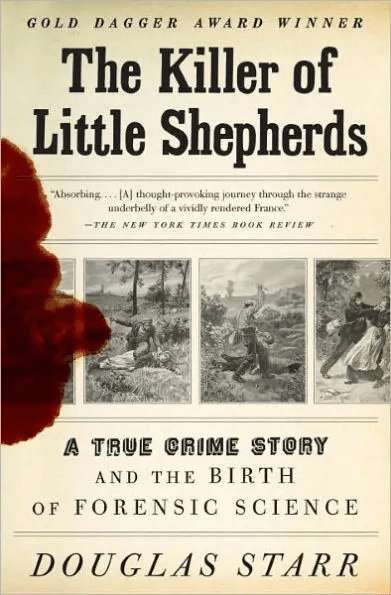
This book is an interesting amalgam of history, crime, and early forensic science. It alternates: one chapter about Vacher; the next about Lacassagne – until the two finally meet at Vacher’s trial in Lyon. The author paints a clear picture of what France was like at the time, from the gas lamps of Paris to the unspoiled – at least until Vacher got there – crags of the Pyrenees. With few words, he helps you see each of the victims as people caught by circumstance in crimes of opportunity. And then he shows how Lacassange takes the case apart and puts it back together again for the trial.
There were two things that drew me to this book. First, I had seen a Julian Sands movie – it might have been Romansanta – about a wandering serial killer in the 1800s who claimed to be a werewolf. I had also recently seen Sign of the Wolf, about a “werewolf” that was killing little shepherds in rural France. So the title of this book and the brief description hooked me. It turns out to have nothing to do with either of those stories but is worth reading anyway. Only now I have to find a book that explains the Romansanta story3, if there is one.
If you like true crime or like reading about the development of forensic techniques, this is one for you. And I give it high marks for one of the best titles ever.
- People often dismiss it when children display cruelty to animals on the grounds that “boys will be boys” and “they’re just animals”. I remember reading a newspaper article a number of years back: someone broke into a NJ animal shelter and killed every single cat in particularly cruel ways. Police didn’t seem much interested, it was just animals. Oh, that’s not going to end well, I thought. Much better to respond like the university in China who rescinded their acceptance of a mathematical genius after he posted videos on social media showing him violently killing cats. He complained – so unfair! Having read a lot of true crime books about serial killers, I would say this guy needs to be locked up. Boys who are cruel to animals often go on to attack children who are smaller than them, young women, older women, and eventually healthy adults. ↩︎
- It is not possible to rehabilitate violent psychopaths, as a Canadian institution found to their deep regret several decades ago. They tell you what you want to hear and return to violence almost immediately. Only now they know: they mustn’t leave behind witnesses or evidence. ↩︎
- Unlike Sign of the Wolf, Romansanta is based on true events. But I quickly realized, reading The Killer of Little Shepherds, that it was a different serial killer – Julian Sands would not have made a good Vacher. Although that never stopped Hollywood before. ↩︎
 Change+Management