
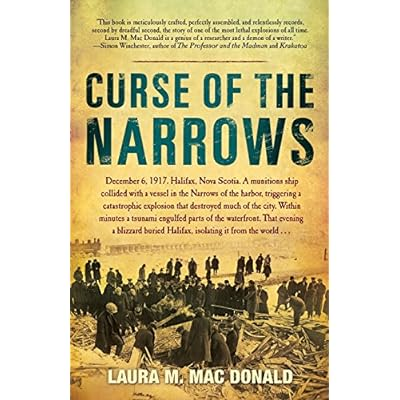
December 6, 1917, two ships collide in the bay of Halifax, Nova Scotia. One ship is carrying munitions – it’s a secret because this is the middle of WWI. The resulting explosion causes a Tsunami that washes up both side of the narrows, followed by a firestorm that takes out much of the city. And, because it’s December in Nova Scotia, a blizzard moves in, isolating the town from assistance.
Man, if you like reading about disasters and the human resilience that follows them, this book is for you.
The bay of Halifax is a little unusual. There’s an outer bay, shaped like a funnel, then a narrow neck (“the narrows”) then a wide basin; the water is deep there, making it a desirable berth for large ships. In 1917, the main piers and associated industry – a sugar plant, the brewery, a dry dock, the admiralty – were located along the narrows. Hallifax proper lay along one side of the narrows and the vacation town on the other side was called, Dartmouth. A ferry connected the two.1 A small Mi’kmaq village of Turtle Grove remained around a cove just off the narrows. The land just along the narrows is flat but, beyond the railroad tracks, it turns steeply uphill. Once you traverse the narrows, you are surprised by the deep, round basin that follows, surrounded by tall hills, which protects it from storms.
In use since before the American Revolution, Halifax was the main port in the Northeast until after the Civil War, when relations between the U.S. and Canada broke down, and U.S. shipping shifted to Boston. It regained primacy during WWI, when it became a setting off and receiving point for naval convoys between Britain and North America.
All of this is important to understand the factors that framed the disaster.
There’s some question as to the root cause of the collision – ship captains blamed the local pilots; the pilots blamed the captains. But what you had was a disaster waiting to happen. A French ship, the Mont Blanc, was carrying high explosives2, so sensitive that they could explode if the ship nudged the dock too hard, and unable to be extinguished by water. It came to Halifax to join a convoy across the Atlantic. Usually, a ship this dangerously laden would not be allowed into the narrows or the basin, and would fly a special flag, warning others of the danger; but, because of the war, these precautions had been relaxed so as not to alert terrorists.3 The other ship, the Imo, was carrying coal and had missed the window for departing for New York. (The narrows closed down with submarine nets late each afternoon until the morning.)
So that’s the situation this bright sunny morning: the Mont Blanc sailing into the hazy narrows, bound for the basin where it will await the convoy. The Imo, hurrying out through the narrows to make up time on the way to New York. Both ships maneuvering around the other traffic and ferries in the narrows, communicating warnings to each other with horns. But, as usual with disasters, that communication went wrong. The men on the ships were confused but the men on the shore, who could read the signals and had an outside perspective, could see the crash coming, although they didn’t know about the Mont Blanc‘s secret cargo.
After the collision, fire started quickly on the Mont Blanc, and the ship swung out of control, headed for the docks. People ashore, children on their way to school, families with windows overlooking the narrows, stopped to watch. Men rushed to the shore, intending to help fight the fire; fire stations and fire boats also responded. Unable to fight the fire or drop anchor – the collision had damaged the fire-fighting equipment and isolated the anchor – the crew of the Mont Blanc abandoned ship, which surprised everyone, since no one else knew what the ship carried. The captain and crew tried to warn the other ships on the water but, in the chaos, no one could understand (or believe) what they were saying. The Mont Blanc ran aground near the wharf, setting it aflame, and 11 explosions ensued, the loudest heard 225 miles away.
The fleeing sailors hit shore and warned people, as they ran quickly away, that the ship was going to explode. But those ashore didn’t understand and gathered to watch the fire. The greatest of the explosive blasts blew apart houses, crushed internal organs of people nearby (killing them), and threw people against lampposts and walls. A fireball shot across Dartmouth, setting houses afire and exploding the windows that people had gathered around to watch the fire4. Every building within a mile of the blast was damaged, many of the thick concrete walls of the industrial buildings collapsing. Following the explosion, a vacuum imploded stoves, furnaces, mailboxes, and yet more windows. Ships on the water were also damaged. Tornados caused by the explosion followed, taking out all buildings within 16 miles. The heat from the fire and explosions on-ship instantly evaporated the water in the narrows and, as water rushed in from nearby areas, a tsunami ensued, washing up both sides of the narrows, tossing ships about, and taking out any houses left standing. The first responders – who had raced to fight what they thought was a normal fire – were wiped out by the explosions so there was no one to respond as house-stoves in neighborhoods jarred by the blast dumped their coal onto wooden floors, setting them aflame. Magazines at the naval base caught on fire and exploded.
People thought the Germans had bombed the town.
Hospitals were overwhelmed.5 No one knew where to go; their homes were gone. Surprised by a disaster that happened out of their sight, they thought it was localized around their homes and things would be better elsewhere. They weren’t. The telegraph lines were down, so they couldn’t send word to neighboring communities for help. The railroad was down.
That night the temperature dropped to below 17′ F and a blizzard started up. Despite the weather, ships nearby who had heard the explosion cautiously made their way into harbor and started to provide what little assistance they could, searching for survivors, preparing the dead for burial. The local newspaper – despite damaged presses – managed to get out an issue, reporting on the locations of people who were alive and looking for loved ones.
Finally, word got out to the outside world. New York, Rhode Island, Maine, Toronto and Montreal sent relief trains. Massachusetts, in particular, sent trains full of doctors, nurses, and medical supplies, as well as clothes and offered whatever else Halifax needed.6
This is an amazing book, very thoroughly researched, and written with compassion and detail. The author told so many stories of individual people and what they experienced. It’s a real page-turner and, once you start, you won’t be able to put it down.
Highly recommended.
- They built a couple of bridges, both of which fell down. ↩︎
- Benzol, picric acid, and TNT. ↩︎
- There had been a series of attacks on ships at harbor up and down the East Coast. ↩︎
- Remember: this was before safety glass, so the windows didn’t just crumble, they exploded into shards. ↩︎
- The injuries were horrific and remember – this was before antibiotics. ↩︎
- After the revolutionary war, Boston’s British Loyalists had relocated to Nova Scotia, so there was a special bond between the two areas. Even now, Halifax provides Boston with their annual Christmas tree, in thanks for their assistance during this emergency. ↩︎
 Change+Management