
As a child, I was terrified of being lost – separated from my mother. I was so small that it was easy to get separated from her; in a department store, for example, I couldn’t see over racks and bins. She might be there, right there on the other side of that bin, but if I couldn’t see her, I panicked. Even as an adult, I hated going shopping with her because we’d agree to meet somewhere or that she’d wait while I was trying on clothes – to give her opinion, I hoped – but then she wouldn’t show up or she’d wander off, bored with me, and the panic would set in again.
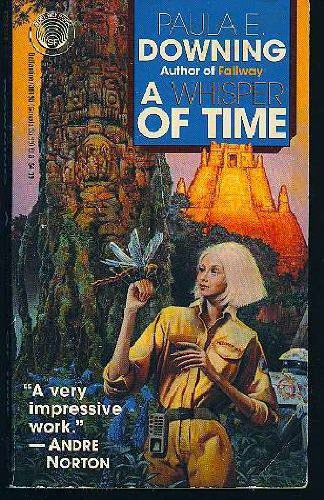
Which is why I picked up this book to begin with: it starts with a child that gets separated from her mother. All Medoret does is follow a brightly-colored insect away from the other children, down a street into an echoing plaza. All she does is explore and, when she makes her way back to where her family had been at the end of a miraculous day, they have left. She is alone in a deserted city, populated only by robots that don’t register her presence. That is how the child gets adopted by humans.
Medoret is our first contact.
She looks humanoid enough to almost pass: human-sized; bipedal, two arms; hands with fingers and opposable thumbs; a face with two eyes, 1 nose, 1 mouth, laid out like human faces are; hair on her head. Her proportions are a little off: the length of tibia and fibula and texture of her hair; the number of joints in her fingers and toes (the number of fingers and toes). She sees colors we don’t see; smells the identities of people around her. The archaeologists and anthropologists and psychologists who surround Medoret argue about her gender, her maturity, whether the lack of development that would be expected of a human her age is natural or a response to diet. Encouraged by her psychiatrist to try to “fit in”, to call the man who found her “father”, to participate in human social rituals; to document, daily, her daily physical functions, her thoughts and moods, all for him to evaluate and document and publish. All to earn him more prestige and funding, more control.
Human social cues confuse Medoret. Stuck into school, the human children bullied and rejected her. Now, a young adult with an expertise in Mayan glyphs – they feel familiar somehow – Medoret still doesn’t fit in: some of the scientists on the base are skeptical of her sentience, treating her like a trained monkey; others she just makes uncomfortable. Some expect her to understand the alien glyphs from the planet where she was found – although that was not her planet, her people were just visiting – others reject her assessments because they do not reflect the hypotheses they have built from carefully groomed data.
And more and more often, Medoret dreams in memory. Mayan gods mixed with memories of her mother, the ship where she lived until she was lost as a child. Are the dreams just dreams? Are they indications, as her psychiatrist would say, of mental illness? Are they communications across space? Or are they just dreams?
When Medoret is offered a chance to return to the planet where they found her, where her ship had left her, she jumps at the chance. To see the glyphs she studies in person, to travel the stars again, to visit the city that haunts her memory, to perhaps find her mother again, her people. To be free of her psychiatric handler – but he comes along and leverages the respect that others accord him to control her. When the mysterious fevers she experienced as a child return – a sort of malaria, cause unknown – she worries that he will use that as an excuse to restrict her to her cabin, to separate her from the first friends she has ever made, to send her back to the off-world base where she was raised.
So she escapes into the city of ruins and stumbles across a way to contact her people. But Medoret also discovers that they are cursed with a fatal plague – related to the fevers she herself experiences. If she returns to them, she may infect them – or perhaps the drugs the humans have treated her with could help her people. She is faced with a choice…
This book is a wonderful melding of science fiction and Mayan mythology. The question of how much Western academics can truly understand the mindset of the Mayan or – having identified certain “universal” meanings to languages we can’t read, apply them to glyphs from other cultures, Mezo-American or Alien.
I am also drawn to Medoret’s feeling of otherness. Although raised by humans to act human, her thoughts are not human. But, when she encounters her people again, she does not speak their language and her thinking is foreign to them. Do children raised by people outside their cultures feel that way, too: trapped between their birth cultures where they learned to speak, and the culture that adopted them. But even if you’re not adopted, you can feel alien: unable to understand people, signals, social cues; making decisions when to fake it and when to risk being yourself, risk rejection. You never know when you’ll make a mistake and expose yourself as “other.” Even introverted children in extroverted families or extroverted children in introverted families find themselves labeled and corrected, treated as abnormal.
In The Yellow Wallpaper, a woman dares to think differently and, when having thoughts offends her husband, tries to conform and grows depressed. That gives him the excuse to use the medical profession to declare her sick, hysterical, and she is confined to bedrest in a room with yellow wallpaper where lies becomes truth and her mental state deteriorates until there is nothing left but the wallpaper and the stereotypic behavior she exhibits, like a big cat compulsively pacing a small zoo enclosure, wearing a path until her paws bleed. Medoret suffers the same confinement by her overseer, the officious psychiatrist. When reasoning with him fails, she tries deception, disobedience, threats, and finally resorts to violence.
Although Medoret experiences challenges, this book is not all sadness or strife. The way Medoret experiences the world, the insights of her dreams, and the friendships she makes hold out hope that things will get better.
This book is going to be a hard one to find – it doesn’t seem to be on e- and it’s out-of-print in paper. Perhaps you will stumble across it in at a book sale or a used bookstore. If so, pick up a copy and see the world through someone else’s eyes.
 Change+Management