
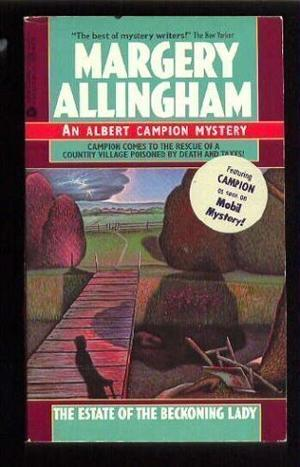
This is another mystery set in the heart of England beautiful, in this case, Pontisbright, the ancestral home of Albert Campion’s wife, Amanda, and a retreat for the happy couple, their young son, and their associate, Magersfontein Lugg. When we first encountered Pontisbright in The Fear Sign, it’s not such a bright and beautiful place. Much of that book takes place by moonlight, with evil henchmen abounding, bodies on the heath, deranged doctors, and danger abounding.
But now, years later, Pontisbright is filled with gloriously long summer days, watermeadows filled with long grass and winding rivers. Oh, and a dead body or two. The first is, I believe, discovered by Mr. Campion’s child, who is too young to understand what he’s found. The body turns out to be a tax collector, from back in the days when taxes were collected rather than mailed in and audited. In fact, he seems to be a sort of tame tax collector devoted to the older couple who live on the neighboring estate, Minnie and Tonker Cassand. Minnie is a portrait artist and a muse, inspiring and encouraging art since her youth. Tonker – also known as Tiger – is a kind of performance artist and inventor of crazy things that make money.
Unfortunately, in their younger days, one of them sold a painting or an invention1 for a wacking large sum of money and immediately paid off all their debts. This was when income tax was new, and they completely forgot that they would need to pay taxes on it and immediately ran afoul of the British version of the IRS. So they sold something else, made more money, and used that to pay off the previous tax debt, and started a cycle of constantly making money, using it to pay taxes, and owing still more taxes. The (now dead) tax collector was advising Minnie on how to escape the tax debt – one suspects he secretly had a pash for Minnie – arranging her finances more and more minutely, to allow her to take maximum deductions, once even suggesting that she and Tonker divorce.
Minnie and Tonker’s estate has become a sort of refuge for impecunious artists who need a place to work in peace, where they won’t be bothered with such things as rent and groceries and tax collectors and things. One of the people who ended up there was The Old Buffer, an elderly man who has appeared in earlier Campion books, who wrote a rather risque autobiography that was turned into a successful London musical, earning him more money than he knew what to do with at his time of life. He eventually ended up at The Estate, where he gradually faded away in a cottage near the main house. Rumor, however, has it that he was poisoned, by Minnie perhaps, to secure his inheritance.
Minnie and Tonker have been planning a huge fete on their property, a combination art show, performance art piece, and grand picnic for their bohemian friends, neighbors, and potential sponsors and purchasers of art. The discovery of the tax man’s body, the threat of loss of property, and a mysterious plot involving sinister London financiers who are perhaps associated with the mob who want to buy up all the land – including the Estate – to build a race course with middle-eastern backing, a race course where only certain horses will win, threaten the success of the party. Which is saved, in the end, by what the book calls clowns but feel more like The Marx Brothers.
Mr. Campion, aided as always by Amanda, Lugg, and – in this case – a lovesick Detective Inspector Charlie Luke from Scotland Yard, has to unravel clues, follow sinister traces to their surprising end, rescue the party from scandal. His only failure is in preventing Luke’s romantic pursuit of a local aristocratic maiden who, his complete opposite, will only break his friend’s heart, Campion worries.
This is my favorite of the Campion books. I like how Lugg refers to the Estate of the Beckoning Lady: it reminds him, he says crassly, of those old stories about beautiful women who appear out of country mists to beckon you near and then, when you approach, are revealed to be all front and no back, like the hollow man that Lockwood and Company come up against.2 Lugg’s suspicions arise from his inner-city background, suspicious, as many urbanites are of beautiful rural locations, and longing for pavement under their feet and a “healthy” amount of ambient commotion at night that prevents them from having to play the podcasts into their ear to help them sleep as my husband does, to my regret. I tried leaving the window open once so he could hear the creek babble but it just wasn’t the same, he said.
For those of us who spent time in the country as children, a retreat from the city, someplace where we can relax on a sunny summer Saturday without the sound of circular saws in our ear, in a home large enough where we can find a room far away from the constant drum of the TV, where we can amble on an Interurban or Black Diamond Trail, to the sound of frogs and insects, and sleep with the windows open, listening to waves lap or wind rustle through the leaves of trees or long grass, is necessary from time to time. Central Park, while a lovely break, still echoes with the sound of sirens and horns, and with passing men who seem to feel that we all want to hear the boombox they have propped on their bicycle handlebars.
Think I’m ready for a vacation.
- I’m being vague here because I can’t put my hand on my copy of this book right now. I know it’s here somewhere and have pulled 9 linear feet of books off the mystery shelves in my bedroom but just can’t find it. ↩︎
- A type of ghost or fairie but I don’t advise you to try to google “women with fronts but no backs” to find out the name of the spirit. Ew. ↩︎
 Change+Management