
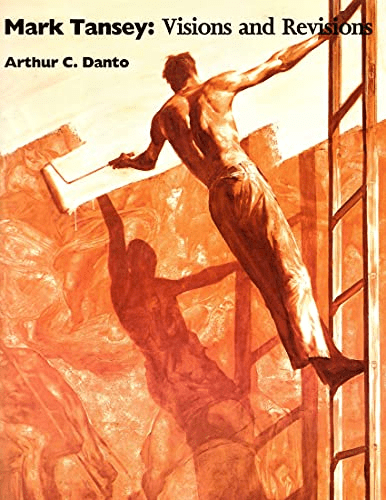
If you see a reflection in one of Mark Tansey’s works, pause, and look closely. There is often something else going on. Perhaps the reflection is not of the things or people being reflected. It is a message, perhaps, that we should not trust history or trust our own perception of history.
Tansey’s paintings are a little, as my husband would say, inside baseball: if you don’t know the game intimately, you may not get the reference. They abound with references to other paintings. The painting on the cover above portrays a man painting over Michelangelo’s Last Judgement from the Sistine Chapel – and, you quickly realize, painting over himself, as well.
Sometimes Tansey’s works reference history: in Chess Game, two soldiers are nearing the end of a chess game at a kitchen table which sits on a bluff overlooking European fields – gridded like a chess board and still smoking from recent battle. As you look closer, you realize that the chess players’ table also sits on a chessboard of paving stones. The chess players are watched intently by a third soldier wearing a medal leaning on this staff nearby but at a slight distance, and an intellectual dressed nattily in a v-neck sweater and tie with a swagger stick tucked under his arm who sits between them, closely examining the chessboard. But… there is a final figure, a Frenchman right out of an impressionist painting in undershirt and straw boater, breaking the fourth wall, looking up from the game to stare out of the painting at you. And you begin to realize that perhaps this isn’t about war but about… art?
And so is the first painting – it’s not just cleverly saying that censorship passes judgement on the censors. It’s also – according to the author of this collection of Tansey’s work, Arthur C. Danto, who does a really good job explaining box scores and bunts – talking about the history of art and some of the modern beefs that artists and movements got into with each other. Tansey grew up steeped in art: his father was an art historian and his mother was a slide librarian, responsible for collections of slides recording art, architecture, and art history, or cultural objects. Imagine the discussions this family had around the dinner table. Inside baseball, indeed.
Tansey paints in a matter-of-fact way, his paintings reminiscent of sepia-tinted photos, as if to imply that he is just capturing what is there before him, just the facts, a WYSIWYG of art.
Don’t believe him.
You can see the lie in works like Action Painting II, in which a painting class (from what looks like the 1950s) has set up easels just across the lagoon from Cape Canaveral. Each artist is, in his or her own way, studiously and seriously painting their shared subject, resulting in absolutely identical canvases. In the background but taking up 2/3 of the painting, we see what they have been painting: an ascending rocket with space shuttle, smoke and steam and exhaust billowing out below and across at precisely 8 seconds following liftoff. This is what the painting class has dutifully captured: not a still life, which sits motionlessly on an arranged table before you while you practice technique, but the intense action of the rocket, which has graciously paused to allow the artists to capture its glorious ascent to the heavens.1
Tansey’s work challenges you to look closely, to question your assumptions about what you are seeing, and then question them again. And then to go and research – who is that man who has stepped out of the rowboat for a stroll across the stormy sea of Galilee in Myth of Depth? Jackson Pollack? Walking on water? And who are those disciples he left in the boat?
There are depths here that I cannot transcend. Humor within humor that I don’t get.
Tansey’s works sometimes remind me of a rooftop sculpture that the Met staged several years ago, when my young nieces came to visit. The Met had just finished digitally cataloging their work and an artist2 took a bunch of the images, made small things big and big things small, recombined them, and 3D printed them in white. The resulting sculpture took up the entire rooftop, where my younger niece and I had retreated while my sister and the older niece poured over Egyptian works, and my brother-in-law gazed at impressionists. All this art stuff was too much for young Lily.3 Until I said, let’s make it a scavenger hunt – pick something from this sculpture, and let’s see if we can find it downstairs. Her eyes lit up, we picked something, I took a picture of it with my phone, and we started on our quest. We never did find what we were looking for – too out of context – but it made Lily look at the art and the museum differently, boredom evaporated.
As we ranged far and wide searching for the object of our quest, we ended up in the basement, and paused before Tansey’s The Innocent Eye Test, in which a cow has been brought into a museum. Studious types in white coats with clipboards watch carefully, ready to record her reaction as the drape over a painting is lowered, revealing a painting of other cows. Is the painting so realistic that she will recognize the cows, mistaking them for real cows? I think also of the scientific tests that they do where they paint a dot on a chimpanzee or chicken’s forehead. The chimpanzee, gazing into a mirror, reaches up to wipe aside the dot; the chicken does not. Will this cow, that Tansey has painted to resemble the cows in the painting she gazes at, recognize herself in the art?
Do we, standing here with a dot on our forehead in front of Tansey’s work, reach up to brush it off?
I like art that makes me laugh, that doesn’t take itself so seriously, that makes me think while laughing. That is why I like Tansey. In a gallery of brilliant dashes and dots and squiggles of modern art, he stands out: linear, realistic, literal.
And lying through his teeth.
- This work was painted in 1984. Had it been painted post-’86, we might read yet another meaning into this work. ↩︎
- Don’t ask me who. I don’t remember and I haven’t got time to go down this rabbit hole online and still make it to work on time. ↩︎
- Ironic, since one of my favorite art pieces is an abstract collage she did of NYC following her visit. ↩︎
 Change+Management