
The other day, my feed included a link to an article that said that, on May 11 every year, the people of Yamhill get together and celebrate Beverly Cleary. Their festival is more than a parade: it’s a celebration of literacy with writing contests based on themes from her extensive selection of books. What a wonderful idea! Every town should do the same for their authors.
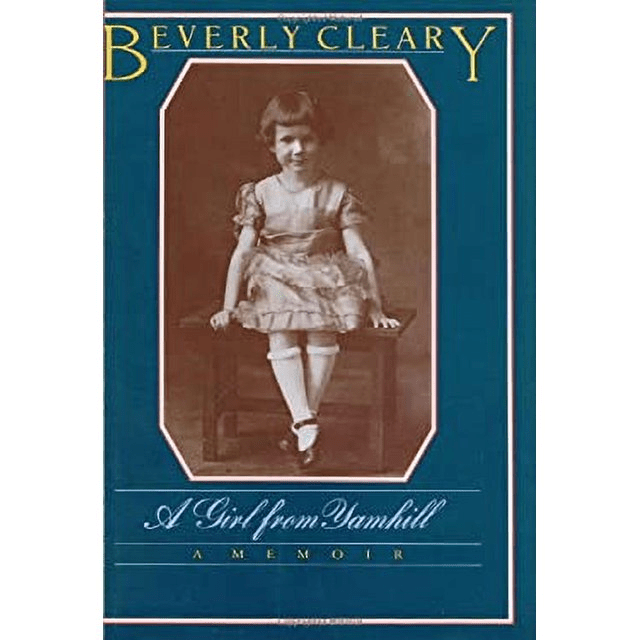
A Girl from Yamhill is Beverly Cleary’s memoir. You can tell what kind of a girl she was by the photo on the original front jacket above – it looks just like the illustrations of her most beloved character (to me, anyway), Ramona.1
I always think of Ramona as a six-year old, although when we first meet her she’s not in kindergarten yet, and in the last book, she is in fourth grade. I love Ramona because she so perfectly captures what goes on in the mind of a kid that age. Although adults often wonder, with exasperation, what the heck a kid was thinking when they did that crazy thing, children do have a logic of their own. Their reasoning may be imperfect – they are, as we all are, still learning – and they may not be able to explain it, but the logic is there.
Why did Ramona squeeze out the entirety of a new tube of toothpaste into the sink? Because she wondered how much toothpaste was in the tube. Cleary also captures the utter unfairness that many children feel about the world: Ramona’s parents don’t have money to waste and that toothpaste is scooped into in a plastic bag for Ramona to dip her toothbrush into twice a day (ick!), until it is completely and utterly used up, while the rest of the family gets to squeeze clean new toothpaste from a tube. So unfair!
At the same time, Cleary’s books are written with such compassion. When Ramona has had enough unfairness and threatens to run away from home, her mother offers to help her pack. The reader feels Ramona’s shock and dismay – mom doesn’t care if I disappea;, she may even want me to, since she’s helping me pack! But mom gives Ramona a huge suitcase and fills it so full of books and roller skates that there’s no way that her tiny kid can carry it on her own. Caught within Ramona’s perspective, we don’t recognize mom’s trick – until Ramona realizes it herself, and we share her relief and joy: mom does love me after all!
As a child – and as an adult – I find it validating to see another character who thinks the way I do and makes similar mistakes and survives. It’s not the end of the world when, longing for the security you feel when your mother cuddles you before bed and calls you her little bunny, and wishing you could bring that warm comfy feeling to school with you for courage, you wear your flannel pajamas to school under your jeans, and then feel too hot and sweaty to concentrate.
The books are also enjoyable to read as adults2, funny and touching, incorporating real situations that adults have to handle, like sudden unemployment, a car breaking down, or the death of a pet. Parents are often busy just trying to handle these situations, deal with their own emotions, and find a way out – it’s easy to forget that children are also impacted by these situations and often interpret them in weird ways if they don’t have the help of their parents. These are good books for parents to read to and with their kids.
Reading Cleary’s memoir, you get a sense of why she is able to get inside Ramona’s head so effectively. First, the title: she only lived in Yamhill for six years and yet her memoir includes that town in the title. My family moved a lot as children, and my little sister has a theory that you hold a special nostalgia for wherever you lived when you were six. For her, that’s Tucson. For me, Whidbey Island. Returning there for fleeting visits decades later, I still feel like I’m coming home, although it seems strangely smaller than I remember. But, when people asked me where I’m from originally, I don’t say Whidbey Island, I say Bellingham, because that was the last place I lived before coming to New York. And my sister doesn’t say Tucson. So, in my mind, Cleary mentioning the town where she lived when she was six, indicates the importance of her memories of being six years old.
Each chapter in this book is a story in and of itself, of something or someone in her life, or of an event that she remembers. Chasing the rooster around the yard until it dropped down dead, discarding her shoes and socks to wander barefoot – ah! – but then burning her feet on the hot sidewalks and her grandparents tending them with ice water. In chapter after chapter she gets into scrapes and out of them. Just like Ramona. And just like Ramona’s parents, Cleary’s parents struggled in the depression, her father sometimes out of work and her mother having to take a job – not the norm in the period that Cleary was writing from the 1955 to the 1984 (with one last book in 1999). The writing is simple and straight-forward, evocative, easy to picture what’s happening.
Not long after this book came out, I was working in a bookstore on Fifth Avenue, when a man asked me if we had any of Beverly Cleary’s books. I led him to shelves in the children’s area where they resided, and began handing them to him, explaining which ones were my favorites and why. Then I handed him this memoir and said it was my most favorite of Cleary’s books because I enjoyed learning more about her, and seeing how much of her characters came from her life, and it made me understand where her insights about the inner monologues of children came from. He stood quietly, listening to my gushing, not saying a word. Finally, I asked about the child that he was buying the books for, so we could narrow down to a selection. He smiled humbly and admitted that he wasn’t shopping for a book – was Cleary’s husband!3
I think it was from Beverly Cleary that I learned to try to get inside the other person’s perspective. It’s so easy to fall into fundamental attribution errors: to attribute characteristics to someone (he’s late because he doesn’t value my time or because he’s disorganized) rather than assuming external factors that could have caused the situation (he’s late because the tunnels were unexpectedly closed). Fundamental attribution errors happen when we don’t know someone well enough or we’re not confident enough to ask, What’s up? Is everything okay? You can learn to recognize them if you drive – it’s what you think about the other drivers who are cutting you off.
When I was 13, I was waiting in the orthodontist’s office to get my braces tightened. I felt awful about myself: no one spoke to me at school; clothes didn’t look on me like they did on the girls in the pictures; I spent hours, hours, on my hair and it was still a stringy mess; I had a mouth full of metal. And this little girl sitting across from me was staring at me and whispering to her mother, no matter how hard I glared at her. I knew exactly what that little brat was saying about me; it sounded just like my inner monologue. Sitting there in that waiting room with that nasty little brat judging me and whispering about me was sheer torture.
That evening, my mom and I were in line at the grocery store and the woman behind us looked familiar. I couldn’t figure out why and I worried that I was ignoring a teacher or a friend’s mom; so I said, I’m sorry – you look really familiar to me but I can’t remember where I know you from… The woman smiled and replied, My daughter and I were in the Dr. Olar’s4 office this morning. My daughter pointed you out to me because she thought you were so beautiful. She said, ‘Mom, I want to look just like her when I grow up.” Oof.
Fundamental Attribution Errors are often more about us than the other person. If you’re thinking nasty thoughts about someone, ask yourself, could this be a Fundamental Attribution Error?
- Oh good god, they’ve changed the cover illustrations again! Why do publishers do this? Why ruin a perfectly good book by making it look so trivial with these dumb modern cover illustrations? Next thing you know, they’ll banish Garth Williams from the cover of the Little House books. Well, trust me: the photo on the cover of A Girl from Yamhill looks just like the cover illustration on the Ramona books in my collection. ↩︎
- Not like those awful Rainbow Magic fairy books that one of my nieces adored as a child. It made shopping easy for her – she just wanted whatever the next two in the series were – and at least they got her reading. But they had no other redeemable value and they were sheer torture for an adult to read. ↩︎
- Authors often came into this store, the largest on Fifth Avenue at a time when Fifth Avenue had dozens of bookstores on it. (Now it has only one.) The store was in a tall office building that housed publishers as well. One type would come downstairs from visiting with their editors, find their books and face them out in front of other titles, hoping to increase sales. (Quit touching my books, I said indignantly to one romance author who persisted in spreading her books all over the Romance shelves.) The other type would wander in quietly, ask bashfully if we had their book without revealing who they were and, when you took them to the section and put the book in their hand, would beam with joy. When I offered Tom Bodett a pen so he could autograph his books, he said in that sweet “we’ll leave the light on for you” Motel 6 voice, “My books in a Fifth Avenue bookstore in New York City and you’ll let me sign them!” Let him, heck, it was an honor. And it made the books sell better. ↩︎
- My orthodontist, Dr. M. Olar. And my dentist, Dr. S. Miley. You can’t make these things up! ↩︎
 Change+Management